SHASHWAT GUPTA RAY
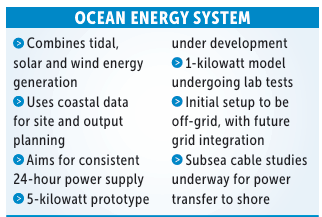
Keeping in mind India’s growing power demand and need for cleaner energy sources, the CSIR-National Insti tute of Oceanography has devised the prototype of a hybrid floating energy platform, designed to har ness three different types of energy sources from the ocean: tidal waves, so lar, and wind. “Our plan involves a floating platform de signed to integrate tidal, wave, and ocean current energy systems. By cap turing the energy gen erated by tidal waves, sun and wind, we can effectively convert these natural resources into electrical energy. This is a technology we have been planning for some time, and we believe it offers a comprehensive solution for offshore energy pro duction,” Director, CSIR NIO Prof Sunil Kumar Sin gh told O Heraldo.

While the CSIR-NIO has been developing this con cept for some time, inte grating these energy sourc es into one station requires extensive calculations and technical coordination. “We are currently working through these complexities to ensure the platform’s viability. Specifically, as we scale the project to 1,000 units, the total distance in kilo meters becomes a critical engineering factor. Unlike a standard flat-surface installation, the platform must be specifically engi neered to sustain the con tinuous impact of ocean waves over that extended range.
We need to ensure the design is sufficiently robust to handle these en vironmental conditions at this increased scale,” Prof Singh said. These systems are de signed to model and cal culate energy production based on specific coastal conditions, such as those found in Goa. By utilising existing data on tidal cur rents, wind availability, and the Global Horizontal Index for solar potential, these models help identi fy the most effective loca tions for deployment. “A critical component of our planning involves the impact on local fishing communities. To minimise disruption to their tra ditional fishing grounds and ensure local support, the current strategy is to begin with a small-scale pilot platform. The initial design consists of a trian gular module measuring 15x15x15 meters. This modular approach allows for scalability; we can inte grate additional triangular sections to create a larger platform capable of captur ing energy from multiple oceanic sources, including water currents, wind, and solar power,” the CSIR-NIO Director said.
Dr Sourav Mondal, Principal Scientist in the Ocean Engineering De partment, CSIR-NIO, said the system consists of two primary components: the individual energy-cap turing devices and a cen tral platform designed to house and support them. “Unlike solar power, which is limited by daylight and weather, this technol ogy leverages wind and wave energy to provide a consistent 24-hour power supply. We are currently developing a small-scale prototype with a target capacity of 5 kilowatts. Before a full-scale deploy ment, we are conducting rigorous lab testing on a first-generation 1-kilowatt model,” Dr Mondal said.
On grid connectivity, he said that while the initial prototype will be an off grid system, NIO Electrical and Electronics Engineer ing teams are concurrent ly working on mature on grid solutions to integrate multiple power sources. “NIO has the necessary expertise in subsea cable installation and is conduct ing studies to ensure effi cient power delivery from the ocean to the shore. We are developing a compre hensive package that cov ers everything from energy harvesting to grid distri bution for households and industry,” he said.