AMITA KANEKAR
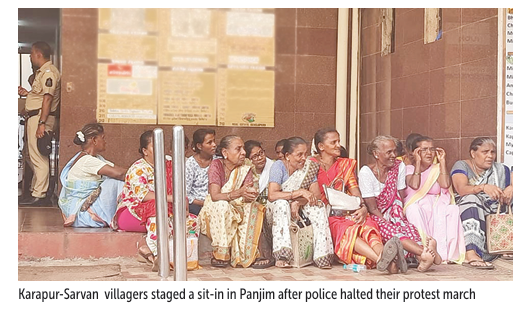
As has become almost an annual event, 18th June – celebrated as Revolution Day to commem orate the launch of a fight against Salazar’s dictator ship years ago – once again saw the arrest of Goans fighting against the dictato rial “development” policies of the present regime. This time it was the people of Karapur-Sarvan, fighting to stop the giant mega project in their village, a 130-acre ‘five-star’ development that promises a variety of luxury apartments and villas en joying not just a clubhouse, skating rink, gymnasium and swimming pools, but even a ‘man-made beach and sea’! Let us place this protest in the larger context.

Because, from crises after crises in individual villages, we seem to have reached potential ly the complete collapse of Goa. For, this was also the week in which, just as the news appeared that Goa’s reservoirs are nearly empty, the world’s climate author ities officially announced the arrival of El Niño, a weather pattern that ris es naturally at intervals in the Pacific and is known to cause a weak monsoon in South Asia. As if on sched ule, the very announcement of El Niño saw the monsoon withdrawing from Goa. The result is that, as of 18th June, Goa has an over-60% deficit in its rainfall and, accord ing to the Goa government, just fifteen days of water supply. Yes, just fifteen days. If this isn’t an emergency situation, what is? Of course, Goans are not merely wringing their hands – they have flooded social media with solutions: suggestions that must be im plemented immediately and kept in force till the rains ar rive and fill up the reservoirs.
Like the immediate halt to all construction projects and road-widening; no digging new borewells and monitor ing existing ones; stopping tree-cutting, especially old trees which are the lifeblood of their neighbourhoods; no cutting of hills and filling of fields; no sewage-dumping into water bodies, and all water bodies to be cleaned and restored to their natural condition; a halt to tourism, with tourists barred from the state till the crisis is past, and all tourist events and activities closed, including casinos; water to private swimming pools stopped; rainwater harvesting and groundwater recharging to be enforced; concretisation of ground surfaces stopped; and conversion of non-set tlement land into settlement immediately stopped. All of the above is not ex actly rocket science, as the saying goes, but just ‘com mon sense’ to conserve wa ter for the use of the local population and local agricul ture. But the government is not interested. Instead, both the Chief Minister and the Minister for Water Resourc es, who claim to be “moni toring the situation closely”, have suggestions for citizens. Goans should not use po table water, so they say, for washing vehicles, cleaning floors, or watering plants. That’s it. Not one word about what the government is go ing to do to save water. It is apparently washing floors and watering plants that has brought us to this situation, not the rampant construc tion projects, or the hun dreds of bore wells – legal and illegal – operating on all construction sites and often seen wastefully pumping out gushing torrents of water to send it straight into the gutters and thence to the sea.
And not one word about stopping the slaughter of trees. Just in these last few days, trees have been felled all over Goa, including a big Banyan tree at Caran zalem and two old Copper Pods in Panjim, while the High Court had to step in to save the last 55 trees re maining to be axed in Ver na for road-widening; 342 have already been cut. Can anything ever replace the loss of an old tree? Planting saplings (even ten lakh of them, as the Chief Minister claimed) is nowhere close as a substitute, according to everyone who knows an ything about the meaning of a tree. It takes decades for a sapling to provide the oxygen, shade, temperature control, water absorption, wildlife home, fruit and oth er invaluable benefits of fered by a mature tree. And that’s if they are actually planted properly and then manage to survive this an ti-tree government; heaps of them were found lying unplanted and discarded at the side of the Panjim-Mar gao highway the day after the much-hyped planting drive. Nor is there any move to rethink any project, even though the Karapur-Sar van protest has crossed 75 days now; and even though this project has, according to the villagers, no environ mental clearance. Yes, no environmental clearance but it has already cut hun dreds of trees – including cashew, mango and jamun planted by the villagers – and also cut the hillside, dug who-knows-how-many bore wells (for a ‘man-made sea’ in the middle of hills!), and poured concrete over large stretches for roads. What is this if not a five-star level of corruption and law-break ing, coupled with utter dis dain for both the environ ment as well as the future of the local populace? And please note, this is no ordinary project, even otherwise – it is so mam moth in scale that the local villagers will be completely outnumbered by the much larger population of outsid ers, if the sprawling apart ment blocks are actually occupied.
This seems to be a deliberate plan for de mographic change that will not only destroy the future of local Goan communities, but also their history and identity. These rich outsid ers may be only a floating population, here today and gone tomorrow; but it is the locals who will have to bear the cost of large-scale envi ronmental destruction, gen trification, desertification, and more. This is the future of Goa, as envisioned by our government. The rest of India is known worldwide for high ine quality in access to water, and also the poor quality of water supplied in its taps. Things were not so bad in Goa – thanks not just to a generous monsoon, but also to laterite hills and green cover, both of which are be ing attacked wholesale now. How long can we survive amidst this insane destruc tion? It looks like we may have to face the answer to that question very soon. (Amita Kanekar is an architectural historian and novelist)