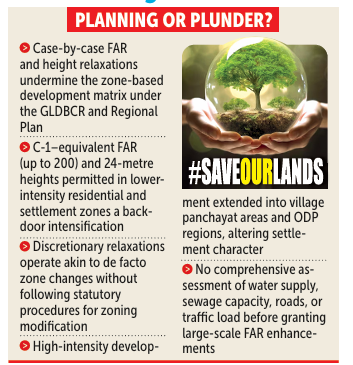
MARGAO: Even as height ened, pan-Goa protests over planning changes continue across the State, the legal battle over the Town and Country Planning (TCP) framework has widened, with the Bombay High Court at Goa fixing April 15 for final hearing and disposal of a Public Interest Litiga tion (PIL) filed by the Goa Foundation and two other petitioners. The PIL challenges sweeping amendments that permit what the petitioners describe as unprecedent ed increases in Floor Area Ratio (FAR) and building height across Goa. The challenge moves be yond the current flashpoint of Section 39A of the TCP Act and directly questions amendments to Goa’s build ing regulations that, accord ing to the petitioners, allow additional floors and height relaxations to be granted to individual applicants any where in Goa — including village panchayat areas and Outline Development Plan (ODP) regions — upon pay ment of Rs 1,000 per square metre. In a statement issued on Wednesday evening, Goa Foundation Director Claude Alvares said the amend ed Regulation 6.1.1(a)(2) enables applicants to seek enhancement of FAR and corresponding height re laxations on a case-by-case basis, without adhering to the statutory discipline gov erning zoning and develop ment intensity under the Goa Land Development and Building Construction Regu lations, 2010 (GLDBCR) and the Regional Plan 2021. Alvares said the amend ment creates a system of plot-by-plot intensification of development detached from the zoning structure meant to guide planned growth.
Under Section 6A.4 of the GLDBCR, the maximum per missible FAR and height are determined by zone classifi cation. He maintained that land use and FAR together form the backbone of planned urban and rural development, and that permitting development intensity equivalent to high er commercial zones in lower-intensity settlement or res idential zones fundamentally alters the character of those areas. The petition cites the example of allowing FAR 200 and a 24-metre height in zones otherwise capped at FAR 60 and nine metres, stating that such permissions substantially increase density and built form beyond what the zoning framework envisages. Under Note (1) of Table VIII of the Regulations, C-1 zoning is intended for the central business hubs of Panjim, Margao, Mormugao, Mapusa and Ponda. According to the petition, over 100 permissions granted under Regulation 6.1.1(a)(2) have allowed C-1-equivalent FAR and heights in non-central business district areas, in cluding village panchayat jurisdictions. Although described as relaxations, Alvares said such per missions operate in substance as changes in development intensity comparable to zone changes, but without follow ing the statutory procedure required for modification of zoning classifications. The petition further raises environmental and infrastruc ture concerns, stating that large-scale increases in FAR and height are being granted without comprehensive studies on infrastructure capacity — including water supply, sew age systems and roads — traffic impact, environmental and social consequences, and the cumulative impact on small settlements and village areas. Planned development under the Goa Town and Country Planning Act, 2008 requires bal ancing growth with carrying capacity and public interest, the petition states, arguing that unstructured intensifica tion risks undermining that balance. The PIL also notes that 739 permissions or no-objection certificates had reportedly been granted up to January 2025 under the amended regime, but details of these ap provals have not been systematically placed in the public domain. The petition contends that such non-disclosure limits transparency and curtails the public’s ability to par ticipate meaningfully in planning governance. On constitutional grounds, the petition challenges the re moval of quantitative ceilings on FAR through corrigendum as violative of the mandatory procedure prescribed under the 2008 Act. It further contends that the grant of unre stricted discretionary powers to enhance FAR and height without structured criteria raises issues under Article 14 of the Constitution, and that differential premium structures for similar categories of development lack a rational basis. In a separate writ petition filed by Sabina Martins chal lenging FAR enhancement granted in respect of develop ment in her building, the High Court observed that the development would remain subject to the final outcome of her writ petition. Reacting to the matter being listed for final hearing, Alvares said, “This issue concerns the integrity of the en tire planning framework and cannot be confined to a sin gle provision such as Section 39A. Development intensity across Goa cannot be altered through executive relaxations that effectively override zoning safeguards embedded in statutory plans.” Sabina Martins of Goa Bachao Abhiyan (GBA), which has consistently opposed amendments to the TCP framework, said, “Successive changes to the Act and related regulations dilute the sanctity of the Regional Plan and weaken statu tory safeguards.” “Hurried amendments enable the back-door conversion of protected and ecologically fragile land for private inter ests and reduce meaningful public participation in plan ning decisions affecting village communities,” she added. Advocate Cleofato Almeida Coutinho has criticised amendments that confer wide discretionary powers in planning matters, stating that changes affecting zoning, de velopment intensity and land use must adhere strictly to statutory procedure and remain subject to judicial scrutiny, rather than being left to executive relaxation. Advocate Cleofato Almeida Coutinho criticised the amendments. “Amendments that confer wide discretion ary powers in planning matters are deeply problematic. Changes affecting zoning, development intensity and land use must adhere strictly to statutory procedure and remain subject to judicial scrutiny, rather than being left to execu tive relaxation,” explained Adv Coutinho. Activist Swapnesh Sherlekar pointed out that, “A detailed examination of permissions granted under Sections 17 and 39A reveals patterns of irregularities, fee waivers and deviations from zoning discipline. There is a need for far greater scrutiny of how the amended provisions are being applied.” Architect Tahir Noronha questioned the TCP’s function ing. He said, “The series of TCP amendments makes little sense and significantly reduces the State’s ability to plan and guide growth. Successive changes to the planning framework dilute regulatory safeguards and undermine the system’s ability to function as a coherent planning in strument.” With the final hearing now scheduled, the High Court’s decision is expected to have far-reaching implications not only for the challenged FAR and height relaxations, but also for the broader structure of planning, zoning and develop ment governance in Goa.