Filling of mangrove areas at city entrance continues
HERALD REPORTER
PANJIM, SEPT 14
Environmentalists and social activists on Tuesday blamed the authorities concerned for turning a Nelson’s eye to the blatant land filling of low-lying mangrove areas at the entrance to the capital city on both sides of NH-17 and NH-4A.
Sounding a warning bugle they maintained that slowly, but steadily, the rich and dense mangrove cover just off the Panjim-Margao national highway between Heera Petrol Pump (towards the city side) and Old Goa by-pass circle (close to Merces) was in danger of becoming extinct.
On a visit to one of the locations with members of Village Groups of Goa, it was observed that an area of approximately 15,000 square metres on the left side of the national highway (while going to Margao between Heera Petrol Pump and Old Goa by-pass circle) is housing commercial operations like scrapyard, bus shelter, godowns, etc.
John Philip Pereira of Village Groups of Goa contends that the 15,000 sq m area has not cropped up overnight. Over the last few years authorities concerned have closed their eyes to the gradual disappearance of the rich mangrove cover.
A scrap dealer operating his yard said he paid a rent of Rs 5,000 per month to a person who came to collect the amount once in a month. When questioned whether his yard possessed a licence to operate the dealer said he had applied for the same.
It is learnt that a Pepsi depot operating in the area for the last three years pays a rent of Rs 24,000 per month. Inquiries revealed that the said area falls in the jurisdiction of Merces Panchayat which has hardly bothered to check the mushrooming of this business hub.
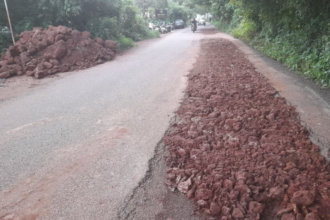
On the Panjim-Ribandar road close to Divja Circle and right behind the Public Works Division Sub-Divisional office (National Highway) mud and construction debris have been dumped to build a ‘kachha’ pathway that leads to a small hut a few metres away.
Further just off the road leading to Heera Petrol Pump from Divja Circle one can see many unused tyres in the mangroves. A part of this outer road connecting NH-17 leading to Margao is fenced but some part of it is left open. Close to where the tyres were seen, construction debris in truck loads are still being dumped by the roadside.
If one stands on this road and takes a look as far as the eyes can see, a pathway is shaping up right through the dense mangrove area. Activists contend that this road is being built to facilitate construction projects in future. The basic objective was to slowly and gradually kill the mangrove cover for housing projects, they stated.
Pereira maintained that the illegal land filling inside the mangrove cover has changed the natural flow of water leading to change in tidal pattern. This has led to some places within the mangrove area becoming dry.
The Village Groups of Goa has now decided to knock the doors of the Centre and the Union ministry concerned to take urgent note of this blatant land filling in the eco-sensitive zone and declare the entire stretch as a sanctuary or a protected zone where nothing can be touched.