Summary
Indo-Portuguese ivory and wooden Christian art has been historically overlooked despite its cross-cultural richness.
Goa’s Zô family of Chimbel has upheld a rare legacy of sacred carving for generations, adapting traditional skills to modern challenges.
Mughal-Christian artistic exchange and Jesuit missionary efforts played key roles in fusing Indian and European aesthetics in colonial religious art.
Rediscovering the Forgotten Art of Indo-Portuguese Ivory Sculpture and Goa’s Chimbel Carving Legacy
The exquisite Christian sculptures crafted in ivory and wood across Asia—especially from Portuguese India—represent one of the most underexplored artistic traditions in colonial history. Long dismissed as provincial or derivative, these artworks have now begun to receive the scholarly attention they deserve for their unique blending of Indian craftsmanship and European religious iconography.
The Global Journey of Sacred Ivory
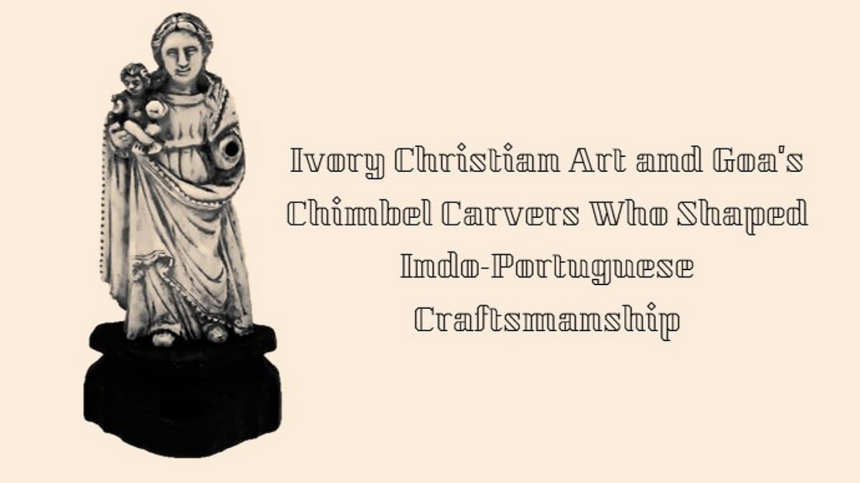
From the 16th century onward, intricately carved ivory figures of Jesus, Mary, and saints were exported from Goa, Sri Lanka, and the Philippines to Portugal, Spain, Italy, and Latin America. These devotional objects—often small and portable—were used for personal worship and missionary work. While the works from India are classified as Indo-Portuguese, those from Sri Lanka are known as Cingalo-Portuguese, and those from the Philippines as Hispano-Philippine. Despite their shared Christian themes, each regional style retained distinct aesthetic traits, shaped by indigenous art traditions.
Surprisingly, most of the ivory used in India came from Portuguese-controlled African colonies. The African ivory, preferred for its durability and workability, was shipped in large volumes to India by the late 16th century, fuelling the production of ivory religious statuary, furniture inlay, and ornate caskets.
The Manila-Acapulco Galleon Trade further facilitated the movement of both raw ivory and finished Christian artworks between Asia and the Americas, establishing a vast network of religious and artistic exchange. Goa and Portuguese Macau were major production centers, both inheriting long-standing local carving traditions that predated Christianity.