KARSTEN MIRANDA
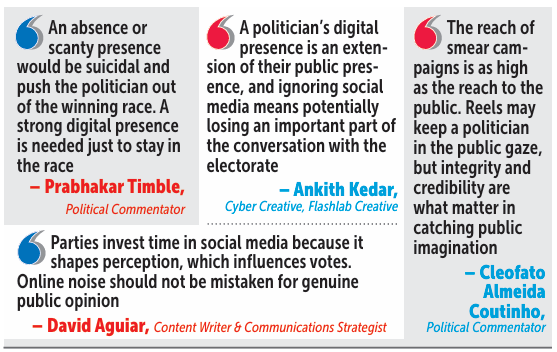
The meeting may last an hour. The in spection may take half a day. A politician may spend an afternoon mov ing through a constituen cy, meeting residents, offi cials or party workers. But increasingly, the day’s po litical work does not end when the politician leaves. There is footage to cap ture, photographs to se lect, a reel to edit, a cap tion to write and a decision to make on what should go online. The activity itself has become raw materi al for a second political product — its digital ver sion. That is the new polit ical contest playing out across Goa. Parties, min isters, sitting MLAs and aspiring candidates are investing increasing time, people and technology insocial media, turning meetings, inspections, letters, development works and political attacks into daily con tent. What has changed is not the presence of social-media ac counts, but the effort now spent maintaining them and the pressure to stay visible. Political commentator Prabhakar Timble says digital communication has democratised ac cess and cut the cost of reaching target voters. “There is an impact on public opinion and choices of people, though exclusive re liance may not give required dividends. However, an absence or scanty presence would be suicidal and push the politician and po litical party out of the winning race,” Timble says.

“Strong digital presence is needed just to stay in the race,” Timble says. That pressure is visible in how quickly an online post can become a political contest. A recent post by BJP Goa vice-president Narendra Sawaikar referring to protesting youth as ‘termites’ triggered a political row, with Congress demanding an apology, and the episode itself becoming ammunition for a rival. A government announcement can become opposition criticism; that criticism can invite an immediate counter; and both can generate another round of content. For a sitting MLA, the digital feed also becomes a contin uous report card — meetings attended, letters written, in spections conducted, Assembly interventions made, devel opment works followed up and grievances taken up. For an aspiring candidate, the approach can be different: highlight what the government or sitting MLA has failed to do, attack the existing record and build an alternative narrative. Ankith Kedar, Cyber Creative, Flashlab Creative, who currently works with an MLA and has in the past handled election campaigns for other candidates, says: “Social me dia has become an integral part of political communication.
It is no longer just a platform for announcing programmes or achievements, it has become a direct channel for politi cians to keep voters updated, detect and respond to issues, shape public perception and take political jibes at their op ponents. In many ways, social media has brought politics closer to the voter which has also made political communi cation more immediate, competitive and confrontational. A politician’s digital presence is almost an extension of their public presence and ignoring social media means poten tially losing an important part of the conversation with the electorate.” What looks spontaneous from outside is often planned. Kedar says political teams generally work around a cal endar, mapping out what is happening on particular days. If there is an inspection, meeting or programme, the so cial-media team is ready to capture it. Once the material is collected, the team decides what message it should convey. Kedar distinguishes this year-round activity from an election campaign. During the year, politicians can use so cial media to document their work and maintain contact with voters; when elections approach, the intensity rises. The medium also creates a direct feedback loop. Voters can message politicians about unresolved issues, while comments, views and shares give teams a quick indication of what is attracting attention.
That response can shape what the politician takes up next, with voter suggestions sometimes turned directly into programmes or initiatives. The machinery behind the posts is itself becoming more organised. A politician associated with a political party that engages a social-media agency, speaking on background, said specialised units can include a ‘social listening’ desk that tracks real-time online conversations to flag what the campaign needs to respond to and how. The day be gins with someone going through the State’s newspapers to take stock of the political mood, which then feeds into graphics, photographs and videos. Everything is routed through party headquarters for approval before going live.
The team can work to a target of 10 to 20 posts a day, built around Facebook Live sessions, photographs and short clips of high-profile campaigners, while a ‘war room’ tracks issues across the State and shapes what content follows. The same machinery can also handle content for individual candidates’ official accounts. A person working with a social-media agency for a po litical party described a similar push for speed and reach. Content goes out as soon as it is cleared and is also seeded into social-media groups to reach audiences beyond a par ty’s usual base. Prominent local leaders can have their own trusted teams working to push hyper-local talking points to specific audiences. The change is significant because political publicity once largely depended on a public event, press conference, As sembly intervention or press release, after which the me dia decided whether and how prominently that activity reached the public. Now the politician and the political team can create the material, frame the message and dis tribute it directly.
Goa’s political feeds reflect the shift. BJP Goa uses its digital platforms to package government achievements as political messaging, while the Congress ecosystem uses so cial media for attacks on the government and responses to rival narratives. The digital battle is not confined to party pages either, with individual ministers, MLAs and aspir ing candidates maintaining their own streams of content. Congress has also recently reorganised its Goa social-me dia machinery, with new appointments being made to the party’s social-media department amid wider changes in its State organisation. But the same platforms can also carry fake posts, misin formation, blatant allegations and coordinated amplifica tion — and politicians themselves have not been spared. In June, Curchorem Police registered a case based on a com plaint by MLA Nilesh Cabral alleging that a false electronic record had been created and circulated on social media, damaging his reputation. Politicians and others have in creasingly approached police over objectionable, defama tory or allegedly false online material. Adv Cleofato Almeida Coutinho, a political commenta tor, says the reach of social media is high, but the reach of smear campaigns is also high. “It is believed that the reach to public through social me dia is high. But the reach of smear campaign is also high. Only past performance would help them get popular sup port. Reels may help keep in public gaze but integrity and credibility is finally what matters in catching public imagi nation,” Coutinho says. David Aguiar, a Goa-based content writer and communi cations strategist, says the planning behind political social media is often invisible to the audience. “A post may look casual, but behind it there is often a clear decision on what image to show, which issue to push, which opponent to target, what tone to use and which au dience to reach. Parties and candidates now feel they either have to dominate the online space or constantly respond to the opposition there.
That pressure has made social media a serious part of campaign planning, not just ordinary post ing,” Aguiar says. Aguiar says the concern arises when this moves from gen uine support to manufactured approval. Supporters, fan pag es and fake or unnatural-looking accounts can repeat similar lines under a political post to make a message look widely accepted. Some accounts also use religious, regional or com munity-sounding names, which can make the support ap pear more local, organic and believable than it really is. “Voters need to be alert to that. Parties invest so much time in social media because it shapes perception and per ception can influence votes. Online noise, however, should not be mistaken for genuine public opinion,” Aguiar says.
Timble sees little lasting value in another feature of this contest — the constant exchange of jibes. “The digital news platforms are on the prowl for jabs at rivals and those who know very little of journalism survive in their business on such jibes. The shelf life of jibes is very low and does not add any material value to the politician or the party. They only generate very temporary entertain ment,” Timble says. The machinery was already visible during the 2022 Assembly election, when parties operated dedicated so cial-media teams. That election machinery has since be come part of routine political communication. With the 2027 election approaching, that year-round operation is likely to intensify. The politician’s work now has two lives: the work itself and the second political product created from it for the digital audience. The contest is increasingly over who gets to tell voters what was done — and who can tell it faster, sharper and more convincingly. In Goa’s new political race, being seen has become part of the game. And staying out of the game may itself carry a political cost.