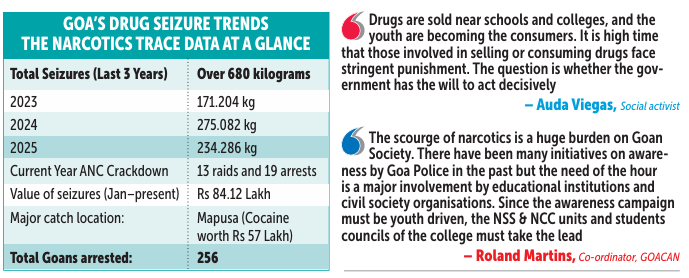
Once confined largely to coastal tourist hubs, Goa’s drug menace has breached rural hinterlands and educational zones, sparking urgent warnings from social activists as tech-savvy peddlers lever age social media to target students. In response, the Anti-Narcotics Cell (ANC) launched a Statewide crack down, executing 13 major raids and arresting 19 sus pected traffickers so far this year. While these operations have seized 7,656 grams of illicit substances valued at around Rs 84.12 lakh, grass roots leaders emphasise that police action alone can not stop a dangerous trend fuelled by peer pressure and the lure of easy money among young adults, which requires an immediate com munity-driven defence to safeguard local families.
The seizures included 6,901 grams of ganja, 326 grams of charas, 127.7 grams of cocaine, 13.6 grams of methampheta mine, 0.16 grams of LSD, 25.26 grams of ecstasy, 261.4 grams of ganja along with three seeds, and five cannabis plants. One of the major opera tions was conducted in Ma pusa, where ANC officials seized cocaine worth near ly Rs 57 lakh and arrested one person in connection with the case. Police sourc es said the accused had previously been arrested in similar narcotics-related offences. In another significant operation in February, the ANC seized five cannabis plants in Porvorim. Inves tigations have revealed that traffickers are increasingly using multiple modes of transport to smuggle and distribute narcotics across the State. Social activists believe the situation has worsened considerably and requires urgent intervention.

Bailancho Saad convenor Sabina Martins said drug addiction was no longer confined to urban centres but had spread to remote villages, affecting teen age boys, girls, and youth across Goa. “The negative conse quences of addiction are being felt by many fami lies. Any indication of drug use should be urgently ad dressed through govern ment programmes with the support of NGOs working in the field to help de-addic tion and curb the sources of supply,” Martins said. Social activist Auda Vie gas alleged that drugs con tinue to be easily available across Goa and that the youth remain the primary targets. “Drugs are sold near schools and colleges, and the youth are be coming the consumers. It is high time that those involved in sell ing or consuming drugs face stringent punishment. The question is whether the government has the will to act decisively,” Viegas said. Roland Martins, Co-ordinator, GOACAN, said, “The scourge of narcotics is a huge burden on Goan Society. There have been many initiatives on awareness by Goa Police in the past but the need of the hour is a major involvement by educational institutions and civil society organisations. Since the awareness campaign must be youth driven, the NSS & NCC units and students councils of the college must take the lead. The village panchayats and municipal councils need to get involved to see that drugs are not sold and consumed in their jurisdiction.
The observation of The International Day Against Drug Abuse and Illicit Trafficking on 26th June is an opportunity to start this process in 2026.” It is pertinent to note that Chief Minister Pramod Sawant, while speaking on the issue in March this year, had said that economic mo tives and the lure of quick financial gains were among the primary reasons for the increasing involvement of youth in narcotics activi ties. “Peer influence and exposure to existing drug networks in tour ist and nightlife areas have forced youth entry into such activities,” Sawant had said. He further noted that a total of 256 Goans were arrested in con nection with the alleged narcotic cases and the lure of quick financial gains has been identified as the primary reason for youth involve ment in narcotic activities. However, officials say that surveillance has been strengthened and intelligence collection intensified. They also said that community policing and coordination with education institutions have been en hanced to address the issue. Authorities noted that ganja remains the most commonly used and seized drug in Goa. Other substances frequently recovered dur ing raids include cocaine, MDMA, ecstasy tablets, LSD papers, and charas. Officials have also raised alarm over drug peddlers allegedly targeting areas near schools and colleges to lure students into sub stance abuse. The Home Department informed that Goa Police has intensified surveillance around educational institutions and strengthened in telligence gathering to curb such activities.
Authorities stated that whenever illegal activities are detected, stringent action is initiated under relevant legal provisions. Meanwhile, officials acknowledged that drug peddlers are increas ingly using social media platforms to reach potential customers, making enforcement more challenging. Data presented in the State Assembly revealed that more than 680 kilograms of narcotic substances have been seized across Goa over the last three years as enforcement and intelligence operations in tensified. Goa Police seized 171.204 kg of narcotics in 2023, 275.082 kg in 2024, and 234.286 kg in 2025. Highlighting measures taken to tackle drug-related crimes, the government stated that Goa Police has adopted a “zero-tolerance policy” towards drug trade, supply, and consumption. Focused en forcement drives are being carried out in vulnerable areas, including beaches, tourist belts, transport hubs, and zones surrounding educa tional institutions. The government stated that Goa Police has strengthened coor dination with agencies such as Customs, the Coast Guard, Railway Police, airport authorities, the Enforcement Directorate (ED), and the Narcotics Control Bureau (NCB) to combat inter-State and inter national drug trafficking. Joint operations, intelligence sharing, and coordinated interrogations are also being undertaken to dismantle organised drug networks. Authorities also stressed the importance of awareness and pre vention programmes to tackle the growing drug menace.
Awareness campaigns are regularly conducted in schools and colleges to edu cate students about the harmful effects of substance abuse. Officials added that behavioural changes are often among the ear liest signs that help identify individuals who may have started using drugs or developed addiction. NCORD (Narco Coordination) meetings are also being held regular ly at both State and district levels to review enforcement measures, intelligence sharing, and preventive action against drug trafficking and abuse. Awareness rallies for students are organised on the Inter national Day Against Drug Abuse and Illicit Trafficking, while senior police officers conduct regular reviews of NDPS-related cases.