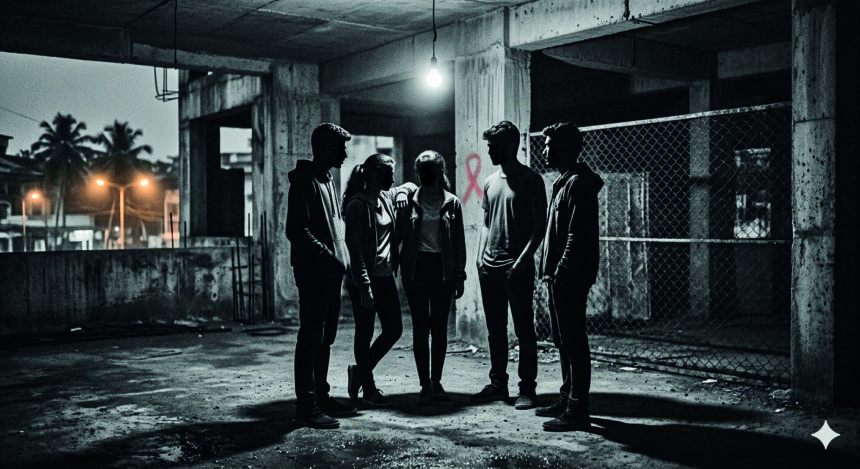
With the success of Highly Active Antiretroviral Therapy (HAART), young people living with HIV (YPLHIV) in Goa are surviving into adulthood, representing the first generation to grow up with the virus. Yet, they face significant socio-economic challenges with insufficient support. Navigating life as orphans, dealing with social stigma, limited employment opportunities, and an uncertain future are barriers they confront daily. These challenges are taking a significant toll on their mental health, finds SHASHWAT GUPTA RAY

At just three years old, life shifted permanently for 25-year-old Amit (name changed), a resident of Vasco. Having lost parents to AIDS-related complications at a very young age, the three-year-old was placed in a specialised children’s home. Without parental guidance, it was not until seventh grade that the stark reality of the diagnosis was finally disclosed.

Growing up in institutional care was difficult, but the discrimination proved to be a heavier burden.
“Residents of children’s homes were kept separate from other children and restricted from making friends freely. During medical checkups, students were forced to stand away from their peers while teachers openly announced their HIV status in front of everyone. You feel discriminated against, lonely, and different from society,” he said.
Today, holding a diploma in Hotel Management, this individual is giving back as an Assistant Lead of Programmes with the Human Touch Foundation, working directly to support those facing a similar journey.
When asked what society needs to learn, the message was clear: community awareness is needed to eliminate discrimination.
“Society should accept us and know the facts about HIV. If someone has lost their family and you discriminate against them, it hurts more. Treat us like normal people,” he said.
Enduring fear of rejection
At 23, Meena (name changed), a young hospitality worker employed in Candolim, carries a weight heavier than her duties. Born to parents living with HIV, she was diagnosed at a young age. Her life remains defined by secrecy, social distance, and an enduring fear of rejection.
Meena’s introduction to HIV status came gradually. As a primary student, she was aware of taking daily medication without understanding its purpose. It was only at 10 that she fully grasped her diagnosis.
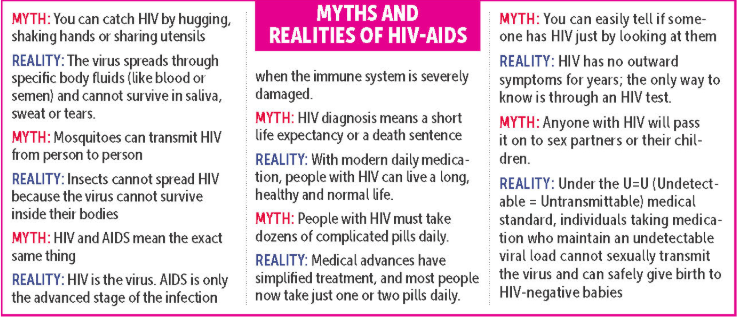
“In school, we had a constant fear. If we told our friends, they would not stay close to us or play with us. Whenever our school went on overnight trips, we had to hide our tablet bottles. We could not disclose our status,” she said.
Once she attempted to hug and kiss a young relative, the child’s parents—who knew her HIV status—intervened, telling her not to touch the infant.
“From that incident, I understood the reality of HIV stigma,” she said.
She lives in a shared accommodation with female colleagues. Despite stable employment, the fear of exposure haunts her. To prevent her roommates from discovering her diagnosis, she hides her daily antiretroviral medication and takes it out of sight.
“If they see me, they will ask what tablets I am taking. If they find out I am HIV-positive, they will not eat with me or let me prepare food in our room. They won’t even allow me to sleep near them. That fear is always there, so I cannot disclose my status,” she said.
For 24-year-old Priyanka (name changed), living with HIV is not defined by the quiet burden of overprotective isolation.
Her story reflects the complex reality faced by those who contracted the virus during early childhood. Diagnosed at age 12 following a severe health crisis, she lost her parents at an early age and was raised by her grandmother and uncle.
Priyanka’s uncle, who chose not to get her married in order to raise his deceased brother’s children, keeps her at home under the belief that she is too weak to work or attend community programmes.
“They want me to remain at home thinking that I am weak… ‘If you die, what will happen? You have this disease. You can’t go to work.’ These words demoralise me,” she said.
Adding to the emotional strain is financial insecurity. Priyanka’s family lives in rented premises with no assistance from government housing schemes. The burden of an unpredictable future weighs on her.
“My primary anxieties revolve around basic survival and life milestones—wondering where I will work, how shall I secure housing, or if will I be able to marry and build a stable life,” she said.
For 18-year-old Shikha (name changed), living with HIV is a curse. Her father passed away due to AIDS complications when she was just two, leaving her mother to raise her alone while managing the condition.
She and her mother faced relentless taunting and rejection from relatives.
“I couldn’t even tie a rakhi to my cousin brother as my aunt stopped me, saying I would pass HIV to him. Relatives refuse to eat with me or let me use shared household items like nail clippers,” a dejected Shikha said.
When an aunt discovered where her mother worked, she informed the employer. Her mother was fired without pay and thrown off the premises.
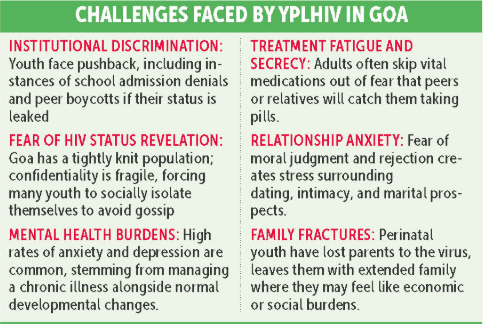
The psychological toll of her HIV status is immense. During college health education lectures, when instructors bring up HIV and AIDS, Shikha experiences panic attacks.
“People need to stop thinking negatively. We cannot spread it by sitting together, sharing food, or living in the same house. Stop taunting us. All we need is moral support, a chance to work, and the freedom to live without fear,” she said.
Serious institutional gaps
Institutional gaps and systemic bureaucratic hurdles are severely impacting young people living with HIV (PLHIV) in Goa, said Celina Menezes, Lead for Care and Support at the Human Touch Foundation.
“Documents are required to access State welfare schemes and employment opportunities. Many individuals are unable to obtain mandatory residence certificates—even if they or their deceased parents resided in Goa for years—preventing them from accessing the HIV pension scheme or securing employment cards,” Menezes said.
She said that bureaucratic barriers harm orphans, who frequently lack birth certificates or identity documents, depriving them of government safety nets and legal protections.
“While Goa State AIDS Control Society (GSACS) continues targeted interventions for sex workers, drug users, and men who have sex with men (MSM), there remains an absence of specialised interventions and counselling centres for PLHIV,” Menezes said.
Without dedicated counseling and youth-focused mental health support, young people experience extreme distress, anger, and loss of hope.
Falsely Labeling Kitchen Staff as a Risk

Those born with HIV before 1997 largely succumbed to the illness. Introduction of free ART by the government in 2004 altered survival rates, turning HIV into a manageable chronic illness.
But, social stigma and discrimination towards the YPLHIV in the State continue.
“Employers in food and beverage (F&B) sectors falsely believe HIV+ kitchen staff pose a risk to food safety. Qualified chefs and service staff face systemic rejection despite wearing full safety gear and maintaining undetectable viral loads, leaving jobseekers helpless,” former chairperson of the Goa State Commission for the Protection of Child Rights, Peter F Borges said.
“A persistent misconception within the food and beverage (F&B) sector is that employing people living with HIV in kitchens or food service poses a food-safety risk. Qualified chefs and service staff face rejection despite wearing full safety gear and maintaining undetectable viral loads. This leaves jobseekers helpless, driving many into risky self-employment avenues,” Borges said.
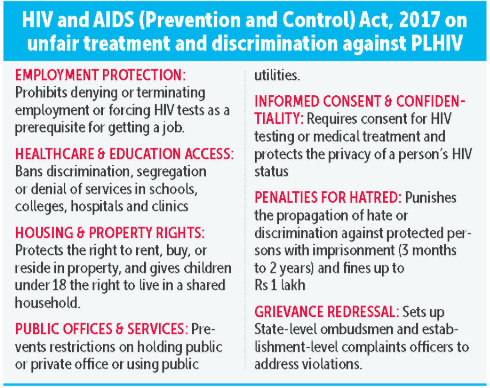
Calling for enforcement of HIV Workplace Policy across Goa, Borges highlighted the need for social protection, subsidised housing for orphans, and entrepreneurial micro-grants for YPLHIV.
“Activate and raise public awareness around the statutory Ombudsman mandated under the HIV/AIDS Act. Re-strategise awareness campaigns to focus on zero transmission facts, and anti-stigma education in key industrial sectors,” he said.
Stigma against PLHIV is a social barrier, preventing the global community from meeting the UNAIDS goal of ending AIDS as a public health threat by 2030, he added.