BY INVITATION — Vivek Menezes
The president of the European Council and former Portuguese Prime Minister António Costa (born 1961) is almost double the age of New York City Mayor Zohran Mamdani, who turns 35 next month, but these two star politicians of Indian origin have a lot in common, including extraordinary “larger than life” global reputations and successes

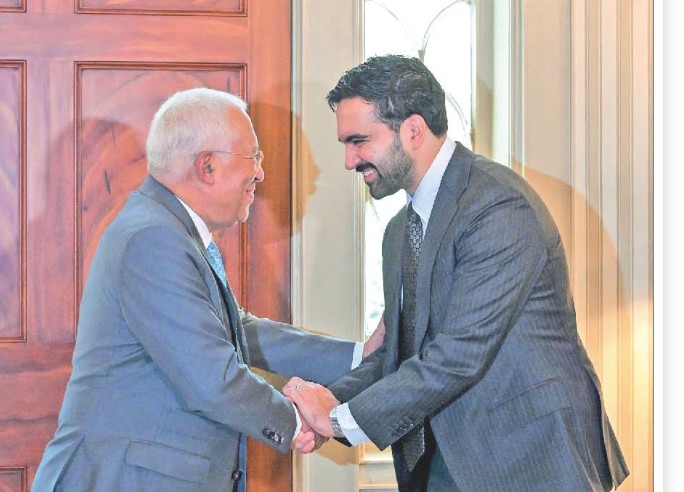
The new multipolar world keeps throwing up fresh surprises, as the leadership in many countries struggles to cope with increasingly complex inter-related crises and challenges. Some bright spots do stand out, however, including both men smiling at each other so widely in the photograph on this page. The president of the European Council and former Portuguese Prime Minister António Costa (born 1961) is almost double the age of New York City Mayor Zohran Mamdani, who turns 35 next month, but these two star politicians of Indian origin have a lot in common, including extraordinary “larger than life” global reputations and successes. Their first meeting on the sidelines of the United Nations General Assembly earlier this week was a landmark event.
Mamdani and Costa met at the “high-level breakfast meeting” on the theme of Building an Economy for the Many hosted by the New York mayor at Gracie Mansion (his official residence) on September 23rd, and the Goan-Portuguese president of the EU was joined by prime minister Pedro Sánchez of Spain and Barbados prime minister Mia Amor Mottley, all of whom, their host acknowledged, are “devoted to the work of building a more free, a more just, a more equal world.” By far the junior-most, and yet considerably the most famous, Mamdani spoke at length about solidarity, highlighted important progressive achievements, and quoted the great Federico Garcia Lorca’s classic poem Rider’s Song as a commentary about interconnected struggles against fascism and isolationism.
In this standout quartet, of course, Costa is the senior statesman with the most impressive proven record. As the prime minister of Portugal, he consistently outperformed the rest of Europe on multiple fronts (from the economy to human rights to social welfare) and before that he shone as the hugely successful mayor of the national capital. Addressing the gathering at Gracie Mansion, he said “from my experience as a former Mayor of Lisbon, I know how important it is for politics to respond concretely to people’s everyday concerns — I must confess, there are moments when I miss it – Zohran you have the best job that a politician can do – I miss the ability Mayors sometimes have of identifying a problem in the morning and having it solved by the end of the day.”
Over the past year, just as Mamdani vastly expanded the global reach and impact of what New York City mayors traditionally stuck to, Costa has also been pushing the envelope far beyond his predecessors as European Council president. “The nice guy of EU politics” said Politico a short while ago, is “often praised for his sure-footedness and ability to build consensus [but now] the former Portuguese prime minister suddenly finds himself in the line of fire, with the heads of the bloc’s two most powerful countries among those most aggrieved. Since he started his role in December 2024, Costa has won little but plaudits from the leaders he represents and on whose support he depends. But a current of annoyance that had started to emerge over the past few months surfaced at a summit he chaired last week: His chief of staff’s unannounced contact with Russian officials, which broke years of diplomatic silence between the EU and Moscow, caught many by surprise. In public, leaders lined up to defend him. Spanish Prime Minister Pedro Sanchez said the Russia contact was “understandable,” while Belgium’s Bart De Wever dismissed it as “completely normal” — even joking to Costa in front of the cameras that the EU should send him personally to Moscow. But behind the scenes the discontent was palpable.”
In his New York comments earlier this week, Costa said “the consequences of war are not confined to the battlefield.” Referring to the Russian aggression against Ukraine, and the US/Israeli war on Iran, he pointed how “these conflicts affect the cost of living, the cost of homes and the ability of families to make ends meet. But the relationship also works, the other people feel that the economy no longer works for them, way when they lose confidence in institutions, in politics and in the future. And when politics fail to deliver for the many, it opens the door to forces that thrive on division and confrontation, forces that turn people’s frustrations into nationalism and nationalism into conflict. The global and the local are deeply connected. And our response must be equally connected.”
Costa said “we must work for peace and security in the world, and for economic and social security at home. These two responsibilities go hand in hand. We need multilateralism. We need international law. We need a strong, effective and representative United Nations. We need to defend the United Nations Charter. And work together for peace and stability. But this is only one part of our responsibility. Because, ultimately, our responsibility as political leaders is to make people’s lives better [and] at every level of government, we need to ensure that families can afford a decent life. To ensure affordability is the main task of all for us here today. That young people can build a future. That everyone has access to an affordable home, good public transport, quality education and healthcare. These must be our priorities. And democracies and progressive forces in particular, must champion both responsibilities. Our citizens must see that democracy delivers. That politics responds to their concerns. And that it makes a real difference in their lives,”
In the end, said Costa, “we need to act together [because] no city, no country and no level of government can solve these challenges alone. We cannot build an economy that works for the many without peace and stability in the world. And we cannot build a more peaceful and stable world if our societies are divided, and people feel left behind. That is why we must defend international law, and work for a strong and effective United Nations. That is why we must put the well-being of our citizens at the centre of our policies.”
(Vivek Menezes is a writer and co-founder of the Goa Arts and Literature Festival)
BY INVITATION — Vivek Menezes