Aman Verma

Prime Minister Narendra Modi’s recent call for Indians to reduce fuel consumption and embrace public transport was meant to sound like a national appeal for sacrifice. In Goa, it landed like a bad joke. This is a State where the last bus disappears before the dinner rush is over, where hotel workers and casino staff stare down a midnight road with no option but a scooter, and where the government’s answer to a broken transport network is — apparently — to ask citizens to use it more. The numbers make the irony impossible to ignore.
Goa is the highest petrol-consuming State in India on a per capita basis — not because Goans are profligate, but because the State has engineered a situation where private vehicle ownership is not a luxury; it is a survival strategy. Goa consumes nearly 52.4 litres of petrol per day for every 100 people — almost five times higher than the national average of around 10.4 litres. Those figures, sourced from the Petroleum Planning and Analysis Cell, do not represent a culture of excess. They represent the arithmetic of abandonment.
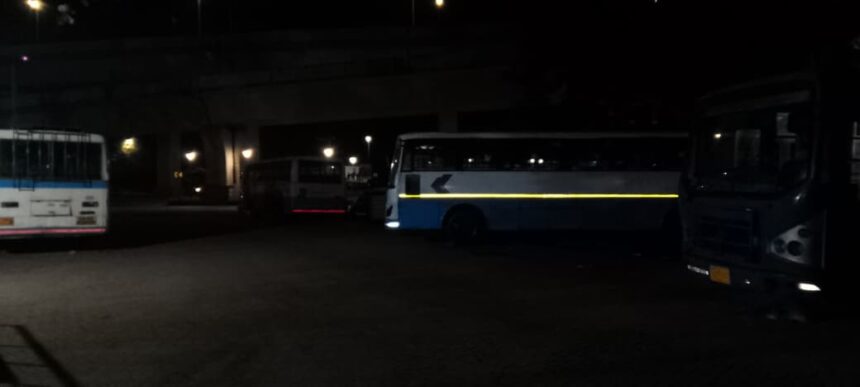
When public transport stops running at 8 pm in a state whose economy runs on tourism, hospitality and nightlife that stretches well past midnight, the fuel bill is not a lifestyle choice — it is the cost of getting home. “After 7 pm, many buses slowly disappear. But Goa’s tourism industry doesn’t stop at 7 pm. Hotels, casinos and restaurants run till late at night. So how are these workers supposed to get home?” said Agnelo Fernandes, former Calangute MLA. That question — blunt and unanswered — cuts to the heart of the State’s transport failure. Goa’s GDP floats on an economy that is fundamentally nocturnal, yet its public transport system operates on a schedule that belongs to a different, quieter era. The mismatch is not accidental. It is the product of years of underinvestment, poor planning and a political class that has remained indifferent to the daily ordeal of working-class commuters.
When O Heraldo put these questions to Kadamba Transport Corporation Managing Director Rohan Kaskar, the response was candid — but revealing in ways he perhaps did not intend. “There is scope for late-night buses on routes like Panjim-Mapusa, Panjim-Margao and Vasco,” he acknowledged. The admission by the KTC’s own managing director concedes that the need exists. Yet the buses do not run. His explanation — that buses after 2 am would carry too few passengers to be economically viable — is a circular argument that would have killed public transport everywhere it was ever introduced.
“Everything cannot be measured by the unit economics of a bus. There are other aspects where there might be bigger gains — reduction of drunken driving, for example. What is the cost of a life lost?” questioned Vivek Naik, a Panjim resident. Naik’s challenge to the KTC’s cost-benefit logic is one the government has no clear answer to. The social cost of inadequate public transport — road accidents, drunk driving fatalities, and the economic drain on low-wage workers forced to maintain vehicles they cannot afford — never appears on KTC’s balance sheet. It is simply externalised onto the public. The burden falls heaviest on those least equipped to bear it.
Casino employees, hotel staff and factory workers in industrial estates — Goa’s working class operates on shifts that end when the transport grid shuts down.
One industrialist with a unit at Verna put it plainly: “We are forced to rely on private operators because there is no public transport. In other States, our employees use public transport to get home. In Goa, such an option does not exist.”
For those without company-arranged transport, the math is brutal. Valerie Monteiro, who commutes from Margao to Panjim with her husband, describes a daily calculus of wasted money and time. “We could take the bus to Panjim, which takes about 45 minutes, but the following shorter distance takes another hour by bus. There are no cheaper alternatives like Ola or Uber for the last bit. We are forced to spend a lot on just commuting.”
“I recently shifted to Goa from Kerala for work. In Kerala, I used public transport. In Goa, the lack of public transport, especially during night hours, compels me to own a personal vehicle. I was forced to transport my scooter from my hometown,” complained Alan Shaji, a Kerala native now living in Panjim. Shahji’s testimony is a damning referendum on Goa’s public infrastructure. He did not arrive predisposed to burning fuel. The State’s transport failure made that decision for him. It is a decision being made every day by thousands of workers, students and migrants — each one adding to that 52.4-litre-per-capita figure that apparently alarms the very government responsible for it.
Kaskar points out, almost as mitigation, that many employers already arrange private transport for staff. This is not a solution. It is an admission that the State has vacated its responsibility and left the private sector to fill the void — at greater cost, with less coverage and with zero accountability to the public. Even where buses do run, the ‘last-mile’ problem renders them useless for a significant portion of potential users.
“We can drop people at the main stand,” Kaskar conceded. “But if somebody stays inside a village or somewhere deeper in Dabolim, then how will that person reach home?” It is a question that answers itself — they take a scooter. They always take a scooter, because that is the only option the State has left them with.
“I live in Ponda but work in Margao. My shift ends at 1 am. If there was a bus service, I could park my bike at the Ponda bus stand and do the bulk of the journey by bus. This would reduce my fuel costs dramatically,” said Satish Dukle, a night-shift worker.
Dukle is not asking for the moon. He has already worked out the hybrid solution — park-and-ride, with the last mile covered by a personal vehicle. He is asking for one functioning trunk route after midnight. That this remains too much to ask of the Kadamba Transport Corporation in the year 2026, in India’s richest State by per capita income, is a governance failure of remarkable proportions.
Into this vacuum, a tourist — not a planner, not a politician — offered perhaps the most sensible idea in the entire debate.
Manoj, visiting from out of State, suggested that the government deploy auto rickshaws for last-mile connectivity, a model already working in several Indian States. Small, cheap, maneuverable, scalable and also available with electric options. The fact that the practical transport proposal came from a visitor passing through is, in a way, a verdict on the state of Goa’s policy imagination.
“We keep talking about reducing fuel consumption, but first give people a proper system to travel,” urged Fernandes.
That is the starting point for this conversation. Not austerity calls from New Delhi, not unit-economics arguments from KTC’s managing director, and not press releases about electric vehicle policy. A bus, on time, after dark, going somewhere people actually need to go. Until that exists, asking Goans to reduce fuel consumption is farcical.