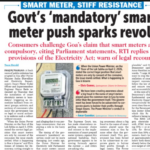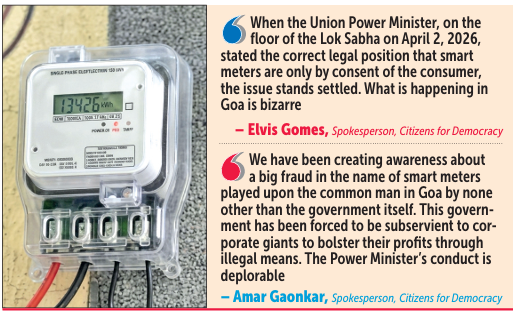
A fresh wave of public criticism has erupted in Goa after Power Minister Sudin Dhavalikar and Electricity Department’s Smart Meter Nodal Officer and Superintendent Engineer Mayur Hede reiterated on Thursday that the installation of smart electricity meters is ‘mandatory’, triggering an immediate backlash from citizens’ groups, activists, and sections of consumers who insist the government has no legal or moral authority to enforce such a rollout without consent. “When the Union Power Minister, on the floor of the Lok Sabha on April 2, 2026, stated the correct legal position that smart meters are only by consent of the consumer, the issue stands settled. What is happening in Goa is bizarre,” said Elvis Gomes of Citizens for Democracy, cutting straight to the heart of the controversy and alleging that it was perhaps commissions that are playing a role in the hasty rollout. The timing of the government’s ‘mandatory’ assertion could not be more damaging.
Just weeks ago, the Union Minister for Electricity told Parliament that smart meters cannot be forced upon consumers. The Supreme Court, too, has made observations regarding consumer choice and consent in the implementation of smart prepaid meter systems. Against this national backdrop, Goa’s government appears to be rowing furiously against the current — and critics are asking why. “We have been creating awareness about a big fraud in the name of smart meters played upon the common man in Goa by none other than the government itself. This government has been forced to be subservient to corporate giants to bolster their profits through illegal means. The Power Minister’s conduct is deplorable,” said Citizens for Democracy spokesperson Amar Gaonkar, not mincing words. “I urge the government to stop the forced installation of smart meters, respect consumer rights, follow the law of the land, and ensure transparency and accountability.” At the core of Citizens for Democracy’s challenge is a fundamental question the Electricity Department has conspicuously failed to answer: does Goa even qualify for the Revamped Distribution Sector Scheme under which this Rs 900-crore rollout is being justified? The RDSS scheme targets electricity divisions with AT&C losses exceeding 25% — or at minimum 15% for divisions with more than 50% urban consumers. Goa’s losses stand at approximately 9%, well below both thresholds and already below the scheme’s own target of 15%.

Citizens for Democracy’s Gaonkar has pointedly raised this anomaly. The government’s response, routed through an Electricity Department spokesperson, was a masterclass in bureaucratic deflection — speaking of ‘phased implementation’, ‘necessary approvals’ and ‘oversight in place’, without once addressing whether Goa meets the eligibility criteria. The big question: if Goa’s losses are already at 9%, what exactly is a Rs 900-crore smart meter programme going to fix? While the government insists the rollout is legal and above board, Citizens for Democracy has compiled a damning list of alleged violations on the ground — violations they say are not abstract legal arguments but lived experiences of Goa’s consumers. Installation is reportedly being carried out without individual consumer consent, violating Section 47(5) of the Electricity Act, 2003.
No individual notices are being issued to consumers as required under Sections 47(5) and 171. Meters are allegedly being replaced even in the absence of consumers, flouting Supply Code clauses. Most alarmingly, police force has reportedly been deployed to coerce consumers — a measure that activists say has no basis whatsoever in the Electricity Act. “People of Goa must simply say ‘no consent’ to installation of a smart meter,” said Gomes, urging citizens to exercise their legal rights. To compound matters, a Right to Information reply from the Electricity Department’s own Public Information Officer revealed that the department does not have a copy of the work order issued to the smart meter installation contractor — the very document that should govern how installers approach and interact with consumers. A second RTI response confirmed the department has no information on record classifying smart meters as ionising or non-ionising radiation devices, nor on their radiation levels. For a department claiming everything is in order, these are extraordinary admissions. The issuance of notices to housing societies rather than individual consumers has also drawn sharp legal criticism. A housing society is not a ‘consumer’ under the Electricity Act and has no authority to waive or grant consent on behalf of individual members. Such notices, Citizens for Democracy argues, amount to the creation and use of false documents — a serious allegation. Senior citizen and social activist Laximan Naik, who has been vocal in South Goa where resistance has been particularly strong, criticised what he called “forced installation” without adequate public consultation or informed consent. His concerns are backed by a legal reality the government appears reluctant to acknowledge: threatening disconnection without a mandatory 15-day prior notice under Section 56 of the Electricity Act is illegal. So is invoking Section 163 to threaten consumers who oppose replacement of a fully functional meter. Margao resident Sudhir Naik voiced a fear shared by thousands: “As per reports from other States, some households experienced higher electricity bills after the installation of smart meters. We have apprehension that prepaid or automated billing systems may increase the financial burden on consumers and reduce opportunities to dispute charges.” The Electricity Department’s response to this was carefully worded reassurance — tariffs remain unchanged, Time-of-Day pricing requires regulatory approval and public consultation.
There is also a complete absence of any Standard Operating Procedure for resolving inflated bills, no prescribed timeframe for grievance redressal, and no effective mechanism under Section 42 that does not require consumers to physically visit the electricity office — a hardship that disproportionately affects the elderly and working poor. Citizens for Democracy has also raised the longer-term spectre of privatisation. With 60% of India’s power distribution already in private hands, the question of who ultimately controls smart meter data — and what happens to consumers if distribution is privatised in Goa — remains unanswered. The department’s response that “all consumer protections continue to apply” does little to address the structural concern. Perhaps the most compelling argument in Citizens for Democracy’s submission is the simplest: smart meters are not being rolled out in the agricultural sector, which by the department’s own implicit acknowledgment carries the highest distribution losses, highest arrears and highest incidents of theft. Urban consumers are being targeted while the primary high-loss sector is left untouched. Citizens for Democracy has issued an unambiguous set of demands: immediate cessation of all forcible installations; issuance of proper individual notices; full disclosure of the legal authority for replacing functional meters; reinstatement of all meters removed without due process; disclosure of State Legal Metrology Department certification for all installed smart meters; a transparent SOP for billing disputes; a safety and environmental impact assessment; and financial justification for a Rs 1,800-crore investment. “We reserve the right to take all legal remedies available, including approaching the High Court and the Supreme Court by way of Public Interest Litigation,” the group has warned.
Meanwhile, a group of consumers and social activists on Friday submitted a memorandum to the Electricity Department in Panjim. The memorandum, submitted by social activists Sanjay Barde, Dipesh Naik, Uday Mahadev, among others, expressed concern over the ongoing installation of smart electricity meters in Goa and alleged that consumers are being informed that the installation is compulsory.