Athul KP
The fastest player at the 2026 FIFA World Cup may outrun defenders. The most gifted playmaker may split de fences with inch-perfect passes. Yet the tournament’s biggest game-changer never scores a goal, never celebrates a winner and never steps onto the pitch. It is artificial intelligence. AI is no longer operating quietly in the background. It has become an integral part of the tourna ment, influencing everything from refereeing decisions and coaching tactics to stadium security and television broad casts.

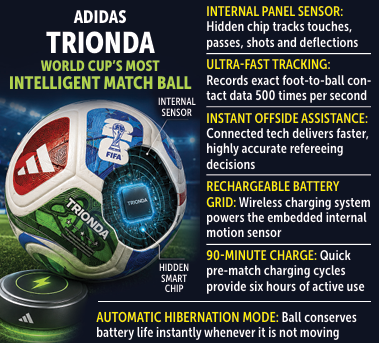
Even the match ball has be come intelligent. The Adidas Trionda contains a tiny motion sensor hidden inside one of its four panels. The sensor records every touch, pass, shot and de flection 500 times every sec ond, allowing FIFA’s officiating systems to determine the exact moment a player makes contact with the ball. The technology plays a crucial role in delivering faster and more accurate offside decisions. Unlike previous World Cup balls, this one also needs charg ing. The embedded sensor runs on a rechargeable battery that is wirelessly charged before kick-off. Around 90 minutes of charging provides nearly six hours of match time, while the ball automatically switches into hibernation mode when ever it is not in use to conserve power. Before a single match was played, FIFA digitally recreated every player at the tournament. All 1,248 footballers represent ing the 48 participating nations were scanned in about a second each, producing highly accurate AI avatars that capture their ex act body dimensions. These digital models help the semi-automated offside system determine players’ positions with unprecedented precision.
For the first time in World Cup history, referees are also wearing body cameras throughout all 104 matches. AI-powered image stabilisation significantly reduces mo tion blur, giving viewers a unique perspective from the referee’s point of view while improving the quality of the footage transmitted over private 5G networks. The technology extends far beyond the pitch. Each of the tournament’s 16 stadiums has a live digital twin—a virtual replica that continuously monitors crowd move ment, security and venue operations in real time. Officials can identify congestion or potential safety risks before they escalate, helping to ensure smoother and safer match day experiences. Artificial intelligence is also assisting security teams through robotic patrols. Boston Dynamics’ Spot robots inspect suspicious objects at venues in the United States, while robot dogs deployed in Mexico provide live video feeds and issue voice commands to support security per sonnel around stadiums. Coaches, too, have embraced AI.
All 48 participating teams have access to Football AI Pro, an advanced analyt ics platform capable of processing millions of data points across more than 2,000 performance metrics. The system allows coaching staff to simulate tactical scenarios, ana lyse opponents and prepare with insights that were once available only to football’s biggest nations. Fans watching from home are also benefiting from the technological revolution. Around 45 cameras capture every match, while ultra-fast networks transfer nearly seven terabits of data every second from all 16 stadiums to a central production hub. The result is roughly 9,000 hours of enhanced World Cup coverage featuring richer graphics, deeper analytics and more immersive viewing experiences. The beautiful game has always evolved through better players, smarter tactics and improved equipment. At the 2026 FIFA World Cup, however, the biggest game-changer may be artificial intelligence, quietly shaping every pass, every decision and every moment long before the final whistle blows.