Braving rain, heat, and endless lanes, the young men driving Goa’s delivery boom carry stories far heavier than their bags. Anil Kumar Mishra reports.
As Goa wakes up to another slow, balmy morning, a different kind of hustle has already begun. Before café shutters lift and office corridors come alive, the State’s delivery boys are on the move—zipping through winding village lanes, negotiating tourist-clogged stretches, and braving the unpredictable monsoon skies. They are the quiet, unseen workforce that keeps Goa’s delivery economy running smoothly, one order at a time.

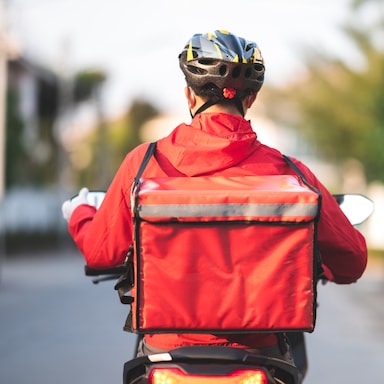
From the lively beach belts of Calangute and Candolim to Panjim’s narrow streets and Margao’s busy inner lanes, the colourful delivery bags slung over their shoulders have become part of the State’s everyday scenery. Their job sounds simple: deliver food, groceries, medicines, and parcels on time. But every order comes with its own small battle.
The price of the gig: Protests over plummeting pay
Recently, delivery riders working for a famous aggregator in Panjim and Mapusa launched a strike, protesting sharp drops in their earnings amid a rapidly expanding gig economy in Goa. Over 500 riders alleged that their per-km rate has been reduced from about Rs 10 to Rs 5–6, making their work financially unsustainable once fuel costs and long travel distances are considered. They demanded a transparent, hybrid pay structure that factors in both distance and order value.
Riders also accused the platform of unfair order distribution, saying newer riders often get more assignments than long-time workers, leading to highly unpredictable incomes. The strike disrupted food deliveries across the city, forcing many restaurants to cancel or delay orders and highlighting their reliance on gig workers.
What is unfortunate is that the company later blocked the IDs of those who raised their voice, and the riders are still waiting for their IDs to be unblocked so they can carry on with their daily routine.
A monsoon gamble: Braving rain and roadblocks
The monsoon, especially, tests them in ways most people never witness. Torrential rain turns low-lying roads into rivers and hides deep potholes beneath murky water. Winds whip across bridges and open stretches, pushing scooters off balance. And yet, the riders press on—phones wrapped in plastic, raincoats dripping, helmets fogged with humidity. Taking a break isn’t an option; demand rises when the rain pours, and so do the incentives many depend on to make ends meet.
Partners, not employees: The fight for security
Most delivery boys in the State are young men in their early twenties—some from Goan villages, others from neighbouring States seeking a livelihood. Many support families back home. Some dream of more stable jobs but rely on this income, uncertain and exhausting as it may be. Their earnings fluctuate wildly, often dictated by fuel costs, weather, and sheer luck.
Job security, however, is almost nonexistent. Riders are labelled as “partners,” not employees—meaning no medical insurance, no paid leave, and no accident cover. Yet they ride for hours on end, exposed to every danger the road throws at them.
In most cases, delivery boys say there are no paper agreements between them and the companies they work for. They are treated as business partners but without any security. With few locals in the workforce and most riders being migrants, the absence of associations or unions leaves them with little bargaining power.
Initial investments, like purchasing company-branded bags and uniforms, come from their own pockets. Working hours aren’t fixed—riders choose how long they want to be on the road, but their earnings depend entirely on how long and how hard they push themselves.
“There are no contracts with companies,” says one delivery boy on condition of anonymity. “We only submit our identity proof, and they give us an ID card. Companies pay us commission, and we have to take care of everything—accommodation, food, petrol expenses, and bike maintenance.”
“Customers like God”: The daily struggle
Ganesh Thakur knows this life too well. Once a delivery boy himself, he now supervises the flow of orders. But he hasn’t forgotten the struggles.
“A delivery boy earns around Rs 30,000 to Rs 35,000 a month,” he explains. “Sometimes more. But a good part of that goes straight into fuel. It depends on how much you’re willing to push yourself.”
He pauses, remembering his early days. “I came to Goa two years ago from Bengaluru. Working in a new city is tough. You follow Google Maps, but it doesn’t always work here. You ask people for directions—some help, others pretend they didn’t hear you.”
He smiles faintly. “But the hardest part? Delivering food when you yourself haven’t eaten. Delivering hot meals while you’re drenched, cold, or tired. Sometimes we ride in scorching heat, sometimes through rains so heavy you can’t see the road. But what to do? It’s our job. We treat customers like God.”
For Ganesh, Goa’s long monsoon is the biggest challenge. “When the rain comes with strong wind, that’s when it gets scary. Controlling a two-wheeler becomes a struggle. One wrong move, and you slip.”
Navigating Goa’s quirks: Puzzles and missing landmarks
Goa also has its own quirks—charming for visitors, confusing for riders. Houses without numbers, tiny internal roads that disappear into fields, and directions based on decades-old landmarks make each delivery a puzzle.
“One customer told me to stop near the big coconut tree,” laughs Rohit, a rider from Mapusa. “But when I reached there, the whole road was full of coconut trees.”
Driven by need, fuelled by resilience
Yet despite the risk, hunger, exhaustion, and uncertainty, Goa’s delivery boys continue their journeys every single day—driven by need, resilience, and a quiet sense of duty. They are the reason a warm meal reaches a family on a stormy night, why medicines arrive at the doorsteps of the elderly, why groceries appear when stepping out feels impossible.
Behind every delivered order is a story—of speed, struggle, patience, and perseverance—written by young men who keep Goa moving, one ride at a time.
Golu Singh from Gwalior, Madhya Pradesh, who has been working in Goa for about a year, says, “I haven’t faced any serious issues here. There is no fixed time of work for us. We start and finish whenever we want. Some people call it a day at 11 pm, while some continue working past midnight. I have no grudge. Yes, it is challenging during the rains, especially in Goa.”
Angad Singh, another rider from Bhind, Madhya Pradesh, adds, “I’ve been in this field for the last three years. There aren’t serious issues as such, but you must drive safely. You carry responsibility with you. Many ride fast, but that’s wrong. In the rainy season, you have to be more careful.”
Parvez Alam from Lucknow, Uttar Pradesh, notes another challenge: “The scenario has changed a lot now. More delivery boys have joined, which has made the work very competitive.”
“Payments have also been reduced. Earlier, we used to get bonuses besides the fixed payments on every order, but now those have stopped. Even the per-km rate has been reduced. Earlier, if I made 30 trips, I earned around Rs 2,000. Now even if I cross 30 trips, I don’t know whether I’ll earn Rs 2,000,” says another rider, also requesting anonymity. “I have a bike, so I can manage, but it’s hard for those with scooters. Our survival is becoming difficult. If we complain, we’re told the company doesn’t have money to pay. But the truth is companies haven’t reduced their delivery charges—they’re just passing the burden on to customers.”
Realising the difficulties, Sundaram Kumar, a delivery boy from Delhi, says, “I came here two years back and started working as a delivery boy, but once I realised that my earnings are not enough, I started working at a casino firm as a part-time worker. It is not possible to manage only with delivery work.”
Voices from the road
“I haven’t faced any serious issues here. There’s no fixed work timing for us — we start and finish whenever we want. Some people wind up by 11 pm, while others keep working past midnight. I have no complaints. Yes, it gets challenging during the rains, especially in Goa.”
— Golu Singh from Gwalior, Madhya Pradesh, who has been working in Goa for about a year
Payments have also been reduced. Earlier, we used to receive bonuses along with fixed payments on every order, but now those have stopped. Even the per-km rate has come down. Earlier, if I completed 30 trips, I earned around 2,000. Now, even after crossing 30 trips, I’m not sure whether I’ll make the same amount. I have a bike, so I can still manage, but it’s extremely difficult for those using scooters. Our survival is becoming harder. And if we complain, we’re told the company doesn’t have the money. But the truth is, companies haven’t reduced their delivery charges — they’re simply passing the burden on to customers.
— A rider on condition of anonymity
“The scenario has changed a lot now. Many more delivery boys have joined, and the work has become very competitive.”
— Parvez Alam from Lucknow, Uttar Pradesh