SHASHWAT GUPTA RAY
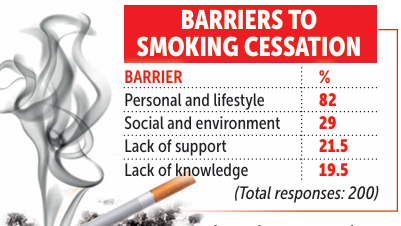
Despite a strong willingness among smokers to quit, lack of self-control and nicotine dependence continue to be the biggest obstacles to smoking ces sation, according to a study conducted by Goa Medical College (GMC) in a rural setting in Goa. Tobacco use remains the single leading preventa ble cause of death globally. In India, nearly one in ten adults currently smokes tobacco, contributing sig nificantly to the growing burden of non-communi cable diseases (NCDs) such as cardiovascular disease, cancer and chronic respira tory illnesses. With NCD prevalence in India now ex ceeding earlier estimates, public health experts stress that tobacco control must remain a top priority. Against this backdrop, a cross-sectional study was carried out among 200 adult current cigarette smokers residing in the field practice area of the Rural Health and Training Centre, Mandur, in Tiswadi taluka. Nicotine dependence was found in 52.5% of partici pants, yet a substantial 152 individuals (76%) reported a willingness to quit smoking. “This level of readiness to quit is significant and encouraging. However, willingness alone is not enough. Many smokers are trapped by nicotine de pendence, poor self-con trol and underlying mental health issues, which repeat edly push them back into smoking,” explained Dr Amit Dias, Assistant Pro fessor, Department of Com munity Medicine, GMC, and principal investigator of the study. Health concerns primary motivation Among those willing to quit, personal health emerged as the strongest motivator. Nearly 59% cited concerns about their own health, while 41% reported family pressure or concern for loved ones as key reasons for wanting to stop smoking. “The desire to quit is largely health-driven, not fear-driv en. People understand that smoking harms them, but ad diction often overpowers intention,” Dr Dias noted. The study also found that willingness to quit was signifi cantly higher among younger smokers, with nearly 60% of participants under the age of 30. Most reported initiating smoking around the age of 21, highlighting vulnerability in early adulthood “This points to the urgent need for school- and col lege-level interventions. Tobacco companies target adoles cents and young adults, and prevention efforts must begin early to counter this influence,” he explained. Relapse common, self-control key barrier While motivation was high, relapse rates were equally striking. About 161 participants (65.5%) had attempt ed to quit smoking in the past. Of these, 97 individuals (45.5%) cited lack of self-control as the main reason for relapse. Lifestyle-related and personal factors—including strong cravings, habitual smoking and stress—were identified by 82% of participants as the biggest perceived barriers to quitting. Social and environmental factors such as peer pressure and constant exposure to other smokers were re ported by 29%. “This debunks the myth that only heavy smokers strug gle to quit,” Dr Dias said. “Even those who smoke five or fewer cigarettes a day can have high nicotine dependence and poor impulse control.” Other reasons for relapse included lack of knowledge about cessation methods (12.5%), fear or misconceptions that quitting could harm the body (3.5%) and peer pres sure (17.5%). Strong link between smoking and depression A key finding of the study was the strong association between smoking and mental health. As many as 76% of participants screened positive for depression — 63% with mild and 13% with moderate depression. A significant association was observed between nicotine dependence and depression. “Smoking and depression are deeply intertwined. Many smokers use cigarettes as a coping mechanism, but nicotine ultimately worsens mental health, creat ing a vicious cycle that makes quitting harder,” Dr Dias said. Participants who had attempted to quit smoking earlier were found to be 2.7 times more likely to express a current willingness to quit, indicating that repeated quit attempts may strengthen motivation over time. “Relapse should not be viewed as failure. Each quit at tempt increases the likelihood of eventual success, provid ed adequate support is available,” he added. Call for integrated cessation services The study, titled ‘A cross-sectional study on the risk per ceptions and barriers towards smoking cessation in a rural setting in Goa’, has been published in the Indian Journal of Community Medicine. It was conducted under the guid ance of Dr Amit Dias, along with Dr Rajat Sawant and Dr Saish Naik from the Department of Community Medicine, GMC. Dr Dias stressed the need for comprehensive cessation strategies that go beyond advice alone. “Smoking cessation interventions must be holistic. Be havioural counselling, pharmacological support and men tal health screening need to be integrated into routine pri mary care,” he said. He further highlighted the importance of strengthening health and wellness centres under the public health sys tem. “Capacity building at the grassroots level is crucial. If we want to translate willingness into sustained quitting, we must ensure accessible de-addiction services, trained per sonnel and continuous follow-up — especially in rural and semi-urban areas,” Dr Dias suggested. The findings underline a clear message: while most smokers want to quit, overcoming addiction requires structured support, mental health integration and sus tained public health investment.