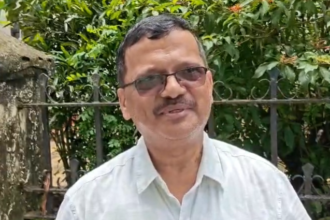
The Goa gov ernment’s decision to sign a Memorandum of Un derstanding (MoU) with Rail Vikas Nigam Limited (RVNL) has triggered sharp political criticism, with South Goa MP Captain Viri ato Fernandes accusing the State of entering into a se cretive agreement without disclosing its contents even to the Opposition. Addressing reporters at the South Goa Collectorate after attending a govern ment meeting on Thurs day, Fernandes questioned why the government had failed to place the details of the MoU in the public domain despite RVNL’s contentious track record in Goa. He said the Congress would take the issue to the people, expose the government and oppose RVNL’s activities in the State. Calling the agreement “an injustice to the people”, Fernandes said the govern ment owed Goans an expla nation before partnering with an agency that has remained at the centre of prolonged public protests over railway expansion projects.
He alleged that the State had chosen to ignore the bitter legacy of the railway double-tracking project, recalling that during the Covid lockdown, when citi zens were confined to their homes, work on the three controversial linear infra structure projects contin ued unabated. According to Fernandes, the double-tracking pro ject was driven by the coal lobby and executed with out adequately addressing public concerns. He further alleged that RVNL had encroached upon private properties and that residents who resisted the alleged en croachments or questioned the agency’s actions were slapped with police cases. At the same time, he said many affected landowners had been forced to seek le gal recourse by approaching the courts. Fernandes also accused RVNL of causing environmental destruction while disregarding the resolutions and objec tions of village panchayats during the execution of the dou ble-tracking project. It may be recalled that residents affected by the rail way expansion have consistently alleged that the State government directly or indirectly backed RVNL instead of addressing their grievances over land acquisition, access roads, environmental concerns and other issues linked to the project.

Against this backdrop, Fernandes claimed the new MoU could further strengthen RVNL’s position by giving the agency official backing for future projects. Claiming that the MoU would give RVNL a free hand, Fer nandes alleged that it amounted to a licence to “loot Goa” by enabling the agency to acquire more land without following due process or obtaining the necessary permissions. He claimed that if locals attempted to stop or legally chal lenge RVNL’s actions, the agency could cite the State gov ernment’s MoU as proof of official backing, saying it had the government’s permission to proceed. According to Fer nandes, locals fear this could embolden RVNL to continue with land acquisition and project works despite objections from those affected, including people who have allegedly lost land, become landlocked, lost access and pathways, and faced other hardships arising from the project.