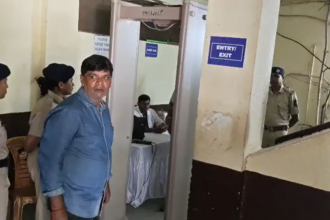
Goa’s private engineering colleges are grappling with a deep ening admission crisis, with nearly 475 seats remaining vacant after the first round of admissions, ex posing structural problems that ed ucators say cannot be solved merely by relaxing eligibility norms. The Directorate of Technical Education (DTE), in an attempt to arrest falling admissions, has eased the mandatory JEE-Main el igibility requirement for engineer ing admissions this year. However, educationists and industry experts say the slump reflects a much larg er shift in student aspirations, an oversupply of engineering seats, changing employment trends, and an outdated academic model struggling to remain relevant. The numbers themselves under line the challenge. Principal of Don Bosco College of Engineering, Fatorda, Dr Nee na Panandikar, said data in the DTE prospectus shows that while around 1,700 engineering seats are available in Goa, only about 1,200 students have applied. “There is more supply than de mand, so naturally seats will re main vacant. Also, I feel that the transition from GCET to JEE may have had an adverse impact.
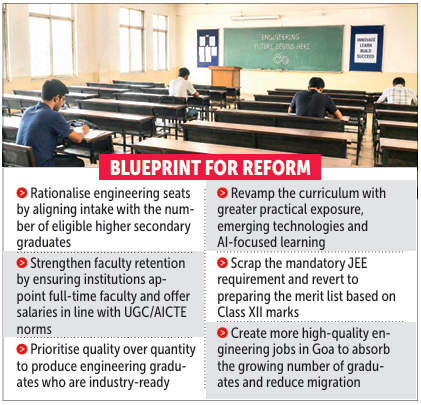
JEE appears to cause significant stress and may act as a deterrent for stu dents opting for engineering.” She believes the State should reconsider the admission process itself. “While Computer Science has dominated for the last four years, we are now seeing a shift back towards core branch es like Mechanical Engineering. There also appears to be a lack of awareness regarding JEE requirements in remote colleges. If the exam is to remain mandatory, outreach and awareness must be improved.” Dr Panandikar also suggested scrapping the JEE require ment altogether and reverting to admissions based on Class XII merit, in line with AICTE norms. The problem, however, extends well beyond entrance examinations. Principal of Fr Agnel College of Engineering, Pilar, Prof (Dr) Annie Rajan, said engineering education today faces a fundamental demand-supply mismatch, with the number of available seats far exceeding the number of eligible stu dents completing higher secondary education. “The number of engineering colleges and sanctioned seats currently exceeds the number of students grad uating from higher secondary schools, creating a clear demand-supply mismatch.

This imbalance has resulted in high vacancy rates, even under management quotas. Moreover, many students are now opting for pure sciences, pharmacy, medicine, or nursing, as a first-class engineering degree no longer guarantees employment,” said Dr Rajan. She also pointed to concerns over faculty retention, say ing many colleges reportedly struggle with a shortage of full-time, permanent faculty. Frequent staff turnover, often due to compensation that does not align with UGC or AICTE pay scales, further undermines educational standards. Industry experts argue that the crisis is equally a conse quence of engineering education failing to keep pace with rapid technological change. Author and start-up expert Prajyot Mainkar said stu dents increasingly expect practical skills rather than text book learning. “We should transition towards a value-added engineer ing model that prioritises hands-on learning and commu nity building. This is particularly urgent given the rapid integration of AI. Our educational framework must evolve to ensure students are prepared for an AI-driven market.” Mainkar also stressed the need for significantly longer industry exposure.
He called for measures such as extended internships of at least six months to provide students with essential prac tical experience and exposure to corporate and start-up cultures. “With declining enrolment across several colleges, it is imperative that we make engineering education more en gaging and professionally relevant. By moving towards a curriculum that is 80-90 per cent practically oriented, we can better prepare our students for future challenges and revitalise the engineering sector in our region.” Business incubation expert Venugopal T R said students are increasingly looking beyond Goa because the State’s employment ecosystem has failed to generate enough qual ity engineering jobs. “While many graduates seek immediate employment, the opportunities available locally often do not match the standards of tier-one cities that students aspire to. There also aren’t enough high-quality roles to absorb the engi neering graduates passing out each year in Goa.” Director of Technical Education Bhushan Savoikar ac knowledged that engineering is no longer the default ca reer choice it once was. “With the rise of numerous medical institutions and pri vate universities, students now have a much broader range of choices than before. Furthermore, we must address the current curriculum.
To remain competitive and relevant, we need to introduce emerging engineering streams while phasing out those that have become outdated.” Experts say the admission slump is not merely the re sult of one difficult admission season but reflects a broader transformation in higher education. With students pursu ing diverse career paths, artificial intelligence reshaping industry expectations, and employers demanding practical skills over theoretical knowledge, they believe engineering education in Goa will require sweeping reforms — not just easier admissions — to regain its appeal.