ANIL KUMAR MISHRA
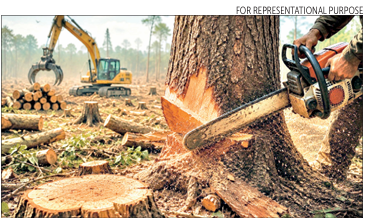
Less than a fortnight after Goa narrowly escaped a serious water crisis triggered by delayed monsoon rains that pushed reservoir levels to dangerously low levels, official records have exposed another glaring failure in the State’s environmental gov ernance — while permissions to fell thousands of trees have been granted with ease, en suring they are replaced has largely remained on paper. As per Assembly records, the Goa Tree Authority has acknowledged a staggering backlog of 44,995 compen satory trees yet to be plant ed by government depart ments, public agencies and private project proponents against tree-felling per missions granted over the previous five years, as on December 2025. The figures, reviewed during the Tree Authority’s 10th meeting at the State Secretariat in Porvorim following directions issued at its previous meeting, underscore the widening gap between the State’s de velopment agenda and its responsibility to preserve Goa’s rapidly shrinking green cover amid mounting climate concerns. The review found that the Public Works Department (PWD) alone accounts for 33,723 pending plantations — more than three-fourths of the total backlog.

Of these, 33,315 trees remain to be planted under the North Forest Division and 408 under the South Forest Di vision. Overall, the pending compensatory plantations comprise 41,613 trees under the North Forest Division and 3,382 trees under the South Forest Division. Among the other major defaulters are the Maharash tra Academy of Engineering and Educational Research (MAEER), Pune (1,605 trees), Rail Vikas Nigam Limited (RVNL) (1,638), INS Mandovi, Verem (1,137), Goa State Infrastructure Development Corporation (GSIDC) (921), Goa Tamnar Transmission Project Limited (727), the De partment of Tourism (585), the 6 Technical Training Regi ment, Ponda (459), the Directorate of Civil Aviation (450), the Deputy Collector and Sub-Divisional Office, Bicholim (450), the Department of Information Technology (360), Goa Medical College and Hospital (240) and the Greater Panaji Planning and Development Authority (207).
A separate review of the PWD’s commitments showed that Works Division-VII (National Highways) alone ac counts for 21,654 pending plantations under a single pro ject, with several other projects under the division adding thousands more to the tally. The Authority has now directed Deputy Conservators of Forests to furnish project-wise pendency details to the Principal Chief Engineer of the PWD, circulate updated backlog statements to all user agencies and obtain recon ciled reports with timelines for compliance. Agencies have also been asked to identify plantation sites within a fort night in keeping with directions of the High Court. The Authority warned that continued non-compliance with conditions attached to tree-felling permissions could adversely affect the consideration of future proposals.
For environmentalists, however, the backlog is evidence of a regulatory system that has consistently prioritised de velopment over ecological accountability. “The Goa Tree Authority has miserably failed in ensuring compliance with compensatory tree planting against the trees felled by various Goa Government agencies. There has been absolutely no attempt by the Goa Tree Authority over the years to ensure implementation of compensato ry tree planting and, as a result, the backlog of trees yet to be planted has continued to mount. It’s high time that the powers of the Goa Tree Authority to permit tree felling are frozen until the backlog of trees yet to be planted is cleared, and punitive action is initiated against the officials respon sible for non-compliance with compensatory tree plant ing,” Goa Green Brigade Convenor Avertino Miranda said.
Linking the issue to the State’s increasing climate vulner ability, he added, “Considering the fact that climate change is contributing to the high deficiency in rainfall in Goa, it’s high time that the Goa Government acts on a war footing and ensures full compensatory tree planting without any further delay. Currently, the Goa Tree Authority is domi nated by bureaucrats who have no passion for trees and have a history of recklessly issuing tree-felling permissions without taking into consideration the environmental and biodiversity impact. It’s high time the Goa Government abolishes the current composition of the Tree Authority and sets it up afresh with representatives of Goa’s leading environmentalists, biodiversity experts and environment restoration experts.” Goa Foundation Director Claude Alvares questioned the effectiveness of the system that permits large-scale tree felling while failing to ensure restoration. “If PWD were doing its work properly, why would the court intervene? There is a huge gap between the number of trees to be planted and what has actually been planted. Nobody can really see what is being planted. PWD can have a green cell to ensure that trees are planted before devel opment work is taken up. It is a very normal expectation.
The problem is that once the work gets over, contractors leave. Anyway, they bypass most of the things. After that, they do not take any interest. Contractors do their job and go while engineers oversee. The Forest Department gives permission easily. Actually, there is no pity.” Drawing from Goa Foundation’s own plantation initia tive, he said, “Goa Foundation had an agreement with PWD to plant 68 trees. Sixty-two trees were planted and we are carefully monitoring them. We are watching them. But it required a big effort and was an expensive affair. If plant ing and maintaining 62 trees is so difficult, then one can imagine what is required for 40,000 trees. There has to be restraint while giving permission for felling of trees. We have enough development and projects. We do not need any more. People are fed up with the digging of roads.” Sharing his experience of tree plantation, Alvares added, “We took slightly grown-up saplings, which cost Rs 400 each. Then Rs 1,200 was required for tankers because the trees had to be watered regularly. Then there were labour charges. However, in spite of this, some saplings could not survive.” Advocate Melisa Simoes said the backlog reflected the government’s failure to recognise the urgency of the cli mate crisis. “Time and again, the government fails to recognise that we are living through a climate crisis. Trees are among our most effective natural defences against its impacts.
Summers have become hotter, monsoons are increasingly erratic, and winters have almost disappeared in Goa. Goa has already recorded the highest mean temperature in the country, and we are foolishly stumbling towards a water crisis.” She added, “Development and environmental protection must go hand in hand. What use will wider roads and larg er buildings be if people are forced to endure increasingly terrible weather? Europe, one of the world’s most devel oped regions, is currently experiencing deadly heat waves. No place is immune to the consequences of climate change. “The Tree Officer must immediately suspend the grant ing of tree-felling permissions wherever there is a backlog of tree planting by any government department. No further trees should be permitted to be felled until these backlogs have been cleared.” Social activist Dipesh Naik said the State had failed to learn lessons from repeated tree-felling linked to infra structure projects. “Big trees were cut when work on the new flyover at Por vorim started.
Even some of them were translocated. How ever, out of the translocated trees, only one survived. If the Forest Department continues to give permissions for the felling of trees, then one day Goa will have nothing. Forests have suffered extensive damage during the last 10-12 years. I think panchayats, too, should be involved while granting permissions for cutting trees. Applications for permission to cut trees should be routed through the panchayats. Now nobody has information about which tree is the next to be cut. As far as the backlog of tree plantation is concerned, I do not think the government is serious about it.” PWD officials, however, maintained that compensatory plantations are being undertaken wherever mandatory but said the department faces constraints, particularly a short age of suitable land. “There has to be cooperation from the people as well in this endeavour because sometimes people do not allow the plantation of trees on their fields,” a PWD official said.