SHWETA KAMAT
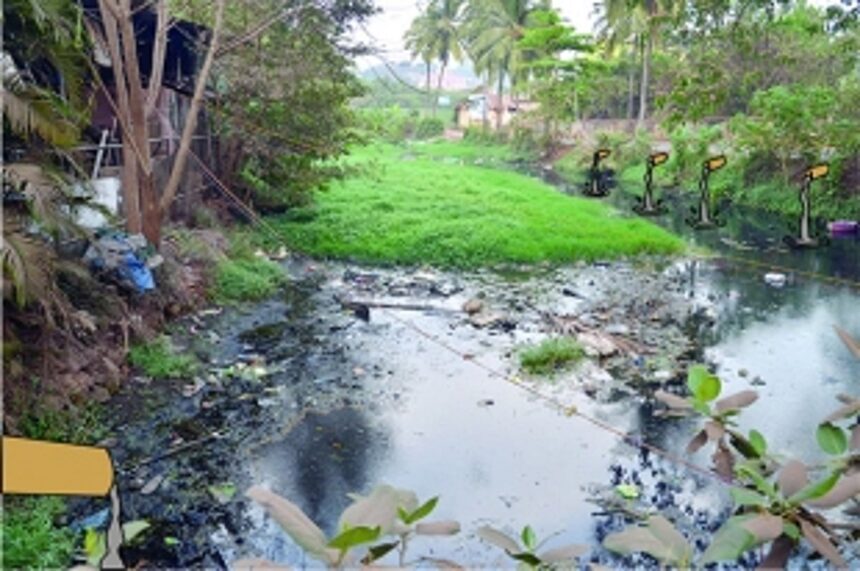
The ongoing process to aerate the highly-polluted waters of St Inez creek, the creek dated back to Portuguese colonial rule, is showing some result, with Goa State Pollution Control Board (GSPCB) claiming that the dissolved oxygen (DO) is no more nil. DO is one of the most important indicators of the quality of water and its availability is vital for aquatic life. For good quality water, the dissolved oxygen level should be more than 5 ppm.
The condition of putrid St Inez creek over nearly a decade now has remained unchanged, with the successive State government’s paying complete ignorance towards this creek, which if cleaned and beautified can be promoted as a beautiful tourism attraction through boating.
Located in the heart of the city, flowing right from Caranzalem to opening up in River Mandovi, has literally been a sewage dumping ground for locals, migrants living in shanties along the creek bank and even to the Government department- PWD section at Tonca.
The creek is 3.7 kms in length, with a surface area of 65,750 sq mtrs with an average width of 12.6 meters. The former Panjim MLA Manohar Parrikar, who ruled the Capital city for over 20 years, kept highlighting this crucial issue in his manifesto- which never saw day of light. Neither under his chairmanship the sub-committee on JNNURM failed to get any funding for the Creek for its beautification, nor under his Chief Ministerial tenure he managed to give lease of life to this much neglected creek.
With government’s ignorance, the sewage-laden creek, continued to remain at the backburner of the Corporation of the City of Panjim (CCP), where elections will be held on March 6. “This is a long process. It cannot be beautified or cleaned in one or two years. It needs proper planning and funding,” Bharati Heble, former councilor from ward No 13, that houses the creek, said.
Govt failure to act against Hutments, Residential Complex, Hotels responsible for putrid creek
It’s been nearly a year since the Goa Pollution Control Board issued directions to CCP and Health Department to ensure a permanent closure of the discharge lines from the residential complexes and commercial establishments in the vicinity of the creek, however, the directions continued to remain on papers.
Following the National Green Tribunal (NGT) directives, the GSPCB along with officials of CCP, DHS, Urban Development had in March 2015 conducted a major inspection of the creek. (See box) It was found several commercial establishments including hotels, a car service centre and residential complexes located within the vicinity of the creek starting from its originating point at Nagali Hills up to Campal discharging waste water, dumping garbage and discharge of sewage.
It had raised concerns over hutment dwellers residing near the creek and discharging sewage water into the creek in the absence of any individual connections to PWD sewerage network. Report indicated that garbage was found strewn into the creek, adjacent to residences and that a residential complex of 150 flats and 13 row villas at Tonca has no sewerage connection.
A senior official from the health department said that ‘as and when required directions are issued to the concerned departments like PWD to ensure that the residential and commercial establishments are connected with sewage pipeline’. “We cannot do anything beyond that,” an official said.
No Action on Goa Rehabilitation Board (GRB)report on the hutments
The GRB had identified nearly 71 shanties located along the bank of the creek for immediate rehabilitation, as they were involved in direct release of sewage into the creek water. Over two years passed, but government still sitting with the report with shanties continuing to mushroom along the bank.
Aeration Process to clean Creek Water by GSPCB
The GSPCB along with private funding form Cipla Ltd under their corporate social responsibility, in November last year, initiated the aeration process in a bid to revive the putrid St Inez creek. In last four months, the process has shown positive result, claims Board.
Around ten rigs have been installed at different locations to meet the GSPCB’s water-quality criteria for DO in the creek. The rigs, placed under water, are connected to a half HP water pump that will help re-circulate the water at 6,000 liters per hour with a timer set to operate the pump every four hours a day.
GSPCB chairman Jose Manuel Noronha said the process is to increase oxygen content in the water. “The four months results are positive. The creek is slowly reviving DO. This is a very good sign,” he said.
In the next stage, the board will issue directions to the water and resource department (WRD) to take adequate measures to clean/de-silt the creek to ensure proper flow.
Beautification Plan by GSIDC
GSIDC has drafted around Rs 80 crore beautification plan for the creek, wherein the work in the first phase is in process. This includes fencing and pavement. It has also floated tender for culvert near Inox.
Creek highlighted in the LKS Master Plan and Smart City Plan
Though both plans outline beautifying the creek, nothing has been spelled out in detail. While LKS Plan just mentions that the creek would be beautified, the Smart City Plan proposes to complete rejuvenation and zero discharge of waste in creek waters by 2020.
It also speaks about the area to be developed as complete pedestrian zones, promoting it as ‘evening leisure’ space for citizens and tourists. Open restaurants along the promenades could be an added attraction.
For now, these promises at best are hot air with some aerated oxygen.