SHASHWAT GUPTA RAY
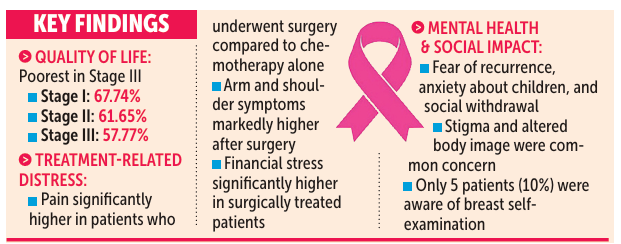
Cancer affects far more than the body — it reshapes emotions, self-image, family roles and futures. This was under scored by a study conduct ed at Goa Medical College (GMC), which found that self-stigma and altered body image are common concerns among women undergoing treatment for breast cancer. The study assessed the quality of life (QOL) of breast cancer patients re ceiving treatment at a ter tiary care hospital in Goa. Using validated tools it evaluated physical, emo tional, psychological, social and functional domains, and found that quality of life was significantly im paired across all these are as during treatment. Pain, fatigue, insomnia, fear of recurrence, anxiety about children and distress related to body image were among the most commonly reported problems. Many women also described so cial withdrawal and feel ings of shame. One patient shared during the study, “Why should I go out? To be laughed at by the kids in my neighbourhood?” Anoth er said, “I was very scared after being diagnosed with cancer. But I didn’t know the effects of the treatment would be no less scary.” The research also ex plored awareness of breast self-examination and docu mented patients’ lived ex periences through in-depth interviews. The findings were published in the IOSR Journal of Dental and Medi cal Sciences. The study was co-authored by Dr Amit Dias, Assistant Professor, Department of Commu nity Medicine; Dr Dilip Amonkar, former professor of surgery; and Dr Siddhar tha Basuroy, head and neck surgical oncologist based in Guwahati, Assam. “Cancer care is not just about disease remission or control. We need to see the patient as a person — a parent, a spouse, a child. It is about rehabilitation and quality of life, not merely treating the disease,” said Dr Basuroy, the first author of the paper. Dr Dias, the principal in vestigator, pointed to the deep impact of internal ised stigma. “More devas tating than social stigma is self-stigma, where patients internalise society’s fears and myths, blame them selves for their illness, and carry a sense of shame.”