SHASHWAT GUPTA RAY
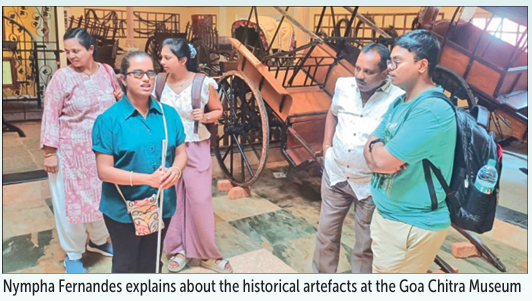
Visitors usually arrive at Goa Chitra Museum to discover the State’s rich cultural heritage. But for Manish Gupta, a tourist from Andhra Pradesh, Friday’s visit to the museum became far more than a his tory lesson. He also received a lesson in resilience, determination and the power of ability over disability. At the heart of that experience is Nympha Fernandes, a 100 per cent visually impaired tour guide whose vivid narration of Goa’s history has been leaving visitors inspired as much as informed. “It was truly an eye-opening ex perience for me,” Gupta said. “I was completely unaware that such ar tefacts existed before. I was deeply impressed by how clearly and thor oughly everything was explained. Despite being 100 per cent visually impaired, she described every as pect so vividly that I was able to understand everything without any difficulty.” Another visitor, Anisha, echoed the sentiment, saying Fernandes’ expla nations were delivered with remark able clarity and precision.

“It was a truly unique experience. I was amazed by her ca pabilities, especially considering her visual impairment. The accuracy with which she explained every exhibit was abso lutely remarkable and inspiring,” she said. Fernandes, who joined Goa Chitra Museum as a tour guide in March this year, admits she never imagined such an op portunity would come her way. “As someone who is 100 per cent visually impaired, secur ing this role has been an incredible opportunity that I never expected,” she said. Her journey to becoming a museum guide required months of rigorous preparation. During her training, found er and curator of the museum Victor Hugo Gomes allowed her to do something visitors normally cannot — touch the artefacts. By feeling the contours of traditional tools, carts and household objects, Fernandes built a mental map of the mu seum’s vast collection. She memorised the layout of every gallery, the location of each exhibit and the stories behind them. “Because of my visual impairment, I was permitted to touch and feel the artefacts during my training.
That allowed me to understand and describe them accurately. To remem ber their exact positions and histories, I mentally visualise myself interacting with the objects, even imagining myself riding in the historical carts,” she explained. The result is a tour that relies not on sight, but on story telling, memory and imagination — qualities that have won over visitors from across the country. For Fernandes, however, the job is about much more than guiding tourists. “My goal is to ensure that every guest has an engaging and memorable tour,” she said. “Professional fulfillment comes from the happiness you find in your work rather than from your salary package or job perks. To anyone facing challeng es, I would say: tune out negativity, accept constructive guid ance and keep moving forward.” Gomes recalls that it was Fernandes’ confidence — not her disability — that stood out during her interview. “She spoke about her abilities, not her limitations,” he said. “Learning that she had been denied opportunities elsewhere made us reflect on how often capable individuals are over looked because of societal bias.” At Goa Chitra, he said, opportunities are based on merit and commitment. “Nympha earned this role and has fully justified our deci sion. She underwent the same structured training as every other museum guide, focusing on patience, discipline and a deep understanding of our collections.” According to Gomes, visitors frequently praise Fernandes for her extensive knowledge of Goa’s heritage and her warm, confident interaction with guests. Her success, he believes, carries a message far beyond the museum walls. “The biggest barriers for persons with disabilities are often society’s perceptions rather than their physical limi tations.
Inclusion should not be seen merely as a legal ob ligation but as a social responsibility and an investment in human potential.” Every day, as Fernandes leads visitors through Goa’s past without being able to see the artefacts herself, she quietly challenges assumptions about disability — proving that vi sion is not always measured by sight, but by determination, knowledge and the ability to inspire others.