Team Herald
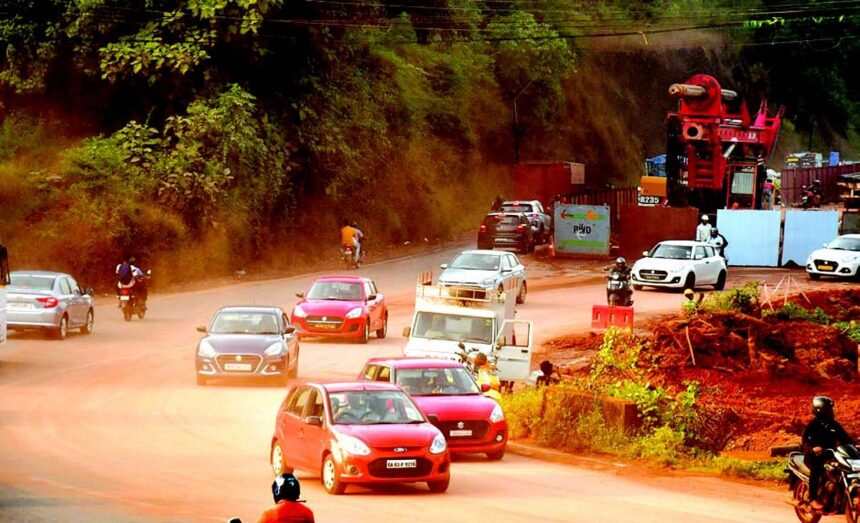
PANJIM: The State government has submitted before the Goa Bench of the Bombay High Court (HC) that a meeting will be convened on an urgency basis with officials comprising of the PWD, RTO, Traffic police as well as the contractors to find out about the causes of dust pollution and inconvenience caused by traffic congestion caused by the construction of the six-lane elevated corridor at Porvorim.

The High Court also directed the contractor to mandatorily sprinkle water four times a day to tackle the dust pollution choking the area and also directed the State government to hot mix the diversion road from Mall de Goa to O Coqueiro Junction as an initial measure to address traffic hazards and pollution caused by the ongoing construction of the Porvorim flyover.
Speaking to the media on Monday, Advocate General (AG) Devidas Pangam, detailed the court’s directives following the hearing of the Public Interest Litigation (PIL) that raised concerns about pollution, road conditions, and public safety.
“One of the major issues taken up by the High Court today was the condition of the alternate roads being used during the construction. These routes are causing pollution and posing a threat to traffic and public safety,” Pangam said.
He explained that the court has directed hot mixing of the stretch from Mall de Goa to O Coqueiro Junction on a test basis. “If this measure proves successful, the rest of the area will also be taken up for hot mixing,” he added.
The results of this intervention will be reviewed during the next hearing on December 12.
Dust pollution, identified as a critical concern, was addressed through specific directives. Pangam stated, “The High Court has ordered four times sprinkling of water throughout the affected area each day to control dust pollution.”
He noted that this measure aims to alleviate the immediate environmental and health impact of the construction work.
In addition to these steps, Pangam highlighted the importance of a joint meeting to address broader issues raised in the petition.
“There will be a meeting of the traffic department of the police, the PWD, and the RTO, along with the contractor, in the next two or three days. This meeting will focus on measures such as installing signboards at relevant places, controlling traffic, and ensuring smooth passage for ambulances,” he said.
The AG also confirmed that the meeting would review preparations for emergencies, including setting up a trauma care centre.
The petition, filed to address issues stemming from the flyover project, had previously prompted the government to assure the court of efforts to expedite construction, which was also followed by a joint inspection by the authorities to assess the ground reality with the aim of addressing various issues that were observed at the site. During the hearing, the court reiterated the importance of minimizing disruption to commuters and residents while the work progresses.
“All these issues, including precautions and measures to ensure public safety, will be reviewed comprehensively in the upcoming meeting,” said the AG, emphasizing the coordinated effort required to manage the challenges posed by the ongoing project.
At the next hearing, the effectiveness of the measures, including hot mixing and dust control, will be reviewed. This assumes significance given the expected increase in tourist arrivals in December, which is likely to add to the traffic problems faced by daily commuters and local residents on this busy route.