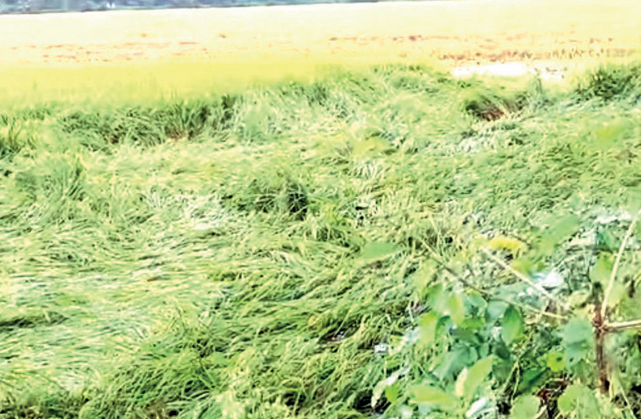
Continuous and unseasonal rainfall across Goa has left the State’s farming community in deep distress, with extensive damage reported to paddy fields—particularly in Sal cete taluka and several oth er regions of the State. Farmers, many of whom depend entirely on this harvest for their livelihood, have demanded that the government not only pro vide immediate compen sation but also formulate a permanent policy to ensure timely financial support during such calamities. Following repeated ap peals from affected cultiva tors, officials from the Ag riculture Department have begun field inspections in several parts of Salcete, including Raia, Nuvem, Benaulim, Varca, Seraulim and Curtorim. The teams are assessing the extent of damage caused by the re lentless downpour and pro longed waterlogging. Pre liminary findings indicate widespread loss, with many farmers reporting that har vest-ready paddy has either been destroyed or rendered unfit for consumption. Officials have confirmed that the farmers’ claims are genuine and that inspection reports will soon be com piled and submitted to the department. “The situation is critical, and many farmers, includ ing those without Krishi cards, have suffered sub stantial losses. This is not just a Salcete issue—farm ers across Goa are affect ed,” said an official from the Agriculture Department on condition of anonymity. However, farmers say that while inspections are necessary, they expect im mediate relief rather than lengthy bureaucratic proce dures. “Every time such disas ters strike, officials visit, take photos, and prepare reports, but compensa tion reaches us very late— sometimes months later,” said Pascoal Fernandes, a farmer from Raia. “This year, I harvested my paddy, but it went to waste because we couldn’t dry it due to continuous rain. All our efforts and investment have been ruined.” Farmers’ associations and community leaders have now urged the State government to adopt a per manent compensation pol icy to address agricultural losses caused by natural calamities. They argue that in the absence of a struc tured mechanism, farmers remain vulnerable to un predictable weather that destroys months of labour within days. “Farmers need a mechanism that ensures immediate aid when dis aster strikes. Compensa tion should not depend on lengthy verification and paperwork,” said a farmer from Nuvem, echoing the sentiment of many across Salcete. Meanwhile, ex perts warn that prolonged waterlogging could further affect soil fertility and delay preparations for the next cropping cycle. The cost of replanting, coupled with the absence of adequate crop insurance, has deep ened the financial strain on Goa’s farming community. Agricultural experts and environmental groups have urged the government to introduce comprehensive crop insurance, strengthen drainage systems in low-ly ing areas, and establish a dedicated disaster relief fund for farmers. As the rains show no sign of abating, Goa’s agricultur al community finds itself once again battling uncer tainty and loss. Their appeal to the State government is clear and urgent: provide immediate compensation, frame a permanent relief policy, and ensure that farmers are not left to bear the brunt of nature’s fury alone.
Unseasonal Rains Devastate Goa’s Paddy Fields; Farmers Demand Immediate Relief and Policy Support