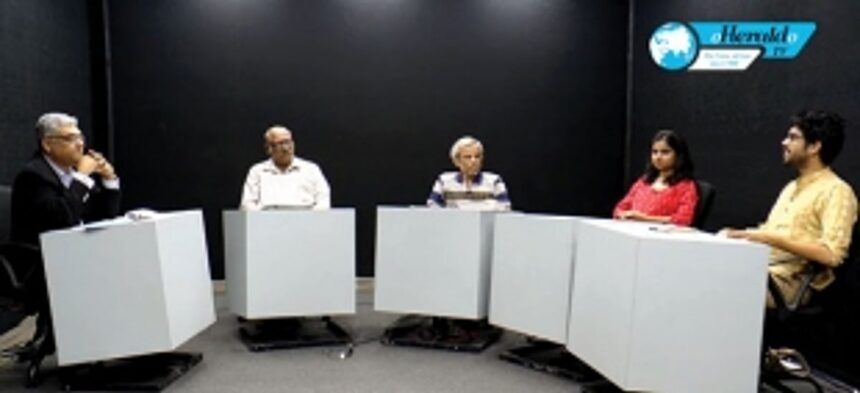
The people of Goa, activists and other stakeholders have been fighting vociferously against the absolutely illegal and immoral manner in which the forests, especially the Bhagwan Mahavir Wildlife Sanctuary would get destroyed. Permission for the same has been revoked by the Supreme Court. But, there is a window of opportunity which has been given to the project proponents – the Railway Vikas Nigam Limited (RVNL), which is executing the project on behalf of South Western Railways, to appeal again and see that this position is restored.
Hence, one need to look at the possibility of whether such a thing will happen or not and of that happens, how the project will move forward. When the judgement was given, there was immediate elation and claim to victory.

But after couple of weeks down the line, one needs to step back and look at whether this was elation or there is a cloud of despondency one needs to look at. Most importantly, there are very important government departments and institutions which have been constituted with the sole objective of protecting our ecology. Have these institutions played their part that they should have, or have they been a “caged parrot” like the Central Bureau of Investigation (CBI).
Abjijit Prabhudesai, social activist, who was sceptical about this judgment, said that although he was thankful to the court for revoking the wildlife clearances, but unfortunately a window has been opened for the RVNL to reapply and get the permissions again.
“Fundamental problem with the SC judgment lies in the CEC report, which has extensively looked into the necessity of double tracking and have concluded after consulting railways and MPT that this only for coal and hence not needed at all because coal transportation is required to be reduced. Hence, the existing line is more than sufficient. Also, there are alternate routes from Krishnapatnam on the east coast, which can do the job,” Prabhudesai said.
CEC is an expert committee. In the law of evidence, the reports of expert committee are evidence in the court. It was expected the Supreme court to take that point that the project was not needed and ask for the project to be actually scrapped. Even if they weren’t doing that, there are question marks in terms of their failure to consider the forest clearances that haven’t been revoked.
“Also, the Railways is pushing through the construction work which is outside the protected area from Vasco to Kullem, which is going through our densely populated villages, which should have also been stopped. All the work should have been stopped because the linear project does not get permission in one part and all the other money that is spent is wasted. This has not been considered by the Supreme Court, which is most unfortunate,” the activist said.

Advocate Sreeja Chakraborty, environmental lawyer, who has been fighting against the double tracking project in Karnataka, said that one of the points the Supreme court has missed is Railways claims that they have land inside the national park both in Mollem and Kali Tiger Reserve in Karnataka.
“Five metres from the existing site they claim as their own and they refuse to apply the Forest Conservation Act as they say that the land was owned before the Forest Conservation Act of 1980. So, now they have used the local Tree Act of Goa and Karnataka and have completely violated the law in Karnataka,” Chakraborty said.
In Karnataka, any public project that requires cutting of more than 50 trees has to go through a public consultation process. That provision is not there in the Goa Tree Act.
“In Karnataka, the Railways felled the trees, but the public did not know of it because it was not in the public domain. It was suddenly in the public domain after I filed a PIL in the Karnataka High court. Similarly in Goa there is a provision that government projects can be exempted from any of the provisions of Tree Preservation Act. So, they used the lacunae in the law. This specific issue has not been dealt by Supreme court,” she said.
Now the loggerhead of legal issues will happen, the reason being in Karnataka, along with the wildlife clearance, which has been quashed by the SC, my client has also challenged the tree felling permission that was given in the national park.
According to her citizens could be at loggerheads with the RNVL in the future again as after little bit of activism pressure, the tree felling permissions were given a status quo by the same tree officer saying that let’s wait till CEC’s report is considered by the apex court.
“RVNL has challenged the status quo. There is uncertainty regarding such projects. In way, we have won as wildlife clearances have been quashed for now, but they will come back in a way when people have forgotten about the issue. For example, the Hubli-Ankola railway line issue. In 2013 the CEC submitted a report. SC did not adjudicate on it and sent it to NGT. In 2016 NGT disposed off the petition saying let them apply for clearances afresh, which were done,” she said.
In 2020, the Wildlife Board in complete illegal manner, gave a go ahead to the project. The project was stopped for one-and-a-half year, there was a good judge who elevated to the Supreme court and now whatever hindrances were there in the path of this project has been cleared.
“So, again coming back to the judgment, the problematic part is it has not gone into the procedural improprieties that have happened. Without addressing it and giving liberty to apply afresh, what new are we expecting? We have to keep this in mind that the Wildlife Protection Act is being diluted. There is an amendment bill that is being contemplated by the Parliamentary Standing Committee, under which there is going to be a Standing Committee of the State Board itself. And the performance of the Standing Committee of the National Board is glorious. What kind of permissions and checks and balances are we talking about?
The present wildlife clearance that got quashed from Goa side was doing the rounds from 2016 and we are in 2022 now. It at least took four years to reach a position where it was challenged. If the Wildlife Protection Act 2021 comes into picture, it will take a year or two to get any redressal.
The general perception seems to be that the Forest Department or the State Wildlife Board in this case, instead of being a protector, has become an enabler of projects, which can be detrimental to the overall conservation of ecosystem.
Former Deputy Conservator of Forest Subash Henriques said that this reality has always been there.
“But the department heads don’t have a say. Somehow, whatever the government wants, it is considered as a ‘yes’. The project should have been evaluated on its merit by the department, whether it would beneficial for the people of Goa or not. It shouldn’t have blindly given its approval,” Henriques said.
While the eco-warriors have secured a crucial victory but this is temporary. Question now arises, how does one then keep the movement alive?
Farai Patel, ecologist with the Amchem Mollem group, which has been at the forefront in the fight to save the State’s fragile ecosystem, said that the SC specifically stated that CEC received thousands of signatures from hundreds of people from all sections of the society. The pressure created by the Goans was enormous.
“The result maybe is not everything we could hope for like complete scrapping of the project, but the apex court has created lot of hoops for the RVNL to jump through like doing a cumulative impact assessment, getting clearance from the National Tiger Conservation Authority (NTCA), which has already said that the project should be a no go. So, there are multiple barriers that the RVNL has to go through if it wants to reapply,” Patel said.
However, giving example of Hubli-Ankola railway line, he said that these issues return silently after a few years.
“We are hoping to put pressure on the State Board to pass a resolution against the railway line because that would be a powerful way of stopping the project in its tracks,” he said.
The judgement stated that the landscape through which the railway like is proposed to pass is an important tiger corridor, connecting three States – Goa, Maharashtra and Karnataka. The report prepared by the NTCA regarding the viability of the project was only for Karnataka. No such report has been prepared for Goa. The Standing Committee of National Board for Wildlife (NBW) ought to have sought to have sought a report from NTCA on the Goa part of the project before giving clearance for the doubling of railway track.
Reacting to this observation by apex court, Advocate Chakraborty said that the Goa segment got the clearance first, followed by Karnataka.
“I remember when we started writing, the Standing committee of the NBW took cognisance of the matter and they said that for the forest part of it, let us look at it together. Before that there was not even a consideration. When it comes to NTCA, they are legally right. Be it the Mollem national park or other forest areas are yet to be declared as a tiger reserve under the Wildlife Protection Act. But it is the same landscape, only the legal connotation is different,” she said.
She said that something very interesting happened at the NTCA. The regional office of NTCA, which is in Bengaluru, the concerned officer made a report from Karnataka side. In the recommendation itself, they wanted to do a cumulative impact assessment before the project was considered. Along with this, they also wanted to do a cost benefit analysis of the railway line vis-à-vis four laning of the national highway.
“This report was sent from the regional office of NTCA to the head office. But the entire report was not furnished to the Standing Committee of NBW. It never saw the two recommendations. Only recommendation they saw was that of employing the Wildlife Institute of India and do some cumulative impact study,” she said.
The question now arises, is the RVNL taking recourse to these technicalities that the wildlife reserves are not notified as tiger reserves because of which the NTCA involvement is happening?
“The problem is more fundamental. The situation is quite scary at the moment since the officers are not allowed to apply their mind. Today we are in a situation where the authorities are instructed what should be their conclusion. After that they have to prepare a report to suit the conclusion,” Prabhudesai alleged.
In this double tracking case also, every correspondence from the Railways to the Department’s top officials that this project was being monitored by the Prime Minister’s Office (PMO).
“In Goa the Forest Department officials gave a blanket clearance by saying that ‘recommended in public interest’. There were only four words in their clearance. So, you can see there is absolutely no application of mind, no implementation of law. There is only following of orders. That’s why we need to step even back and find out what is the project all about. CEC has actually exposed it. It is only for private interest and private profit. In that sense all of these clearances are a hoax,” the environment activist said.
He said that more than private interest, this project is against the national interest. This project is about port connectivity. If you see the Sagarmala report, this project is aimed at allowing MPT to handle much more coal (50 million tonnes of coal). The MPT as well as railway line connecting the hinterland of India was built by the British in 1880s. The main purpose of MPT seems to have been to take out the resources out of India to the western world and bring back the finished industrial products at that time.
“Then the purpose was to flood our market with European products and destroy our economy. Today it is not doing anything different. The purpose of double tracking is to bring coal from outside and burn in India. Dig our iron ore out, make steel and send to the western world. Nothing has changed. I believe that the struggle against these three projects is struggle in our nation national interests,” he said.
An important point of concern is there is rampant destruction of ecology all over the State, which is not just related to the three linear projects. Mopa link road is one such example where acres of cashew plantations have been destroyed, which has led to the loss of livelihoods completely. A lot of these things have happened under the name and seal of Forest Department, ultimately leading to not just heartbreak but also destruction of lives and livelihood.
In this context, Henriques reiterated that the bureaucracy in the department has got no say. They do whatever the government wants.
The whole double tracking project is needed because the MPT needs to ensure that more and more coal is brought into India and larger amount of coal is transported to steel plants in Karnataka. The impediment lies in the form of large forest area of Mollem belt.
There are alternate routes, which have been mentioned by the CEC and the court as well. If that route is taken then the need for double tracking goes in a jiffy. But it will cost the project proponents much more. But to save this cost, Goa is paying a huge price in terms of hard currency but mainly in terms of loss of ecology, heritage and absolute destruction of Goa.
The Supreme Court in its order has stated that as per the CEC report, requirement of coal can be met through Krishnapatnam port, which is a viable for transportation of coal. This can also prevent the degradation of Western Ghats. Hence, whether you have the State Wildlife Board or NBW’s permission or not, becomes irrelevant in the light of this statement made by the apex court. But is the government listening?
“Based on what CEC has stated in its report and SC orders, it would have been logical for the State and Centre to drop the project right away. That is basic logic. When your exeprt is saying this project is not required, you are supposed to say that I am going to drop it. On the contrary, the work is being expedited across the non-forested areas,” Prabhudesai said.
He said that State government has taken a decision that the project will be continued, irrespective of the Supreme Court order.
“The ports in the east coast of India have substantial spare capacity. This coal requirement of Karnataka’s Bellary and Hospet region can be easily satisfied from the ports on the east coast. Especially when the coal is also coming from the east and the terrain is not so ecologically sensitive, this feasible and possible. But the Sagarmala report recommends that the coal be brought from the east and bought by sea to Mormugao and taken to Karnataka. It is not just 40-50 MT of coal from MPT but also another 80-90 MT from all our rivers and khazans,” he said.
According to him, this is in contrary to the promises made by the Prime Minister regarding reduction of coal usage by 40 per cent. Niti Ayog also in its report has stated that MPT stop handling coal and move to “green cargo”.
“These policies are being thrown out of the window and the Sagarmala project seems to be running the show now,” he said, adding, “all this is being done for saving some money on transportation because Goa is nearer to the destination that the east coast. For few rupees of profit, the government is ready to destroy the environment of Goa.”
Taking through the important aspects of CEC recommendations and the status of some those recommendations, Patel said that the CEC was very expansive when it came to do its fact-finding mission and didn’t just deal with the ecological aspects of the western ghats, bio-diversity but also a detailed analysis of the number of trains, amount of coal, number of empty rakes and did an economic analysis.
“The RVNL, which had to file its response to the findings of the CEC, was pretty annoyed. It tried to contest the jurisdiction of CEC. But the report is very powerful and should put the nail in the coffin. Since the Supreme Court has not put the nail in the coffin, it will be very good resource for future litigation, especially for cases that should happen outside the protected area because the railway line is economically unviable,” he said.
According to the young activist, the world is living in times of climate catastrophe and yet government is giving huge subsidies to burning coal for its power plants when renewable energy is a much viable option.
Speaking about the resources for the project and the kind of funding it is getting, Advocate Chakraborty said, “The 245 km Karnataka stretch from Hospet to Castle Rock, the non-forest part, has been funded by Asian Development Bank. The remaining 100 km, of which 30 km is protected area, is being funded by Government of India and Goa as well.”
She said that ADB has its own internal environmental audits. It was brought to their notice that inspite of having numerous internal checks and balances for its own funding requirements, how come it missed the fact that what it was sponsoring would eventually lead to destruction of the eighth hottest hotspot of the world and its is a UNESCO world heritage site.
“ADB did not get back to the organisation which flagged the funding. It said that the Bank was concerned about the development of the country. This development debate is absolutely bogus. ADB being a forefront banking organisation, should know that the word development does not exist. There is only one word which we can see over and over again in every climate change treaty that is sustainable development. Courts have also started using it,” she said.
Now, why Krishnapatnam port is not being used and why MPT, the whole justification for this comes from the Sagarmala report.
“Sagarmala report has been prepared by McKinsey & Company, whose only objective is to make profit. It has so much spine that it mentions in the report that the ‘project should be done ASAP. If required, the State governments should be pressurised’. When this was brought out before the court, RVNL was very unhappy,” she said.
The young environmental lawyer said that another reason is that only five signatures are required for passing a project through a protected area. The signatories are the Deputy Conservator of Forest, Conservator, Principal Chief Conservator of Forest and the State Board and the National Board.
“It is easy to acquire forest land. However, if you have to acquire third line through the Krishnapatnam port to given to the needs of Hospet industrial area, you have to go through agricultural land, revenue land. Land acquisition price goes up immensely. So, in comparison requirement of only five signatures and a distance of 345 Km distance and far less compensation amount, it is much cheaper to take projects through forests,” she said.
Corroborating with Adv Chakraborty’s statement, Henriques said that though there is internal assessment of land acquisition proposal but ultimately the decision is taken by the top bosses.
While the activists have no doubt win the battle, but the war has for saving Goa’s ecology has not ended yet. The Supreme Court decision has given a temporary relief to all those fighting for protecting the environment. But it can be surely considered as a lull before the storm and hence one has to prepare for a long haul against the system, which is determined to go against people’s wishes.