Union Tourism Minister Shripad Naik’s announcement of a new bridge or flyover linking Panjim to Ribandar came as a surprise last week. No such flyover was proposed in the highly publicised master plan prepared by LKS for Panjim which is being followed by the Goa State Infrastructure Development Corporation (GSIDC).
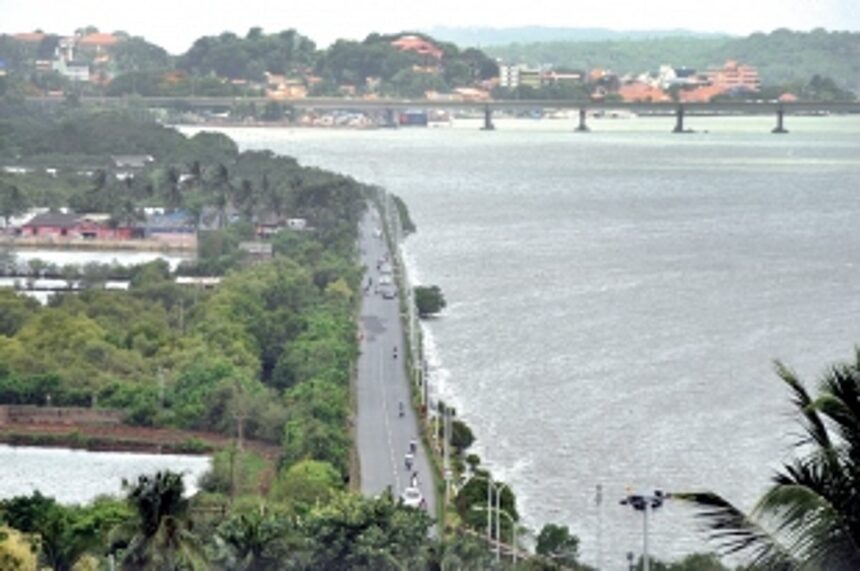
The existing 17th century causeway Ponte Conde de Linhares built between 1632-1634 is still standing and hasn’t required any major repair work. The causeway was ordered to be constructed by D Minguel de Noronha the 4th Conde de Linhares and the 23rd Viceroy. Jesuit missionaries’ expertise was used and it was built using jaamwood and laterite. It was considered a marvel of civil engineering at the time and was the longest bridge in Asia.
“The main motive which led D Minguel de Noronha, who was a Portuguese nobleman, to order the undertaking of this major project was
his determination to spend locally the revenues of the Estado da India rather than have to remit them to Portugal. An estimate of its cost computed at prices prevailing in the mid-1860s put the figure at around Rs 40,000 (A Lopes Mendes). A project of this nature and magnitude would have cost over a hundred crores today according to experts,” Vasco Pinho writes in his book ‘Snapshots of Indo-Portuguese History- I. The bridge provided an important link to the Tiswadi islands and development came as a result of the bridge.
The Portuguese Viceroy moved to the Adil Shah Palace in 1759 when Old Goa was hit by plague. The new capital officially moved to Panjim in 1843. The Panjim side of the bridge was strengthened in 1859.
Architect Charles Correa has often referred to the causeway as one of the most beautiful drives in the world. The new flyover which is expected to be built on the river side ending at Sao Pedro may require a portion of the River Mandovi to be reclaimed. When asked what type of bridge the government was now proposing, Shripad Naik wasn’t sure. “It will be just like a flyover. It is still in the primary stages and we’re preparing an estimate.
The CM’s office is handling it.” The flyover will be executed with joint funding from the centre and the state. The master plan proposes a continuous cycling track from Dona Paula right up to Ribandar. Ponte Conde de Linhares extending from Ribandar right up to Panjim will be closed for motor vehicles. The master plan also seeks to convert the salt pans and mangroves along the causeway into a biodiversity park to enhance tourism. It proposes the ‘enhancement of salt pans as a part of culture and history of the area’ and talks of exhibiting ‘the salt pans as a tourist attraction’. It also proposes to ‘create pedestrian and cycling pathways inside the park’. An interpretation centre is also planned in the vicinity where tourists can learn about the biodiversity park.
One GSIDC official said it would turn into a “happening place”. Scientist AG Untawale retired from the NIO (National Institute of Oceanography) says development cannot be stopped but it has to be done carefully. He says there isn’t much biodiversity left in the area in
the first place. He has his reservations about the park and the plan to build pathways within it. The government he says shouldn’t take a unilateral decision before opening the plan to the public and before considering expert opinions. “What does the engineer who prepares the plan know about biodiversity? They can interfere in the area provided they have a suitable and viable plan.” Regarding the further narrowing down of the Mandovi River with the new bridge, he says it was already narrowed down when Ponte Conde de Linhares was built. A tributary of the Mandovi River would flow right up to Taleigao but this stopped after the causeway was built. The Portuguese built bunds all along the Mandovi River. This is harmful too.
This stopped the water from entering and as a result of this and the mining silt deposited in the river, it has become shallow and its carrying capacity has been considerably reduced. Tomorrow if there is a cloud burst as was the case in Canadona, the water will have nowhere to go. “It will enter into Panjim city. We want development but not in this way. We want it in the correct way,” the scientist says.
Scientist Dr Nandkumar Kamat too believes the government should not interfere with the ecological security of Panjim by manipulating, modifying or altering the highly vulnerable low lying eco fragile flood plain of River Mandovi. Any further interference he says would lead to total environmental chaos. “The proposed projects are going to be executed in an area which is at sea level or less than four metres
above sea level. Higher tidal amplitude would flood these areas. Panjim’s present charm as one of Asia’s most scenic towns depends on lack of concretization of its surrounding wetlands.” The slowly sinking EDC Patto Plaza is an environmental disaster and no solution has been found till date. It has no cushion against higher tidal forces and sea level rise.
Massive corrosion free cured teak logs sunken several metres deep in the mud provide the pile foundation to stabilize the foundation of the
columns of the old causeway. Advisors selling ideas with heavy ecological footprints are only thinking about digging deeper foundation pits in the mud of Mandovi and pouring more steel and concrete on the already traumatized Mandovi waterfront.
A cable stayed causeway in consultation with local stakeholders is possible he says with environmentally sustainable technology, provided the causeway is built like a long viaduct with tall columns without effecting underlying tidal drainage. The government’s plans to turn the
old causeway into a fun street don’t impress Kamat. “The full Mandovi riverfront from Inox to Santa Monica jetty is already an unofficial ‘fun
street’ with tourists openly defecating in public and disposing garbage in the river. Now the government wants to extend this indiscipline for another three kms by virtually privatizing the whole heritage structure.” The causeway has only received minor repairs recently. The PWD has used laterite masonry on the sides to provide support to the bridge. Cracks and uneven settlements in the carpet ave been sorted out and the department is monitoring the progress. Buses which used to ply on the route have been stopped from using it.
The Goa Heritage Action group in 2010 had sent a proposal to the Unesco committee to declare the causeway as a world heritage monument but have received no reply. The cash-strapped Parrikar government has gone on overdrive proposing around eight new bridges
with the cost running into hundreds of crores. Town planner Edgar Ribeiro had reiterated that Panjim’s strength was its riverine and historical relation. For the Chorao, Divar and Betim bridges he had suggested alternatives like the RORO (roll on roll off) system. Here large ferries can transport cars and buses and this system is used between mainland Italy and Sicily. The first mantra of every political party should be ‘conservation’ he said. Development only where it is needed. He likened Parrikar’s model of development to the Gujarat model.
Locals in Raia have also protested against the Raia-Shiroda bridge which they say will destroy their heritage.
The proposal for the Tiracol bridge too had come under much suspicion after the government proposed a highflying signature Sydney harbour style bridge.