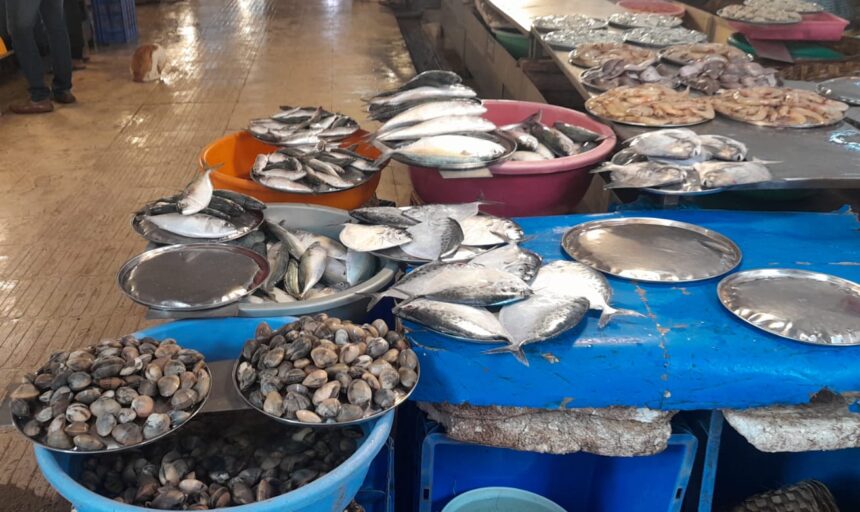
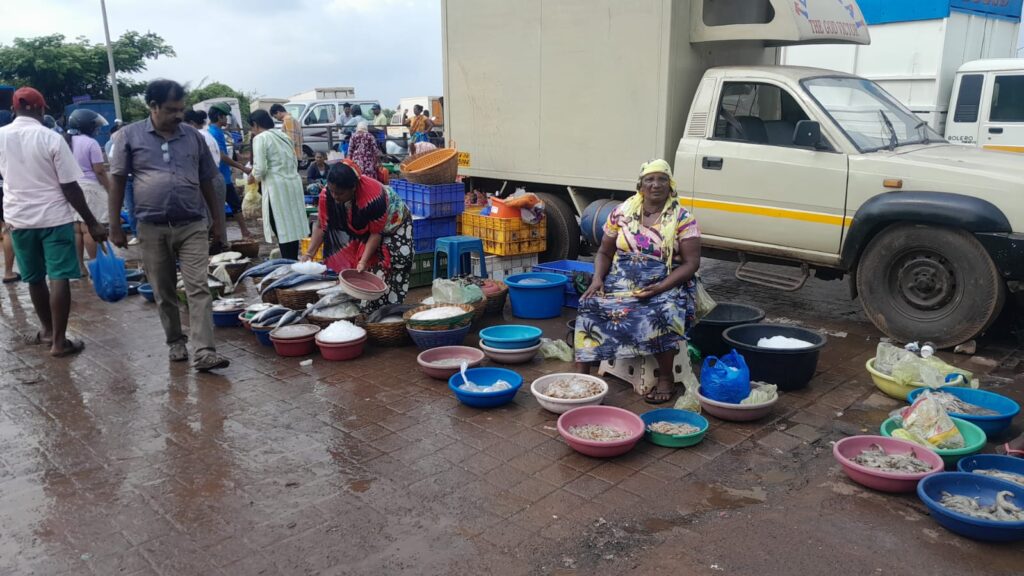
While official figures suggest the industry is holding steady with an annual marine catch between 1.1 and 1.3 lakh tonnes, local markets in Margao and Mapusa tell a different story. Despite the apparent statistical resilience, consumers are facing rising prices and a scarcity of staple fish, making this daily necessity increasingly unaffordable for many Goans. MARCOS GONSALVES reports
The total production figures do not reveal what kind of fish is being caught, where it is going, or who benefits. For local con-sumers, the issue is whether the fish is available and affordable.
The contradiction between stable production an dshrinking local availability reveals a deeper transformation in Goa’s fisheries. This transformation is shaped by export markets, changing catch patterns, industrial fishing practices, environmental pressures, and evolving consumption dynamics, which are re-defining who gets access to Goa’s fish-and at what cost. In recent years, Goa has recorded an annual total fish production between 1.27 and 1.28 lakh tonnes. Over the past decade, the overall trend has remained stable.

The export drain
The significant shift in Goa’s fisheries is the role of exports. Industry estimates suggest that around 40% total fish catch is either sent to other States or international markets.
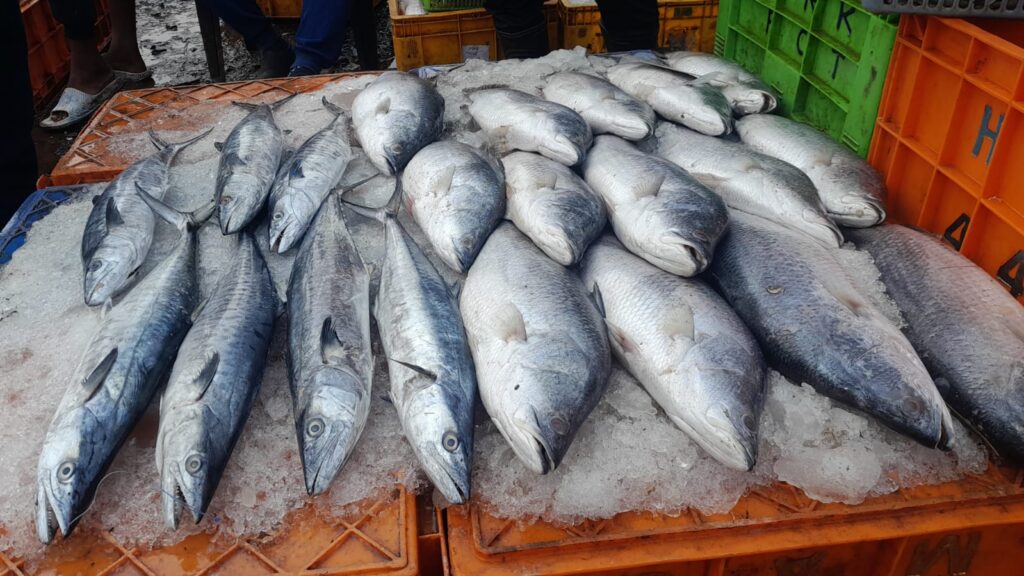
Export markets offer higher prices for premium species. When a substantial portion of the catch leaves the State, the supply in local markets shrinks. This is felt on the ground—through rising prices, limited choices, and the growing absence of fish varieties.
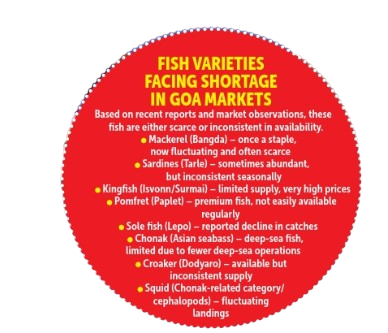
If Goa is catching so much fish, why isn’t it reaching Goan plates? Goan diets have relied on mackerel (bangda), sardines, tuna and shellfish, which have declined. Fishermen and market vendors report reduced landings of mackerel and sardines but prices have surged.
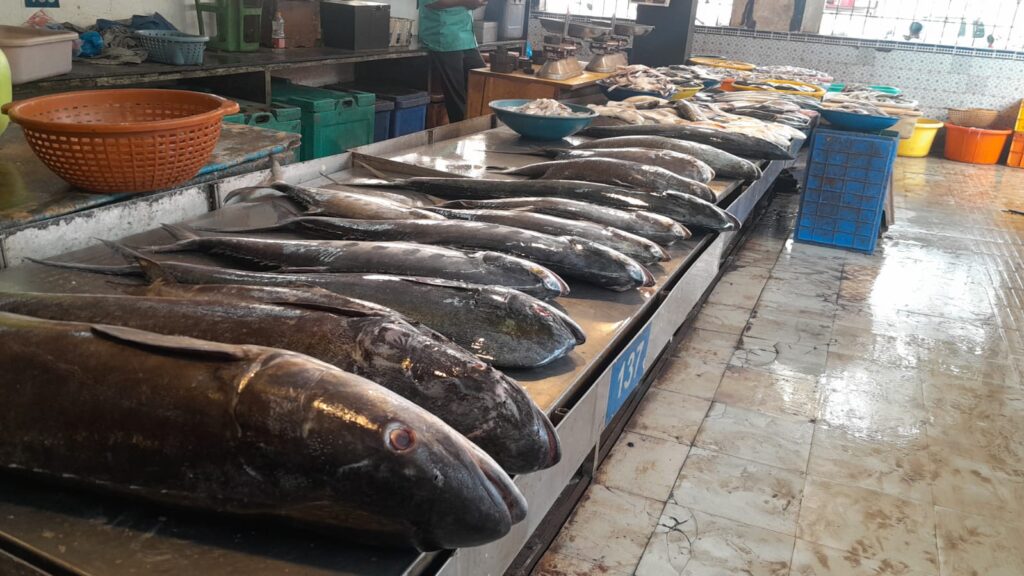
There is an increase in the catch of kingfish, squid and sole fish, which are more lucrative in export and hospitality markets.
Trawlers versus tradition
Another major factor is mechanised fishing. Traditional fishing practices in Goa — canoes, hand nets, and seasonal rhythms — allowed fish populations to regenerate. Today, mechanised trawlers account for a substantial share of the total catch as they harvest large quantities of fish.
Trawling can lead to overharvesting, damage marine ecosystems and increase juvenile fish capture.
Tourism and the ‘purchasing power’ gap
Much of the catch is pre-committed to bulk buyers, exporters, hotels and restaurants. For local markets, this translates into reduced access to quality fish. Vendors speak of inconsistent supplies. Buyers complain about high prices. Familiar fish are either missing or available in limited quantities.
The tourism and hospitality sectors demand high-quality seafood. Hotels and restaurants have the purchasing power to secure better fish from suppliers. Premium fish flows to hotels, exporters and high-end buyers, while local consumers are left with less desirable or expensive options.
A sector under environmental stress
The situation is complicated by seasonal factors. Goa enforces a fishing ban in June and July to allow fish stocks to regenerate. It temporarily halts fishing activities, leading to a drop in supply.
During this period, prices spike sharply, and dependence on stored or imported fish increases. Weather conditions, fuel costs, and operational challenges can affect daily landings. For consumers, this means that fish availability is unpredictable. Environmental changes play an important role.
The western coast, including Goa, is experiencing shifts in marine ecosystems due to climate change, rising sea temperatures and changing ocean currents.
These affect fish behaviour, migration patterns, and breeding cycles. Species that were once abundant may move to different waters or decline in number.
Mackerel and sardines have shown fluctuations linked to environmental factors. For Goa, these changes have consequences. Environmental shifts are harder to control—and their impacts can be long-lasting. Recent figures suggest stability, while the broader trend over the past decade tells a cautious story.
Fish production in Goa dropped from 1.24 lakh tonnes in 2017–18 to 1.05 lakh tonnes in 2019–20, before recovering in subsequent years. This highlights the vulnerability of the sector to environmental and economic pressures. If fish stocks are under pressure, the consequences will become unavoidable.
Protecting the Goan plate
From fish curry-rice to traditional festive dishes, seafood is central to Goan life. The decline in availability is cultural. When fish becomes expensive or scarce, it alters dietary habits. Families adjust, substitute, or reduce consumption. The question, then, is about preserving a way of life.
The paradox of Goa’s fish economy —abundant catch but limited local access—calls for a closer look at policy and priorities. Several questions emerge. Should there be mechanisms to ensure a minimum share of the catch remains for local markets? Can traditional fishing practices be supported to balance industrial operations? How can sustainability be strengthened without harming livelihoods? What role should regulation play in managing exports and pricing?
There are no easy answers. The fishing industry supports the livelihoods of fishermen, vendors, exporters, and processors. Any intervention must balance economic growth.
On one side is a thriving industry integrated into global markets, driven by efficiency and profitability. On the other is a local population that depends on fish as a daily staple, now facing rising costs and shrinking choices. Bridging this gap will require more than just maintaining production levels. It will demand a deeper understanding of how fish flows through the system—from sea to shore to market—and who ultimately benefits. The story of fish in Goa is about access, equity and sustainability.
Exporters in crisis: Empty units and shifting labour
Goa’s seafood export sector is facing a sharp drop in fish availability disrupting processing units and cutting into export volumes.
Ibrahim Moulana, a leading fish exporter from Goa, said, “We are getting only two-thirds of the expected catch. The rush to catch as much fish as possible has affected availability.”
The reduced landings have impacted business. Exporters struggle to keep units running, while some have scaled down due to a lack of raw material. The slowdown has affected employment, with workers leaving amid reduced workload.
According to industry sources, exporters are bracing for a 20–25 per cent decline in shipments. Processing units operate below capacity. Goa’s dependence on fish from outside has increased, with a major portion sourced from Karnataka and Maharashtra. Despite a strong local demand—estimated at around 50 tonnes per day—the supply and demand gap widens.
Mechanised vessels have contributed to the depletion of marine resources. Exporters urge the government to step in with supportive policies, stricter regulation of fishing practices and investment in infrastructure.
Antonio Rodrigues, a trawler owner said, “There is a shortage of fish. The foremost factor is the unpredictability of fish catch, as it depends on weather conditions.”
“Trawlers bringing in a large catch cannot be supplied directly to local markets because there aren’t enough bulk buyers. Goa lacks adequate fish storage setup, which leads to losses for trawler and boat owners,” Rodrigues said.
“Many are forced to sell their catch directly to fish processing plants or exporters. Bringing large quantities into the local market without proper demand or storage can result in financial losses,” he said.
“This is not just a Goa-specific issue but a global one. Countries like China operating in Indian waters using ‘mother boat’ systems—where large vessels remain at sea for extended periods, continuously harvesting fish—impact fish availability,” Rodrigues added.