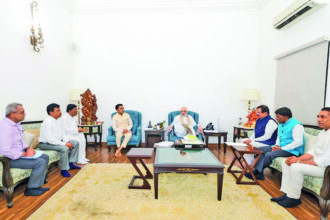
The problem here is that Goa’s IT policy is there on the wall, but not on the table. Over the past two or three years, several attempts have been made to form a policy and implement it, neither of which has happened. We do not have a policy despite three failed attempts. The fourth one is on the anvil. Public expectations are not very high because cynicism has set in. At the same time, a lot is happening in the IT space. There are over 200 startups, there are various IT companies and fantastic IT professionals. In fact, if you get out from the government corridors and get into the IT space, you can see that there is a very energetic, young Goa moving. But that Goa is moving despite the government, not because of it. That synergy between a Goa that tries to create and a government is non-existent. That is the crux to the IT policy. The other issue is that the IT policy has been traditionally drafted and gotten through by people who are not fundamentally in the sector. It’s being handled by babus and bureaucrats, and enough professional help has not been sought. Our panelists are Nitin Kunkolienker, member of the Advisory Committee on IT; Vincent Toscano, vice president of the Goa IT Professionals; Prajyot Mainkar, chairman of the Young Entrepreneurs Forum; and Mangirish Salelkar, CEO of Umang Software Technologies.
Herald: Nitin, three failed attempts. Now when will the baby be born?
Kunkolienker: It is four failed attempts. On April 8, 1999, IT did not have a separate department. It was under the Ministry of Industries. On that date, the first IT policy was announced, but nothing happened because the government was short-lived. In 2003, the industrial policy announced by then Chief Minister Manohar Parrikar had a specific mention about an IT park. The policy said that IT, IT parks and special economic zones (SEZ) would be a thrust area. In 2005, Narvekar tried coming out with a clear policy, which was a basic document, but somehow Digambar Kamat could not take it forward. No incentives are paid to most of the units and not a single rupee or benefit is given today. Not a single provision of the policy has come into force.
Herald: None of these policies saw the light of day. What is the reason for that?
Kunkolienker: There is no strong political commitment. This manifesto of the BJP had a strong mention about an IT policy. It always took a backseat because there is sufficient pull of the IT industry. That is what is being projected. The government is not seeing this as a sector. The investment policy (IVP) is out and we had hoped that many things would happen. In the IVP, IT has been considered as a thrust area, but you can’t just discuss this in the IVP; you need to come out with a clear sectoral policy.
Herald: Vincent, what are your hopes and what are your frustrations?
Toscano: Unfortunately, there is a severe lack of vision, will, and competence when it comes to the entire government machinery put together. I don’t know if this competence is real or just an illusion because a competent person can behave incompetently for certain reasons or compulsions. When we spoke to the CM, he was very positive, but it just doesn’t translate into anything. We are not talking about drafting the Constitution of India, we are talking about a 10 or 20 page document. We are not the first state in the country to do it; others have done it. We have to just smartly cut, copy, paste. If we can’t do this within a week or two weeks, then it’s a huge question mark on our capability of our leaders and government machinery.
Herald: Prajyot, do you feel that there is a gap between the government and the IT professionals who are really committed to do serious work? How can that gap be filled?
Mainkar: The most important point here is that the government under cited the potential in Goa. The startup scene is actually booming. It’s not the story right now, but the whole ecosystem in India has been growing. As Toscano mentioned, Goa is not the first state that is doing it. Once you find and dig into the potential, the scope will arise. The gap is not about the talent. The whole idea is the potential, which the government is not able to figure out. Once that gap is filled, all processes will be followed. Its just copy-paste. Another important thing is that problems should be heard by people who have already been there and done that. I think that people should have one corner where they hear from the professionals and entrepreneurs and then they formulate the smart component of the copy-paste.
Herald: These start-ups that you are talking about, how are they functioning? If they are functioning in the same space where the government has been inactive, how are they managing? Are they managing without the government, which would lead us to a conclusion that the government is not really needed?
Mainkar: As far as statistics go, around 80 percent of startups are doing it. In an IT startup, there are no major requirements. Goa has always been known as services oriented, but the trend is changing. Not you can see many product companies coming in. Now you have a lot of incubations coming up and you have mentors on board. The trend is changing, but primarily they will use their in-house resources. I think they need the government, but there is no scope right now. Once the policy is drafted, there could be another face to this.
Kunkolienker: Should we have a cut-paste policy? Strictly no. You can’t compare us to Pune or Bangalore, where a very matured education system exists. They have very developed infrastructure. We need a tailor-made policy for Goa. All along, we have been doing cut-paste. We need to map the existing set of people and we need to see what we need to get. We don’t want a huge inflow of IT companies. We want focus on startups in Goa. Today, Goa’s total IT manpower is only 2,500 people. We need to draft a policy for Goans and we need to work on our education system.
Herald: If the government suddenly changes and become proactive, how will your lives be better? Aren’t you functioning well without the government being active? What we want to know is where exactly can the government take it to the next level?
Salelkar: There is nobody here to mentor an IT entrepreneur. There are IT companies that are just formed because at times there are no job openings. When I started off in 2009, I did not know what to register or where to register. No CA’s knew and no legal advisors were there to tell us what the formation processes are. I went to STPAG in Porvorim and asked them about the processes and paperwork. They actually handed another well-known company’s papers to me and asked me to refer to them. If an authority does something like this, I can imagine what kind of an authority it is. I then approached STPI in Mumbai and they helped us. We were one of the few export-oriented companies in Goa. If the government can be there to at least help us start or at least boost us, there is a level of encouragement or motivation which can take care of an IT entrepreneur.
Kunkolienker: IT has succeeded in India because the government did not know where to intervene. If the government knew when to intervene, then things won’t move. Most professionals are not organised. Forget about the policy. You can work without a policy if you have a will. Goa was not anti-business. It is favourable. If you go to the government, it will support you. But the government has not come out with proactive policies. Today you have the Economic Development Corporation (EDC). Funds go to everyone, except IT professionals. They cannot mortgage their property. I wish this point would have touched me when I was chairman in 2012. Today, some startups lack funds. Someone might approach them and take 50 percent equity. The startup will slog and someone else will get the benefit. That is also wrong.
Herald: Vincent, what is your dream IT policy?
Toscano: My dream IT policy is something that will encourage Goans to prosper in Goa. We are not in favour of mega corporations coming down here in the hopes of getting huge piece of Goa. It cannot be afforded here. It’s not that we define a policy and the next month companies will pop up and employment will happen. It’s going to be an organic process. On one hand, we have a limited supply of educational output, but at the same time we have more than 1,000 IT professionals of Goa who have had to live in exile. I’m sure many of them are yearning to come back to Goa. If even 5 or 10 percent come back to Goa in the next one year, you have global expertise made available locally.
Salelkar: The government talks big about getting big giants, like Infosys, in Goa. You look at the companies working on the ground-level. Give them an opportunity.
Kunkolienker: In the last 20 years, people have either become rich in mining or real estate. How many first-generation entrepreneurs have become multi-millionaires through their efforts? Rarely. Goa has immense potential who can, through means of IT development, capture the world. That is possible only in startups. The government should support startups and go out of its way for that. The State should take pride in that. We don’t want Infosys to come; we want an Infosys-like unit to be created from the Goan startups. And that is possible.
Salelkar: More importantly, make a startup a company. It should not remain a startup forever.
Toscano: We don’t need a 25,000 headcount of Infosys or Wipro to be set up. It’s not going to be viable in the first place. At the same time, can we depend on start-ups just to employ the masses of Goa? I do not believe it. In 10 years, we may come to that point. We also need to look at some mid-size companies, which might be outside Goa. There are a number of them. In fact, we met a few who are keen to come to Goa. They will also help in creating a pool of trained resources. If a startup has to train people, it is a cost to incur. Time and money are lost. If you have a set of mid-side companies, they will also serve the purpose of creating a talent pool on a larger basis. It will provide more employment opportunities. When many people graduate, they have different appetites for risk. Not everyone has the guts to join a startup and think that they’ll become a millionaire one day. Most need an assured job, and for that, we need to have a reasonable amount of mid-size companies.
Herald: Prajyot, what exactly does a startup look for in the government or the IT ecosystem. What kind of help would a startup need to ensure that they move on? What about things like subsidies and bank loans? Nobody wants to give an IT startup a loan. Who funds them and pays for salaries?
Mainkar: I would say initial investment in terms of achieving breakeven, which is crucial. Just to start off, it’s about the passion of the startup. You need to have a good culture in creating. Besides, the initial fund that is required, like the resources or transportation, will play an important role here.
Kunkolienker: Goa industrial policy has a provision where capital up to Rs 1 crore can be given. The government also has to take a risk with them and gradually give them the option of exiting. That is very essential.
Herald: To sum up, what would you like to see in the IT policy?
Kunkolienker: I want a complete facilitation process for existing players. Give a major thrust for the existing players and young startups. That is the need of the hour.
Toscano: Look into the possibility of taking IT to our villages. That something we’re working out right now. IT is one such industry which can be done from anywhere.
Mainkar: I think it would be knowledge facilitation. If I am a college student who wants to start a company, I would want knowledge pool, which will be really beneficial.
Salelkar: One is a resource pool that has to be industry-ready. Second is transport facilitation. It is very poor.
Herald: Nitin, could you elaborate on how logistics is so important for IT to work.
Kunkolienker: ESDM, like the industry I hail from, is very sensitive to the supply chain. It is input-based as of today. The government is talking about Make In India. Hopefully in this budget it will address some of the issues. It needs import and export and a value chain has to be created. Today, 65 percent of the electronic market is in the South and West. Goa could become a very good hub. All products cannot be manufactured here. Low-volume products would be traded. In such a scenario, you need to incentivise the trading. Goa does not have a full-fledged port. Other vessels come to Bombay, and from there they come to Goa. From the port to factory also there are disabilities. India has a disability of 16 percent in manufacturing. In Goa and rest of India there is a gap of three to four percent. Disability is in terms of finance and logistics cost, etc.
Herald: What according to you are the biggest logistical failures?
Kunkolienker: Imports. We don’t have a very good shipping line connected to Goa. Secondly, we don’t have logistic trading hubs, which we have been demanding. Thirdly, Goa needs a good eco-system. Air connectivity; Goa does not have direct shipments. Shipments have to come to Bombay, and from Bombay it is trans-shipped to Goa under Customs bond. The freight is very high. Goa airport does not have cargo handling facility. You lose almost another half-a-day. After paying two or three percent of the value of goods as freight, if the delay is so much, then you lose a lot. Goa has some of the best brains in the country. We need to have units which will create a long-term value chain and value for the state in terms of employment and tax and no-tax revenues.
Herald: Vincent, you made an interesting point about taking IT to the villages. If you could just elaborate on that.
Toscano: We in Goa are blessed to have a semi-urban infrastructure in most of our villages, unlike other villages of India, which are in a deprecated condition. We have reasonably stable electricity, broadband coverage, high education levels. We have an advantage which we are starting to lose rapidly, because other states are catching up. IT is one such industry where you could instead of dragging people to progress, you could take progress to the people. No longer are we in an age where you need IIT to do computer programming. The best of the brains do not come out of any engineering background, but out of their own inner passion and logical thought process. Goa has this in abundance. It’s just that we have left our people deprived of this exposure. Today if you look at out computed curriculum in schools, it is centred purely around Microsoft. Unfortunately, the state of affairs in our village schools is so bad, that out of the three schools that we are covering as part of a project, one school in Quepem has barely one computer working. That computer is for 200 students and it also hangs. And we hear the government say that it has given computers to schools.
Mainkar: Once any person wants to start up, the most important thing for him to look out for is a knowledge base. To start a company, it’s not just about an idea that will prosper. At the same time he has to go through a lot of hiccups. Talking to people, having mentors on board will help them prosper better and take their product to the next level. This applies to more of the startups as well. The second thing is, if you’re looking to build a company, it’s not just your company, it’s your team. Nobody wants to hire someone who is not really productive. The team builds the company, not the other way around. When you have a skilled team, that’s where the knowledge comes into place. If you have a skilled workforce and a knowledge base, it would be enough for a company to prosper.
Herald: Manguirish, you spoke about transport. Can you elaborate?
Salelkar: People from rural areas are the people who are really hardworking. I really fetch people from those areas because I can get commitment from them and I can give them the right exposure. More importantly, they are facing the issue of transport. I cannot afford to startup in a place that is centrally-located. I am put up in Gogol, Margao. From there, I need connectivity to the KTC bus stand. I have kept a transport facility of Umang. But what if there was some connectivity to that area? If we are expecting big companies to join, the first thing people will expect is transport. When I was working in companies in Pune and Bangalore, I used to get buses back home at midnight.
Toscano: We need to exploit the possibility of working from home. You need to have a really stable internet, but if we have that, then probably some of these issues can be resolved. In urban centres, like IT hubs, companies are consciously moving to a mindset where no employee is expected to be on campus after 8 pm unless there is approval from a manager and only in certain situations.
Herald: Let’s do a quick round on the problems of internet connectivity and what can be done.
Kunkolienker: Telecom bandwidth of the state is in crisis. You need to create telecom infrastructure. Everyone is scared of investing in Goa. Everywhere there are different rates. There is no facilitation. It should be the state’s responsibility to create a platform for telecom infrastructure. It’s killing the future of Goans. Very soon we will become a backward state. Try to call on the Dona Paul-Bambolim road. Twice your phone will disconnect. In this era, you cannot have call drops.
Toscano: Talking specifically about connectivity in the schools, right not it is non-existent, whatever the claims of the government might be. We are in the process of filing an RTI to get the state of affairs of all computer labs and broadband connectivity problems of all schools in Goa to get a reality check. There is a bit of a touchy situation there due to the tablet scheme that happened a few years ago and the misuse that resulted from it. There is a scare amongst the school management, teachers, and also parents that internet is dangerous for the children. Internet is a must in all out schools, but it needs to be moderated and controlled. Once way would be to push the government to fix all these issues and get high-speed broadband available to the children. While this happens, the school management and parents should donate a dongle. Don’t wait only for the government to fix the issue. Let’s do our part as well, while pushing the government to fix it.
Herald: How has connectivity affected young entrepreneurs who have been in startups? What are the painful stories that emerge from that space?
Mainkar: What we require is very stable internet connectivity. Besides infrastructure, there is another factor, which is the cost factor. You buy a Rs 103 or 104 card and get 300 MB of data, which is half an hour of work for an IT professional. Imagine that multiplied by eight hours of work. We are spending a lot of money. For an IT company to function, internet plays 90 percent of the role. Everything else is the other sector. The communication in the IT is very important. If you ask, the problem is with the infrastructure.
Herald: How has Umang been affected by the internet fiasco.
Salelkar: The first thing is that IT companies have clients across the globe. You cannot afford to be offline for a minute. I have two internet providers: BSNL, which you cannot rely on, and GWave, which is good in Margao. I have to pay twice the cost. One of the two has to function.
Herald: I’ll just get into two short aspects: one is what we need to do in the educational system. How can education systems be improved? How can engineering colleges which have so many students be dovetailed into this?
Kunkolienker: First of all, you need integration. The education system is completely disconnected. Anything under skill development should be brought under one cap.
Herald: How do you link education to jobs in Goa?
Toscano: If our students are not aligned to what the industry demands, then there is a two-way loss. One is the employment opportunity; the employability of the person is reduced. Secondly, whoever picks up such a person needs to incur avoidable costs to train and get him up to a productive level.
Mainkar: I think it is directly proportional. If you want to create a good ecosystem, a job will play an important role here. Internship cycle is being treated as a fun element. Hardly any internship rate. It shouldn’t be a two-week internship, which nobody would take seriously. There’s nothing to learn in two weeks except to do layman’s work. Taken internships which are around six to eight months. It works, the IT ecosystem will go up to the next level in Goa.
Salelkar: What people have to understand is that instead of stressing on entrepreneurship, people have to be made industry-ready. You cannot come out of college and start something on your own. You need to have experience. You need to be an employee before being an employer. Instead of stressing on entrepreneurship, cut short and get more into industry-ready. That gap has to be filled.
Toscano: A stronger foundation need to be built at the school level through use of IT. There will be two-fold benefits: one is to teach students to start thinking on their own, and the second is to use IT to make other subjects more interesting to learn by creating a state-level repository.
Herald: There’s so much that’s been left unsaid. The way forward is to create, conceptualize, correspond and ensure that the IT whole space is integrated. There are a lot of open spaces and loose ends. Different departments don’t talk to each other and professionals don’t talk to each other. Let’s all start talking and interacting a lot more. At the end of the day, it’s important that all these interactions should also be bought and received by the government. The government can’t do this IT policy alone. It needs to talk to more people. We need to create a group of dedicated people to do this. Last but not least, Goa and Goans are equipped to do it. We need to have confidence in ourselves and move forward.