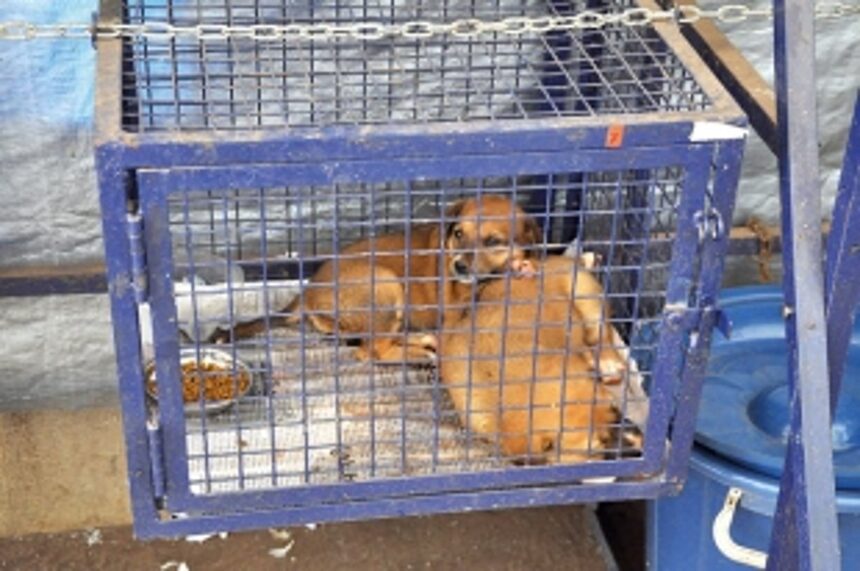
It’s hard to miss the nine cages at Mapusa’s crowded and busy market. A note reads, “Animals left in these cages will not be returned to their owners. These cages are for stray animals only. We offer free sterilization for anyone who cannot afford to pay,” along with a contact number. Often people come with a litter of pups or kittens and place them in the cages. Fishermen and women selling their daily catch have seen them and the animals that get placed in the cages.
Ever wondered what happened to these animals? Yes, they do get taken to the International Animal Rescue (IAR) Goa center located in Assagao, from where they will be put up for adoption. Most of these animals – dogs, cats, puppies and kittens – do find homes. But what about those that don’t get placed in homes?
In a rather startling revelation speaking to Herald Review, founder of the IAR, John Hicks says it’s an unfortunate position to be in, but he is left with no choice but to put sick as well as healthy animals down.
“There are far too many animals being born but no homes for them. Any animals that are healthy we take to the center and put up for adoption. We offer the animal up for free adoption and sterilization and we keep a record as well,” he says.
Diseases among strays dropped in the cages are a major issue, he says, “It is sad that when you keep animals together, disease is a massive problem. With dogs, canine distemper and parvovirus are highly contagious,” says Hicks adding that unfortunately they are euthanized too. Animals too young or too ill to fend for themselves join this category.
“But one has to be realistic and it’s not something I’m ashamed of but something I hate. There are times we have so many animals that we have no room and we have to put even the healthy ones to sleep because there aren’t any homes. If you think logically, if I were to say I would never kill and that we have a no kill policy, how long will it be before the kennels get full of puppies that are quickly growing into adults?” asks Hicks.
He shifts the blame to the pet owners saying, “If they can’t afford to sterilize their animals, we do it for them. We are in an impossible situation. We are clearing up the mess of these people. I personally do not believe it is right to turn my back on this animal dumping in the market. Is it better to leave them to die on the road or be taken to my center where they are going to be fed properly looked after, in the hope of finding a home? But if they don’t find a home at least they get a humane death. They just get an injection and go to sleep.”
Hicks himself admits to putting down between 200 and 250 animals a month. Records obtained from the center lists a section titled “Puppy/kitten euthanized – strictly for office information only”. The January 2013 to June 2014 figure totals 5415.
It was for this reason, that many persons who were initially associated with the center have refused to continue with it.
Max Patel, who worked as a volunteer with the center and later served as Chairman during Hicks’ absence between May and September 2013 says once he realized what the situation was, he had the cages removed.
“It was absurd that we were taking in animals that were going to be put to sleep. I think it is better that nature takes care of them. They are in a market that has a fresh supply of food and water as well as people. I don’t see the need to bring in animals if you don’t have the space and would rather just kill them,” says Patel who eventually resigned after Hicks had the cages replaced in the market.
One member found Hicks methods disturbing and willingly chose to leave the organisation.
“He would have cages set up in Mapusa and have people put their cats and kittens in them. Sometimes people would also come to the centre telling him to place their kittens in nice homes. It was in 1998 that I witnessed Hicks killing one of these kittens. It is then that I left the association,” she says requesting anonymity.
The Animal Welfare Board of India in its Prevention of Cruelty to Animals Act states that only seriously ill dogs be euthanized under specific condition. It says, “Incurably ill and mortally wounded dogs as diagnosed by a qualified veterinarian appointed by the committee shall be euthanised during specified hours in a humane manner…”
Earlier this month, IAR, under Hicks issued an advertisement in various newspapers around the state saying IAR was shutting down due to a lack of funds.
IAR UK that provided the funding for the Goa division stopped the supply of money that was roughly around Rs 9 lakh a month. On contacting the UK division, its CEO Alan Knight said, “It is with tremendous sadness that, due to some serious ethical and moral differences with the board of International Animal Rescue Goa (IAR Goa), which we were unable to resolve satisfactorily, International Animal Rescue UK (IAR UK) has exited its relationship with this organisation (which is a completely independent NGO).”
Hicks claims to have spent his own money including his pension money after IAR UK stopped funding and is now facing a financial crunch because of his ailing health. Unfortunately his advertisement didn’t get many takers and he has now decided to put up his Camurlim tree house, where he runs another organisation called Primate Trust with his wife Jo, to keep IAR Goa alive.
Review Bureau