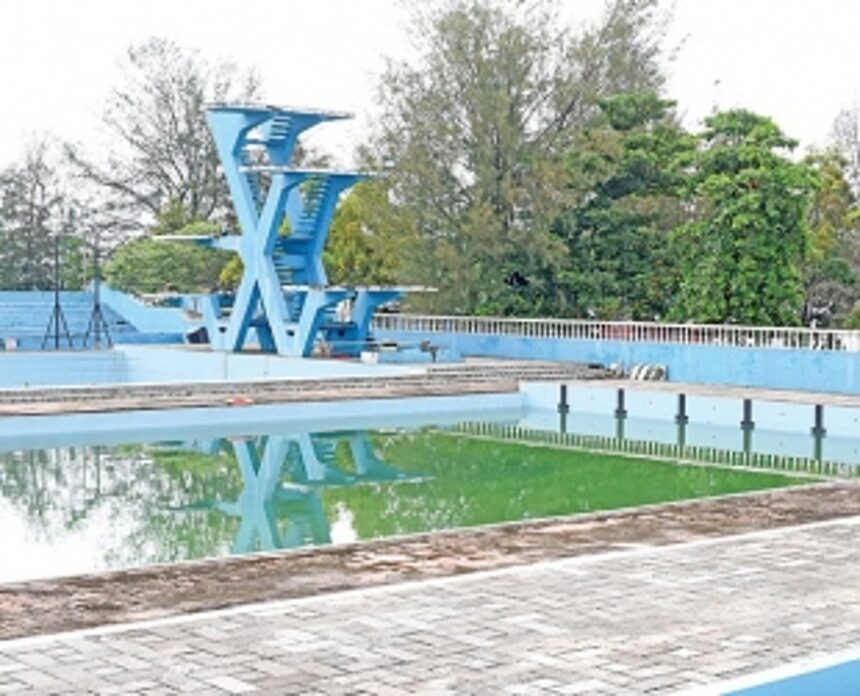
This has been the longest courtship ever, Goa and the National Games. The host city contract was signed between Goa and the Indian Olympic Association (IOA) in 2008. What then followed was something everyone now knows. Promises were made and not kept. Senior officials would fly to Delhi to make presentations, but when teams from Delhi would fly down to inspect the situation on the ground, the reality was strikingly different.
Fed up with this state of affairs, a decision was taken to shift the Games out of Goa and was awarded to Gujarat, and was subsequently held in 2022.

Now the 37th edition of the Games will be finally held in Goa. It will be inaugurated on October 25 by Prime Minister Narendra Modi and will culminate on November 9.
The performance of Goa at these games has not been praiseworthy. It must be noted that in Kerala, in 2015, Goa won 11 medals. Six of those medals were won in Taekwondo. In 2011 in Ranchi, Goa won 11 medals which included 5 gold medals and 5 silver. Goa finished a credible 16th. In Gujarat, however, the performance was pitiful, with the State winning 5 bronze medals and ending in the bottom three of the medals table.
Now with the games set to be held in Goa, will Goans be fortunate to witness a better performance from their athletes. To ensure this, the State government initiated a policy to encourage a competitive environment for local athletes.
For example, in badminton, the thrust of the government policy besides promoting a competitive environment to the locals was also to encourage the exchange of skills and experiences that could help to elevate the overall standard of badminton in the State. This would provide an excellent opportunity for local players to challenge themselves against competitors from different regions, further honing and tuning their skills.
The current policy was endorsed by the government and intended to strike a balance between nurturing local talents and attracting skilled players from other regions, ultimately benefiting the sport of badminton in Goa by aiming to bring State players on par with National and International standards, which is the primary objective of the Khelo India Centre of Excellence. It was also decided that outstation players would not be able to exceed 30% at the very limit.
This was certainly a turnaround when the Goa Olympic Association stopped the State associations from fielding outstation players for the 36th National Games in Gujarat. Eight top teams in each discipline were allowed to take part in the National Games. A few associations had qualified by virtue of impressive performances at the previous Nationals. Here, the Goa Olympic Association held the line and said imports would not be allowed.
The State Kabaddi team had history by entering the semi-finals of the Nationals, but it had five outstation players. They were not allowed to be part of the team and the team ended being in the crowd. It was overall a pathetic performance.
Now with the games being held in Goa, State teams are being allowed to bring in outstation players to boost the strength of their squads. This was a policy that was followed to ensure India (Goa) competed and, importantly, won medals at the Lusofonia Games held in Goa in 2014. Due to the presence of national players, India (Goa) won 92 medals and ended first in the medals tally.Now, with this National Games, many will hope the athletes of Goa win medals and improve on the appalling performance in Gujarat.
Secretary General of Goa Olympic Association, Gurudutta Bhakta said the government had mandated that a maximum of 30 percent athletes from outside the state would be allowed in the squad. He then went on to say that these selections were being allowed only for the National Games and they would not be in a position to ask for jobs as reward for winning a medal for the state.
Asked about Judo, Bhakta, who is also the President of the Judo Association, said a request could be made to the outstation athlete based at the Sports Authority of India (SAI)
centre.
“A circular had been sent to the coaches to make an assessment based on performances in the last nationals in Gujarat. It was decided that judokas from outside the State would be brought and fielded in the categories, where it was felt Goa did not stand to win a medal and would need outside help to be competitive,” Bhakta said.
Another administrator who was considering seeking help from outside was Danushka Da Gama, Executive Member of Goa Amateur Boxing Association (GABA).
She said, “We need to have a squad that can bring us medals. Our young boxers have improved dramatically in the third week of the non-residential camp being held in Peddem. We are assessing the boxers every Tuesday and Friday. We will need boxers in weight categories where we are weak. If we do badly, the association doesn’t want to be blamed. The coaches will have a major role. We are looking for a psychologist to help the boxers prepare for the games”.
Each and every sporting association in the State is governed by their rules. The game of cricket in Goa generated much excitement when Arjun Tendulkar, the son of the great cricketer Sachin Tendulkar, moved from Mumbai to Goa to represent the State in the Ranji Trophy and other tournaments.
In football in the State, players from the North East play in various teams in the leagues. The question that is being asked is whether all this is denying talented Goan players a spot on the team in various sports. According to the rules, if he or she has a job or is studying in the state or has parents working in the State, then they are allowed to take a transfer.
This is a very sensitive subject in Goa. A spot on a team that wins a national championship can mean financial rewards and, more importantly, a job in the government sector. That is something that is prized in Goa, which has the highest number of government employees relative to its population.
Athletes had interesting responses to this policy decision by the State government. A senior member of the volleyball community in the State who was advised to go off the record said this decision by the authorities was a way of looking for an easy solution. He said the association
had not done anything to promote the game.
He said the association had failed to hold the state championship for 10 to 12 years, held no category wise competition or encouraged promising players. He went on to say that no summer camps were held in any category and there were no facilities provided during the monsoons.
The players, he said, took all the effort to stay fit. Not enough coaches were provided by the Sports Authority of Goa (SAG) or the association. Most of the players in the team, he said, were self-made. The team, he said, won bronze in Gujarat and received Rs 1 lakh for it. Rs 50, 000 was still not paid. Incompetence, it seems, runs through and through.
Another athlete Abhijit Nimbalkar, who won a bronze medal in Trampoline, was very pragmatic when he said, “If we have to win medals, we have to get people from outside. If we have to win medals, we will need players who are better than us. We need athletes who will guarantee us medals. We need to excite the youth by winning medals. We should be up in the medals tally.”
Another young female athlete who participated in the National Games in Kerala and Gujarat but was not willing to come on record said the recent reports of parents expressing their opposition to people from outside taking spots in the Khelo India scheme and also in state squads was understandable.
She said parents were spending a lot of time and money on their children and then having this move initiated by the authorities would inflame tempers. She said it was understandable the authorities were interested in improving standards, but it could be done with greater understanding.
Mrs Coutancar, whose 14-year-old daughter plays badminton and is ranked no 2 in singles in her age group, said it was difficult to get a court because of the Khelo India competition.
She said, “We requested the government to help us, but no help was forthcoming. As a parent, I am involved in taking her around, we spend time and money on her training. None of that is of any importance to the authorities. There are many other parents who feel strongly about this.”
Another parent who has a son in a team sport said the move by the government to keep aside at a maximum 30% of the squad for outsiders was not a good move.
He said, “The authorities don’t do much to promote sports and then to cover their incompetency come up with this initiative. Goan players who have spent their time practicing and hoping for a spot in the team,
can now say good bye to higher honours and possibly a job in the
government.”
Perhaps the views of Shallum who played basketball for the State in the Gujarat nationals said one had to be pragmatic.
He said, “We had a player from Mumbai in our squad and he was good. But I would prefer Goans in the squad because their understanding is so much better. If we don’t have good players in a position, then we should perhaps explore the possibility of getting a player from outside. The rules are very clear; these players are only there for the tournament and nothing else.”
Perhaps it should be made clear to everyone that such a decision was taken only because the alternative was not good enough. Also, this is only relevant until the tournament concludes.
Everyone would have to learn to look and understand the larger picture that the standards had to improve because the world was changing very fast and everyone had to adapt. This is applicable to the father who questioned the decision by the government to bring in players from outside and the authorities who should have communicated these decisions better.