Six years after Goa’s railway double-tracking battle first exploded across the State, residents across several affected villages say hearings, complaints and public protests continue even as tracks steadily advance through disputed landscapes, heritage settlements and ecologically sensitive stretches of Goa. KARSTEN MIRANDA reports
On May 4, villagers from Velsao, Pale and Issorcim once again assembled outside the office of the Inspector of Survey and Land Records (ISLR) in Margao, hoping the long-running dispute over railway land acquisition and double-tracking works would finally move forward.

Instead, the hearing ended much like several before it — with another adjournment, another date and another wave of frustration among residents who have now spent years attending proceedings linked to the controversial railway expansion project.
The latest hearing was the 17th since January 2025. Yet villagers alleged that substantive arguments over ownership and land acquisition issues had still not commenced. Proceedings were reportedly deferred after notices to additional respondents had not been served, pushing the matter to June 3.
Outside the hearing room, however, the issue had long moved beyond paperwork and procedure.
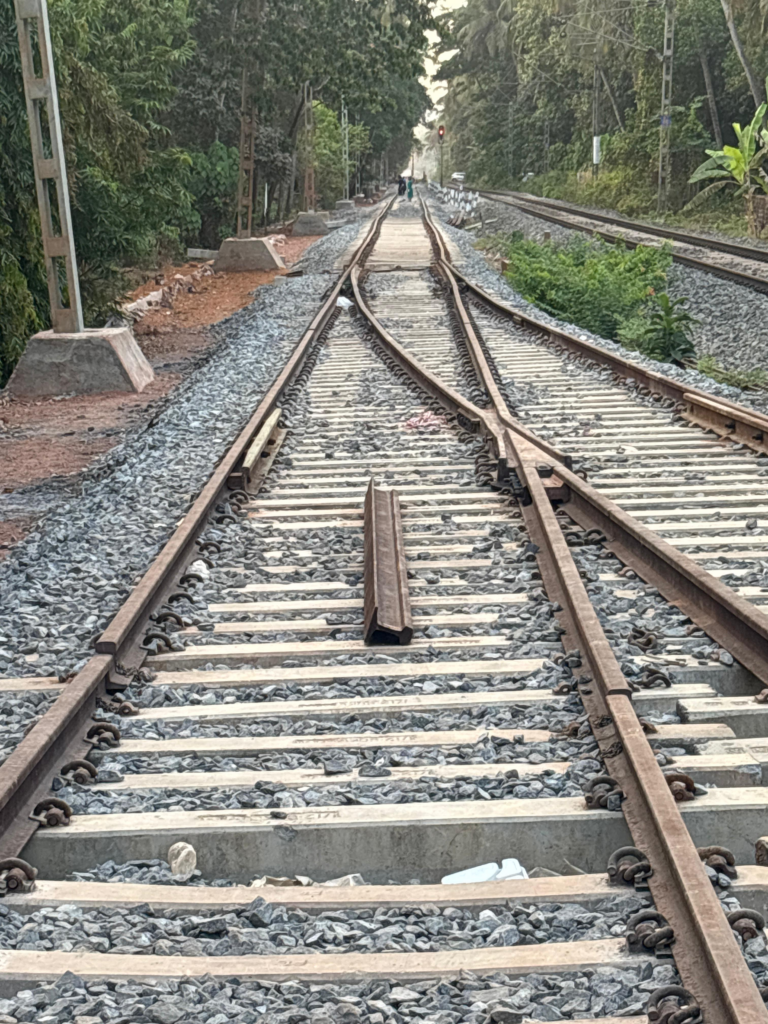
Residents questioned how hearings could continue month after month while physical railway work allegedly advanced through disputed areas. Activists accused authorities of repeatedly delaying proceedings even as tracks, embankments and related infrastructure steadily altered the landscape around affected villages.
Soon after the hearing, residents, activists and political representatives met South Goa District Collector Egna Cleetus, warning that public frustration was mounting as proceedings continued to drag on.
For many residents, the latest hearing represented more than just another administrative delay. It reflected the accumulated fatigue of a conflict that has stretched across multiple summers and evolved into one of Goa’s most layered and emotionally charged infrastructure battles.
The roots of the present controversy trace back to 2020, when large-scale public opposition erupted against railway double-tracking, highway expansion and transmission line projects passing through ecologically sensitive areas of Goa.
At the centre of the railway controversy was the proposal to double the South Western Railway line passing through protected forest areas between Castle Rock and Collem.
Environmental groups warned that the project threatened one of the Western Ghats’ most sensitive wildlife corridors and would permanently damage biodiversity-rich forest landscapes.
What began as an environmental movement, however, gradually evolved into a broader conflict involving coal transportation, village settlements, land acquisition disputes, heritage homes and the lived consequences of railway expansion in densely populated stretches outside forest areas.
The conflict later reached the Supreme Court, where wildlife clearances linked to the project faced major legal setbacks.
Yet while the project encountered legal and ecological hurdles inside protected forests, double-tracking work simultaneously progressed in several other parts of Goa.
In stretches between Collem and Vasco, tracks were laid, embankments widened and infrastructure steadily advanced over the past few years. Residents opposing the project increasingly found themselves confronting a difficult reality — while legal questions remained unresolved in some areas, physical work elsewhere continued moving ahead.
That contradiction has come to define much of the anger visible in Velsao and neighbouring villages today.
Velsao becomes a flashpoint
Over the past two years, Velsao, Pale and Issorcim gradually emerged as some of the most emotionally charged centres of resistance linked to the railway project.
Unlike Mollem, where the debate was centred heavily around forests and biodiversity, the conflict here increasingly revolved around homes, access routes, vibration concerns and disputed land parcels passing through inhabited settlements.
Residents repeatedly approached police, district authorities, land officials and elected representatives alleging that work linked to railway expansion was continuing despite unresolved ownership disputes and pending proceedings.
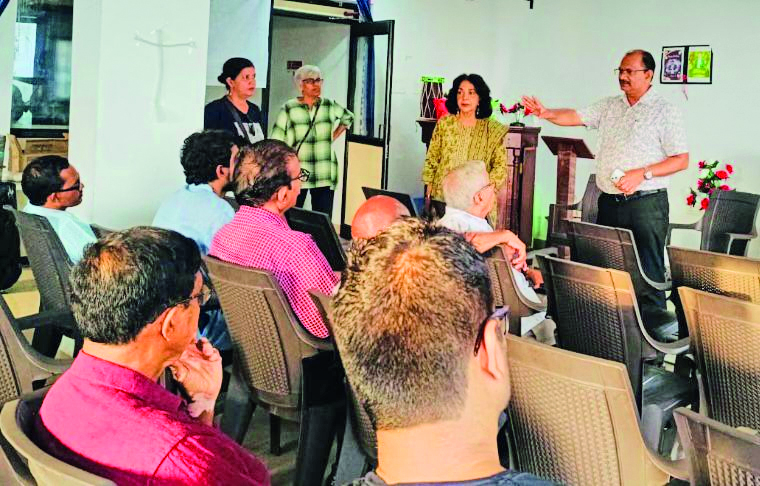
Public meetings were organised. Delegations met officials. Protest gatherings continued intermittently as the issue drew support from activists, residents and political representatives across party lines, including Goa Forward Party president Vijai Sardesai and Goa Congress president Amit Patkar.
The April 17 hearing marked one of the sharpest flashpoints in recent months.
Villagers and activists gathered, expecting movement in the dispute, but instead witnessed another adjournment without a final order. Tempers rose outside the administrative complex as residents accused authorities of allowing “delay tactics” while work allegedly continued on the ground.
A formal complaint was later submitted to Collector Egna Cleetus, with residents and activists demanding intervention into alleged illegal work on disputed land.
Over time, the language surrounding the agitation also began changing.
What initially started as objections over surveys and land records increasingly evolved into allegations involving “encroachment”, “occupation”, blocked access routes and denial of Right of Way.
That evolution reflected how deeply the railway conflict had entered everyday life for several affected families.
Homes, coal and cracks in the walls
The railway conflict in Goa has never remained confined to forest clearances and court hearings alone.
Across several stretches linked to freight movement and double-tracking works, residents have for years raised concerns over coal dust, vibrations, noise pollution and structural impacts on homes located close to railway corridors.
In Vasco and nearby areas, anti-coal protests repeatedly highlighted health concerns linked to coal transportation and dust pollution. Residents living near railway lines complained of black dust settling inside homes, increasing respiratory discomfort and affecting daily life.
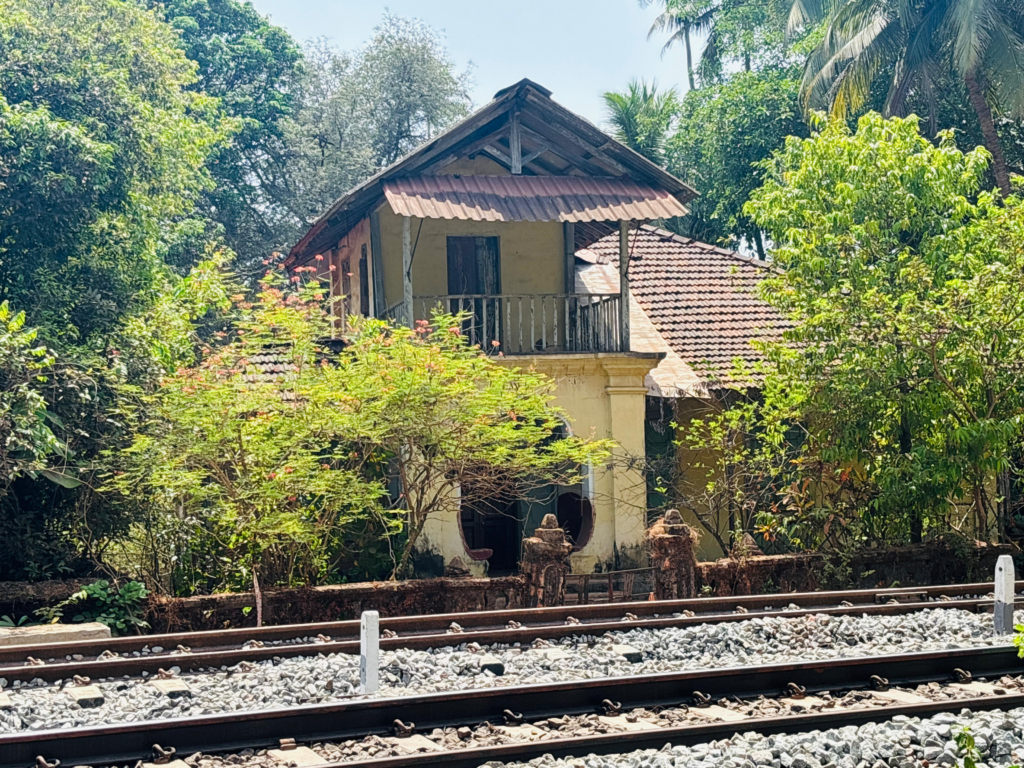
Elsewhere, families residing close to railway tracks alleged that vibrations from passing freight trains had affected compound walls and old structures, including Portuguese-era heritage homes.
Residents alleged that traditional access routes had narrowed or become obstructed due to railway-related work and dumped construction material. Some claimed pathways historically used by villagers had effectively disappeared under gravel, embankments and newly laid infrastructure.
One recurring concern raised by activists involved emergency access.
Campaigners alleged that ambulances, fire brigade vehicles and hearses could face difficulty reaching certain homes because the traditional Right of Way used by villagers had been disrupted.
The issue drew wider attention after activists pointed to a fire incident at the heritage home of Dr Sanjay Coelho in August 2025. According to campaigners, the same access route now allegedly obstructed by railway work had earlier been used by fire brigade personnel responding to the emergency.
For some residents, the emotional toll has become as significant as the legal dispute.
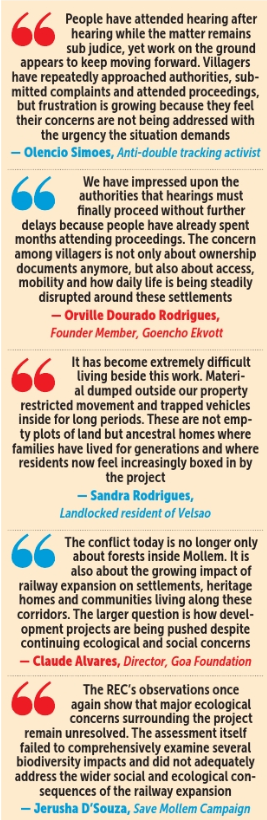
Sandra Rodrigues, one of the affected residents, had previously described conditions around her ancestral property as a “living hell”, alleging that rubble and construction material dumped outside the house severely restricted movement and effectively trapped vehicles inside the compound for months.
Many residents fear that by the time proceedings conclude, irreversible physical changes may already have transformed the villages around them.
The Mollem battle returns
Even as tensions escalated in Velsao and neighbouring villages this year, the larger environmental and legal battle surrounding Goa’s railway double-tracking project also returned sharply to the forefront.
For many activists associated with the original Mollem movement, the developments unfolding in Velsao are no longer viewed as a separate localised dispute. Instead, they are increasingly seen as an extension of the same larger conflict that first exploded across Goa during the pandemic year of 2020.
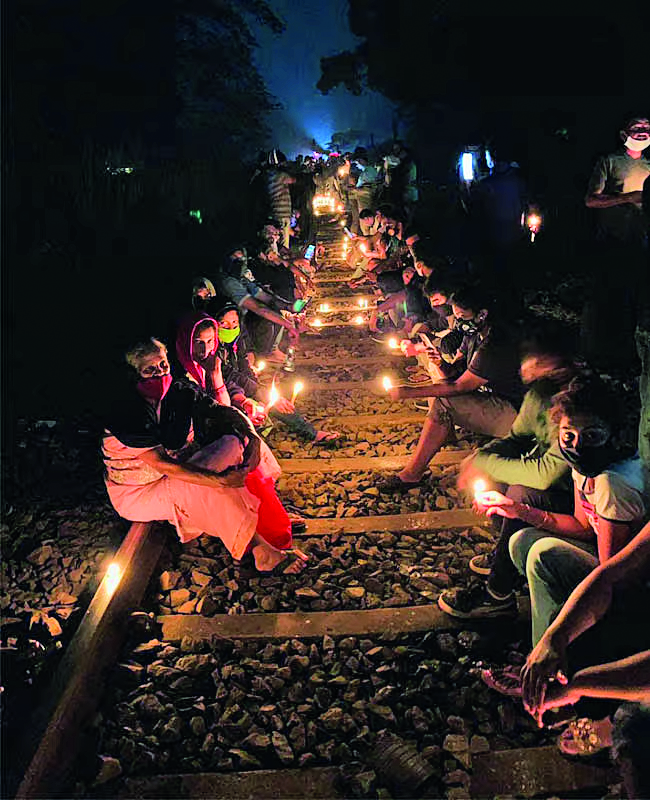
Despite pandemic restrictions at the time, protests spread rapidly both online and offline. Citizens’ groups, environmentalists, students, village communities and professionals joined demonstrations, signature campaigns and public outreach efforts opposing the project and questioning its ecological impact.
In May 2022, the Supreme Court accepted recommendations of the Central Empowered Committee (CEC) and struck down the wildlife clearance granted for the Castle Rock-Collem section of the railway doubling project. Following the judgment, the Ministry of Environment, Forest and Climate Change kept forest clearances linked to protected stretches of the project in abeyance.
Yet the conflict did not end there.
According to activists and environmental groups, the Goa government made repeated attempts over the following years to revive or restore suspended clearances connected to the project on behalf of South Western Railway (SWR) and Railway Vikas Nigam Limited (RVNL).
That effort suffered another setback in March this year when the Regional Empowered Committee (REC) once again rejected attempts to restore forest clearances linked to stretches passing through Bhagwan Mahaveer Wildlife Sanctuary and adjoining eco-sensitive zones.
Importantly, the REC reiterated that the railway project could not be artificially broken into separate stretches merely for obtaining approvals and observed that the spirit of the Supreme Court’s earlier intervention extended beyond only one isolated section.
The committee also noted that Goa’s own forest department had informed it there was little ecological difference between the Castle Rock-Collem stretch and adjoining Collem-Kalay sections falling within the protected landscape.
Environmental groups sharply criticised the Wildlife Institute of India assessment commissioned for the project, arguing that it focused excessively on mitigation measures rather than carrying out a deeper examination of ecological impacts within protected forest areas.
Activists alleged that the assessment inadequately examined freshwater biodiversity, habitat connectivity and the ecological role of the region as part of a tiger and elephant corridor.
Questions were also raised regarding the absence of social impact assessment despite sustained public opposition and years of conflict surrounding the project.
For environmental groups, the repeated refusal to restore forest clearances has become significant not merely as an administrative obstacle but as evidence that core institutional concerns surrounding the project remain unresolved.
At the same time, activists argue that the issues visible in Velsao, Pale and Issorcim represent the human and settlement-level consequences of the same larger infrastructure expansion debate.
What began in 2020 primarily as an environmental resistance movement centred on forests and biodiversity has gradually expanded into a broader conflict involving coal transportation, village settlements, land rights, access routes and heritage homes and competing visions of development in Goa.
Between expansion and exhaustion
Supporters of the project continue to maintain that railway doubling remains essential infrastructure needed for freight movement and future transportation requirements.
Railway infrastructure has steadily advanced across several parts of the State over the past few years despite sustained protests and legal battles. Yet in villages where disputes remain unresolved, that same progress has deepened public frustration.
Residents argue that while they continue filing complaints, attending hearings, meeting authorities and waiting for proceedings to move forward, the project itself increasingly appears irreversible on the ground.
That feeling — more than any single hearing or protest — now lies at the heart of Goa’s railway conflict.
As another monsoon approaches, hearings continue, tracks continue to expand and residents continue returning to government offices carrying the same unresolved questions they first raised years ago.