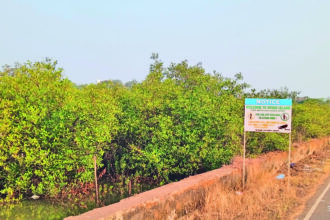
Mangroves are ubiquitous trees found along the river systems of tropical India. The crucial role played by mangroves along tropical coastlines is well established: they are highly productive ecosystems, support a diverse heterotrophic food chain, act as spawning and breeding grounds and hence nurseries for marine biota, offer protection from erosion, tides and storm waves, help in natural building of land and stability of shorelines. The role of mangroves as inherent protectors of the coast was remarkable in Tamil Nadu after the tsunami of 2004. Therefore, mangroves should continue to form an integral part of coastal ecosystems.
Of all coastal ecosystems, mangroves have received maximum attention from a research perspective. Our field observations reveal an excessive spreading of mangroves over the years. In an exhaustive review of coastal zones of India, the Space Applications Centre, Ahmedabad, concludes that in Goa, mangroves with Avecinia as a dominant species, showed a cover of 6.7 sq. km in 1990-1993 that increased to 34.63 sq. km in 2005-2007; this time-series exercise indicates an overall growth of 515 per cent in 15-17 years. A phenomenal increase of mangroves in Goa is confirmed. Therefore, the conservation of mangroves does not seem to be critical at this moment; in comparison, the management of these rapidly expanding forests is in complete disarray and needs urgent attention.
Can degraded mangrove forests be restored? It is probably the only natural system that can be easily rejuvenated. Globally, Bangladesh can be cited as an example where large low-lying areas are now occupied by mangrove plantations. In India, there are reports of site specific mangrove plantation programs. The Coastal Regulation Zone (CRZ) laws guarantee protection of mangrove forests as CRZ I where human interference is forbidden. Nonetheless, mangroves are routinely destroyed and reclamation of marshy lowlands is common. Unfortunately, CRZ law neither proposes strategies for restoration of woodlands nor does it guarantee the conservation of coastal vegetation. India does not have a mangrove preservation strategy, except for some isolated cases. Hence, there is an imperative need for a comprehensive policy for the conservation and management of mangrove forests.
For a meaningful management policy, the distribution, richness, diversity, and evolution of mangroves in space and time merits plenty of discussion:
(1) Mangroves are flourishing in wrong sites: At places such as Candolim, upstream of Nerul bridge, mangroves have invaded ‘khazans’; a dense mangrove forest now occupies an erstwhile paddy field; such cases are found at Patto – Ribandar where former salt pans are now supporting mangrove colonies; from Rachol to Macazana, and from Carambolim to Agassaim, the largest ‘khazans’ of Goa are gradually being taken over by mangroves.
(2) Fringing trees are fast disappearing from river banks: The Chapora estuary is one example where fringing mangroves have disappeared in totality; whereas Panjim river bank has no mangroves left, only a few patches are visible on Betim side; similar examples abound wherever human interference along river banks is identified.
(3) Unwarranted concrete retaining walls: Scientific literature has proved beyond doubt that sea walls exacerbate erosive processes, beaches in front get narrower, sand vanishes over time, and the area gets deeper; retaining walls thus lead to a complete modification of coastal landforms and associated vegetation; mangroves simply disappear. Essentially an interface between land and water, a riparian buffer zone plays a significant role in soil conservation and hence environmental management; unjustified landscape alterations adversely impact micro habitat of many faunal assemblages, create permanent loss of natural shoreline diversity, loss of floral assortment during excavation, and impact on shoreline fisheries; wild otters which are common in Goa’s marshes get trapped inland, unable to access river water; as such, concretization of marshes cause negative impacts, severely aggravate erosion, lead to complete destruction of fringing mangrove vegetation and take a heavy toll on riparian biodiversity.
(4) Afforestation to be adopted only along river banks: The Forest Department of Goa had published an action plan for mangroves in 1992; accordingly, plantation programs were undertaken (often in inappropriate sites). However, the concept of planting mangroves only because a mud flat is available is wrong. Mangroves are needed wherever they are missing or removed due to human actions, but precisely along river banks and along the periphery of ‘khazans’.
(5) Antecedent mangrove swamps as bio-reserves: The riverine systems of Goa are blessed with natural saline marshes within lagoons and backwaters. The mangrove lagoon at Paliem, Patto – Ribandar – Merces mangrove complex, Cortalim- Quelossim backwater system, Agassaim – Durbat mangrove ecosystem, Rachol – Macazana ‘khazan’, all contain dense, luxuriant natural mangroves. Such areas easily qualify as natural heritage sites, and need to be designated as such. At present, Chorao is the only preferred mangrove reserve in Goa.
(6) Man – mangrove conflicts: The spread of mangroves is so intense that a large strip of Patto – Ribandar causeway engulfed by mangroves, as roots have penetrated the foundations; these trees have sprouted over the last two decades or so. At many other places, mangroves are bending over roads. A strategy is neededso that the heritage structure maintains its identity by adopting an adequate setback.
(7) Research and monitoring: Published scientific literature has enlightened the present status of mangroves; a simple exercise will then show where these forests have exceeded boundaries and where they are missing or uprooted; routine monitoring can effectively contribute towards their conservation and management.
(8) Awareness programs: The Salim Ali sanctuary at Chorao conducts regular nature walks where the functions of coastal vegetation can be experienced. Dr AG Untawale, a former scientist of NIO is actively involved in these programs. Such public-oriented initiatives on mangroves are commendable and already on a sound footing.
In summary, mangroves in Goa can be termed as “bona-fide offenders”; they function as opportunistic colonizers of soft soils. These trees are thriving where they should not grow (paddy fields), but are vanishing from their rightful places where they belong (river banks). Their evolution needs to be curtailed at certain places (paddy fields and khazans), but promoted at appropriate places as fringing mangroves (river banks). Concrete walls through swampy saline woodlands have to be banned forthwith. Precursor mangroves marshes need to be designated as heritage sites or bio-reserves. Hence the imperative need for a science-based mangrove conservation policy for Goa.
(Dr Antonio Mascarenhas is a former Scientist, NIO, Goa)