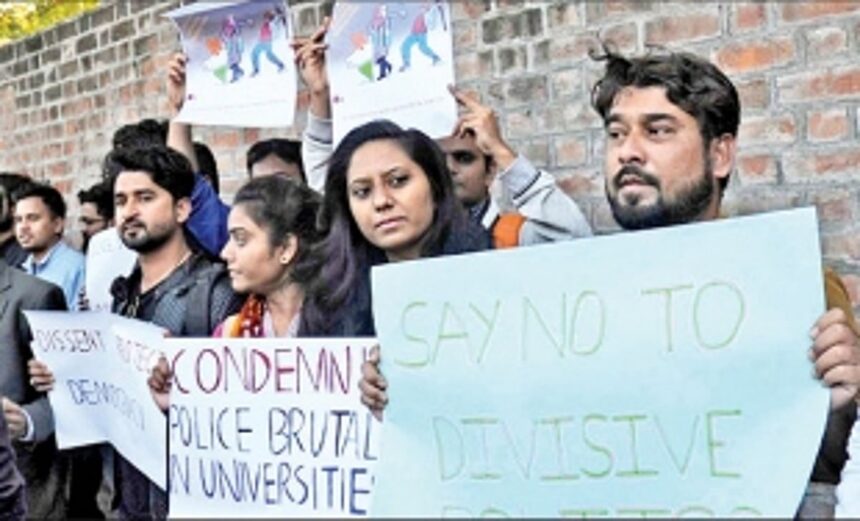
Probably the government felt that the massive mandate at the 2019 general elections is a carte blanche for the government to have its way. It may not have been anticipated that the amended citizenship law, which brings a religious virus into a legal system would overwhelm the country. The new India is under siege.
Traditionally IITs, IMMs, law schools and scientists have always remained neutral in any political or democratic struggles. Their entry into the movement to oppose Citizenship Amendment Act (CAA) and in a way to stand for the diversity of the country – basically Hindu Muslim unity is a silver lining in the defense of the constitution and the values upon which the idea of India is based. The resistance movement is to bring in some sanity in the country’s democratic process.
Though the ruling party blames the principal opposition for leading the campaign, the Congress is just a cheer-leader of this movement, which is massive in scale and spontaneous in character, overwhelming the country’s urban centers, turning them into war zones. In fact, the street took over as the opposition stood crushed. This resistance was required to protect the institutions that went into making our democracy. The removal of Article 370 from the constitution and scaling down the state of Jammu and Kashmir into two Union Territories and keeping them under siege with the entire political establishment behind bars was almost taken lying down by the country. By that standard, this civil disobedience movement is by far the biggest in recent times and it has certainly brought that ray of hope in civil society. St. Stephen Delhi was shut for the first time in 30 years.
The movement has forced the fence sitters, who supported the government in Parliament to have second thoughts and the number of States that have rejected the National Register of Citizens (NRC) is only increasing. This should also be seen as an assertion of federal principles and if this movement spreads it could certainly give a centrifugal dimension to the centralizing forces of the ruling party.
The recent steps by the central government had pushed the country’s largest minority to believe that they are at the grace of the majority. The CAA, it appears has provided a new force to them to come out to reclaim their nationhood. The ‘go to Pakistan’ seem not to bother them anymore. They are also at the vanguard position of this resistance movement.
Whichever way one looks at it, there is a rising tide of discontent amongst the young on the ruling party’s divisive prescription to polarize India as part of their larger game plan. The outrage is certainly over the controversial law but it is clearly a reaction against an uncertain future of the economy that is coming down like a water fall.
It could certainly be said that the current upsurge is the biggest in the last quarter of a century. Students have always been at the forefront of resistance movements in the country. Struggles attract them as Suhas Palshikar puts it, “they have very little stake in the present but they have a stake in the future”. Students have opposed to discrimination since a century. In 1920, in King Edward Medical College Lahore was the first students fight in undivided India. The anti-Hindi movement of the sixties in the last century had self immolations by several students and ended with the then Prime Minister Lal Bahadur Shastri assuring that Jawaharlal Nehru’s promise of English to continue to be the official language would be honoured. A 20% fee hike in the hospital food in the engineering college in Ahmadabad in 1973 and another student strike in 1974 in Gujarat gave the country, what is now known as the Nav Nirman Movement which ended with Indira Gandhi seeking the resignation of Chimanbai Patel as Chief Minister of Gujarat. The JP led movement of 1974 with Mulayam Singh Yadav, Nitish Kumar and Lalu Prasad Yadav brought about the upsurge of the backward classes in north India. The students’ role during the 1975 emergency has been stellar. Arun Jaitley was a shining star of that time. The Assam agitation against illegal immigrants ended only after signing the Assam accord and the student leader PK Mohanta becoming the Chief Minister at the age of 35.
With little opposition to the ruling party, the country’s young have taken control of their destiny. In it lies the hope for democracy and the diversity of our country-the founding fathers gave us. They have started reading the preamble of the constitution all over again. Reading of the preamble is become the new prayer at all rallies. It certainly evokes a sense of belonging and gives a firm reply to those who attempted to drive a wedge.
Satya Nadella of Microsoft and Deepika Pandukone have provided a new dimension to the resistance movement. Particularly Deepika’s stand is worth saluting taking into consideration the cost at which she decided to take a stand. It is personalities like this that can salvage the republic and the country’s inclusiveness.
Could it be said that the ruling party has alienated the young? Has the regime recognized the discontent amongst the students and the youth over the party’s polarizing policies and dealing with that discontent with iron hand? It may be too early to view the resurgence as shape of things to come. As the movement spreads, the ruling party would harden its attitude with a view to further polarize the polity as part of larger Hindutva agenda. The government has certainly taken a belligerent stand and the government which often speaks of the young India, instead of negotiating with them; it has gone ahead and notified CAA. Looks like the fight is far from over! The brutality unleashed at the Aligarh Muslim University and the Jawaharlal Nehru University is nothing but an attempt to browbeat them into submission. The Prime Minister’s recognition from the clothes of the protestors clearly shows his communal mind. It is clear indication to what extent the government shall go to crush a movement.
History has also shown that many student protests fizzle out for lack of wider societal and political support. In recent times the Hong Kong protests, which started over extradition laws is now going into challenging the foundations of their political system. Who knew that the spark lit by Jayprakash Narayan in 1974 would actual result in ouster of a government within 3 years?
(The writer is practicing advocate, senior faculty in law and political analyst)