Team Herald
PANJIM: The High Court of Bombay at Goa has come down heavily on the local authorities, particularly the Goa Police and Transport Department for failing to curb illegal sand mining and its transportation.

The Division Bench comprising Justice M S Sonak and Justice M S Jawalkar took a pot shot at the authorities claiming they are ‘too eager to be hoodwinked’ while directing the State to install CCTV cameras below Amona bridge and at Oxel-Siolim where the activity is rampant.
“The police authorities, in particular, are most lax when it comes to preventing illegal and unauthorised sand mining,” states an excerpt of the 10-page order.
The Director-General of Police (DGP) has been directed to issue strict instructions to the concerned police stations to render all possible cooperation to the authorities in taking steps to prevent illegal sand mining. The DGP has also been asked to ensure all the concerned police stations attend to the complaints about illegal sand mining, promptly. “There are instances where the police authorities simply refuse to come to the sites. The DGP is expected to take action against the police officials who indulge in this type of dereliction of duties,” the court said.
The court also observed that persons involved in illegal sand mining are out to hoodwink the authorities. “Unfortunately, we find that in many cases even the authorities appear to be too eager to be hoodwinked. Therefore, if no steps are taken against the unregistered canoes parked on the river banks, such canoes are invariably used for illegal sand mining no sooner there is no surveillance from the authorities. The implementation of the ban is, then, rendered most difficult,” it said, as the order was pronounced on September 27 in a petition filed by The Goa Rivers and Protectors Network led by Claude Alvares.
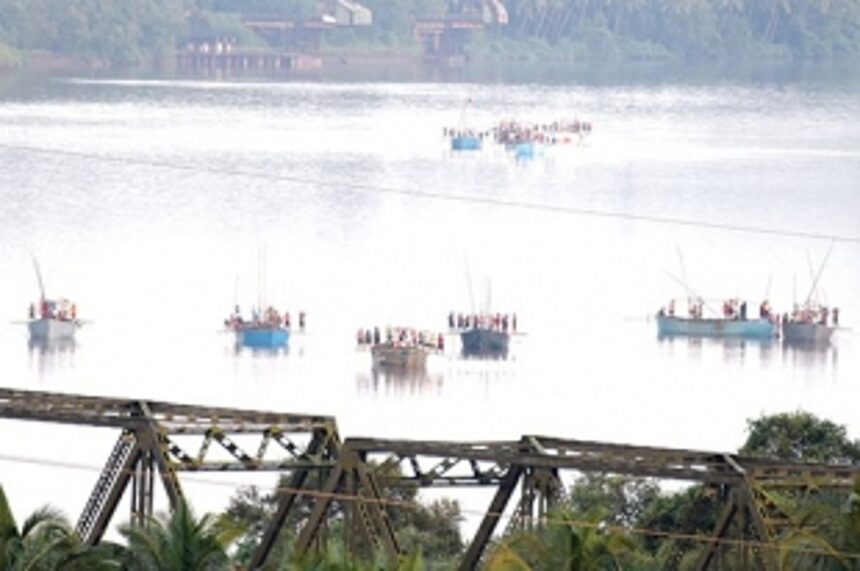
The Division Bench further directed that at least for the present canoes found parked below Amona bridge and at Oxel-Siolim must be immediately seized and kept at a secured location, away from the river banks. “These canoes have no good reason to remain parked on government property. The government also has no good reason to permit such canoes to be parked on its property, particularly when these properties appear to be hot-spots for illegal sand mining,” it observed.
The responsibility to comply with these directions has been allotted to the Captain of Ports and has been asked to file a compliance report within seven days along with photographs and details.
Advocate General Devidas Pangam, during the hearing told the court that the confiscated suction pumps will not be auctioned or disposed of, but will be retained by the government for use by the government departments like sanitation, sewage treatments, etc.
“We find that the illegally extracted sand is transported quite freely. In our earlier orders, we had referred to routes where such transportation takes place. Unfortunately, the RTO authorities are extremely lax when it comes to action against such trucks,” the order further said.
The AG then pointed out that the seized trucks are released in terms of the orders made by various courts having criminal jurisdiction. He submitted that many trucks bring in sand from the neighboring State of Maharashtra, which may have been legally extracted.
The court said that RTO authorities should stop every truck that are transporting sand because, presently, there are no permits issued for the extraction of sand to any party within the State of Goa. “Prima facie, therefore, transportation of sand will amount to transportation of illegally extracted sand. The RTO authorities, after stopping the trucks, should then find out whether the trucks have necessary permits or authorisation and the sand they are transporting was indeed extracted in the State of Maharashtra through legal means. If the trucks are unable to produce any such documents, then, the RTO authorities should proceed on the basis that this is the transportation of illegally extracted sand. The Director of Transport will be personally responsible for the implementation of this direction,” the order said, adding, “Even, if the courts having criminal jurisdiction release trucks, the RTO authorities should consider whether the permits for transportation granted to such trucks need to be suspended or revoked.” Advocate Norma Alvares, appearing for the petitioner told the Court that several complaints are made to the authorities about transportation of illegally extracted sand. She, however, pointed out that such complaints are rarely attended to. Accordingly, the court directed that the nodal officers, North Goa and South Goa upon receipt of such complaints, even telephonic complaints or complaints by WhatsApp, must pass on this information to the Director of Transport. The Director of Transport should then verify whether the trucks, in question, have necessary authorisation/ permits and if not, appropriate action must be taken against such trucks/transporters. The Director of Transport shall be responsible for compliance and should file a compliance report.
The court has sought compliance reports November 22, 2021 and adjourned the matter for further consideration on December 6, 2021.