vents in Goa in the past few years, and especially in the past six months, more of the political kind, make us realise just how relevant Francisco Luis Gomes is today, a full hundred and fifty years after his death.
It happened in July last, when 10 Congress MLAs broke away from the party and merged their faction with the Bharatiya Janata Party (BJP) claiming that they did it for development of their constituencies. Prior to that in March this year, two Maharashtrawadi Gomantak Party (MGP) MLAs quit and merged their faction with the BJP. It is indeed a matter of concern when elected representatives find that they are incapable of serving the people when they are seated on the opposition benches. In the case of the MGP faction that merged, they were actually already occupying the treasury seats, but still felt the need to switch their allegiance. There have been other defections since the 2017 elections, and these all indicate just how dependent the politician is on having a seat in power. Against this backdrop, it is relevant to see how Gomes conducted himself when he was elected to represent Goa in the Portuguese Cortes.
At 31, Gomes went to Portugal as a Parliamentarian from Goa, and there he preferred to sit on the opposition benches, despite being offered a ministerial berth. Thrice he was invited to join the government and thrice he turned down the offers, believing that joining the government would inhibit him ‘politically, ideologically and culturally’. Seated on the opposition benches in the Portuguese Parliament, Gomes introduced various bills and managed to get them passed, thereby doing away with the marriage tax, funeral tax, the 1/10 house tax, and monopolistic estates in Goa.
He, of course, can be a role model to today’s crop of politicians, many of whom see nothing wrong in changing their political affiliation and also their ideology.
His thinking, so different from that of today’s politicians who view a ministerial berth as the only means of development, should be a lesson to be learnt by those who yearn to occupy the treasury benches, the moment they are voted to political office. How contrary to the manner in which the group of 10 Congress MLAs shifted allegiance in July in return for various positions – ministerial berths, corporation chairmanships and planning authority heads.
But his example does not end there. Just three days after making his debut in the House, Gomes was asked to reply to a motion depriving the Portuguese colonies of representation in the Portuguese Parliament. So the young man Gomes, in new surroundings and in a new land, stood in the Portuguese Parliament and brilliantly demolished the arguments for the motion. Can we imagine a debutant MLA in the House being called to reply to a government motion and making an impassioned speech that would make the government recoil?
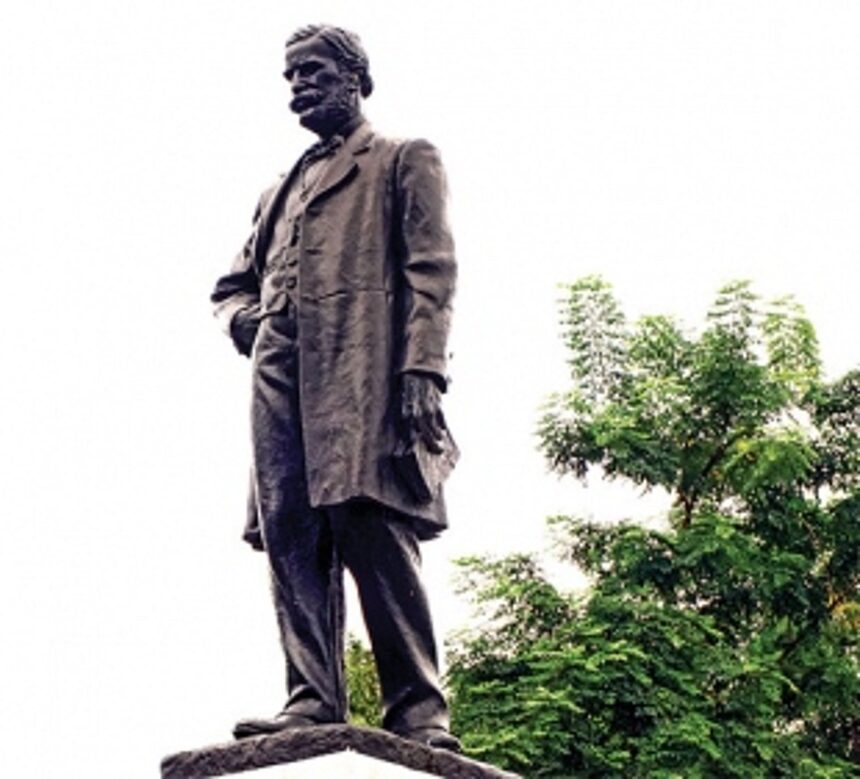
But, Gomes was no ordinary man. He was a visionary far ahead of his times, who expounded the concept of freedom long before the Indian National Congress could even be formed. His letter to Lamartine, is perhaps his best remembered piece of writing, especially the part where he says, “I was born in the East, once the cradle of poetry, philosophy and history and now their tomb. I belong to that race which composed the Mahabharata and invented chess. But this nation which made codes of its poems and formulated politics in a game is no longer alive! It survives imprisoned in its own country. I ask for India liberty and light; as for myself, more happy than my countrymen, I am free.” It is this quote that appears on the pedestal on which stands his statue in the garden in Panjim. But, we shall not dwell on that, as this is a passage that has been analysed and quoted by whoever writes or speaks of Gomes, and so well documented.
In the annals of Goan history, Gomes has a special place, and is reverently known as the ‘Prince of Intellectuals’, but unfortunately he is little remembered in the State today. September 30, 2019 marks his 150 death anniversary, and like so many other of his anniversaries, this one too is passing by without any commemoration from the State, his memory evaporating even as his house in Navelim remains crumbling, with promises of it being saved for posterity. There is no announcement of any event to commemorate his death anniversary, though citizens and opposition political parties have demanded that it be. It is as if the man who showed the world the intellectual side of Goa has been consigned to the dusty shelves of history, and is becoming a means for those on the other side of the dispensation to lash out at the government.
It is unfortunate that the memory of this giant, who has been variously described as a politician, historian, economist, doctor, writer, and whose fame transcended the borders of Goa and even India is fading. He was born in 1829 and died in 1869, but his achievements in the short four decades of his life have led to many referring to him as the ‘greatest Goan of all time’. The man who represented Goa in the Portuguese parliament, the man who was the toast of Europe in the mid 19th century and was even feted by French emperor Napoleon III, is just a fading memory in his home State, just 150 years after his death.
Gomes belongs not just to Goa, but to India. Can his novel, his only one and the first modern Indian novel, Os Brahmanes (The Brahmins), published in 1866 be forgotten? The novel is set, not in Goa, but in Lucknow and has the Indian Mutiny as the backdrop. It drew much praise when it was published, and is still regarded by many as a fine example of prose and fiction and for its timeless relevance.
Long before Aamir Khan could portray Mangal Pandey and bring the revolt of 1857 to the screen, Gomes had touched upon this historical event in the novel. It was undoubtedly the first novel by a Goan, among the first by an Indian. Os Brahamanes is a historical novel set in Faizabad, that is in today’s Uttar Pradesh, and weaves a story around the Anglo-Indian community there and the native Indian population. In the novel Gomes focuses on the caste system, especially untouchability, and joins the cause for justice to those who are discriminated upon.
Not a plot that should surprise anyone who is familiar with the writings of Gomes, and whose ideas were much ahead of his time. Long before socialism could make a mark in the world, he had been propounding the transfer of power from the classes to the masses, just as he demanded freedom for India, years before the Indian National Congress could be formed and take up the cause. Over the decades there has been much praise for the novel.
He could perhaps have achieved much more, but, Gomes didn’t live too long. He was returning to India from Europe, but never made it back to this homeland. He died during the long sea voyage to India, aged just 40. His body, as was the practice at sea, was weighed down and dropped somewhere in the Mediterranean Sea. The man who made, and still makes, Goa proud never got to see his homeland and in Goa there is no grave and no monument to him.
Today, 150 years after his death, Gomes’ writings and ideas remain as relevant as they did in his lifetime, a far different era from the present times. He lived for Goa, espousing the cause of freedom, and fighting for the liberties that he could extract from the colonial government. He succeeded at the latter, and freedom came much too long after his death. It is not fair that he should be so ignored by those who share with him the land of his birth. It reflects poorly on the people when an intellectual giant is forgotten.