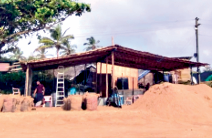
The early erection of beach shacks along Goa’s coastline — permitted unusually in September this year — has triggered serious environ mental concerns. Fishers and environmentalists are sound ing the alarm over illegal sand excavation and dune distur bance, warning of accelerating coastal erosion that threatens both homes and ecosystems. Traditionally, shack construc tion begins in October with most preparatory work starting in the first week.
However, this year, the Department of Tourism allowed shack owners to start building in September. Fishers claim that this early activity, especially during a period when the sea is still rough, has led to the illegal removal of sand from the intertidal zone, which is then dumped on the landward side to create elevated platforms for the shacks. “Fishers have their houses on beaches. Sand excavation on beaches has triggered massive sand erosion. Bore wells are being dug to extract water for kitchens in shacks. It’s a massive disaster unfolding,” warned Dr Sebastiao Rodri gues, an academic with a doctorate on intra-inter conflicts and sustainability issues in Goa’s fisheries sector. With high water levels still prevalent in September, shack operators have been seen manually digging and carrying sand in bags to elevate shack platforms — a method now being used in place of machinery, which had previously drawn complaints from locals. “Before, they used to bring machines into the beach late at night and carry on this work. But since we started com plaining to the authorities, they have now resorted to doing this work manually. But it is still illegal because it is against CRZ laws,” said Joao Fernandes, President of Kandollchea Kharveamcho Ekvott (KKE). In a letter to the Collector and District Magistrate of North Goa, KKE expressed deep concern: “We draw your attention to the main Candolim beach un folding disaster due to rapid erosion of coastal shore sand. For the past six years, beach distance has reduced by nearly 25 metres in monsoons. Anytime, Arabian Sea water is like ly to enter Candolim village, threatening a major disaster.” This concern is echoed further south, though not with the same intensity. “I do not understand the need to allow them to build the shacks so early when the water is still rising and it is difficult to walk safely on the beach, forget sitting on a shack to enjoy a snack,” said ArcanjoFernandes, a fisher from South Goa. Dr Rodrigues, who also serves as General Secretary of the National Federation of Small-Scale Fishworkers (NFSF), criticised the policy shift: “By allowing shack own ers to start construction work in September, two months prior to the traditional timing of November, the greed of the people connected with shacks — including those who illegally sub-let their shacks — is clearly evident.” He added, “Fishers suffer greatly as tourism no longer respects local people as hosts. Instead, tourism has tak en Goa’s fishers and ecology as hostages. Even turtles no longer find their nesting spaces intact on the beach due to this destructive, greed-driven human behaviour.” An on-ground assessment by O Heraldo from North to South Goa revealed multiple instances of sand being exca vated near shack sites. In some areas, sand dunes them selves appeared to have been tampered with to make way for structures. “Sand packing for temporary or more permanent shacks may not significantly affect the sand, but it can accelerate coastal erosion. If sand dunes are being packed, this will affect sea turtle nesting, increasing the vulnerability of coasts to tidal erosion. Further, CRZ notification does not permit this activity. Hence, it is illegal as well,” explained Dr Roshni Kutty, South Asia Coordinator of the ICCA (Indige nous and Community Conserved Areas) Consortium. When shown photographic evidence of sand excavation, Director of Tourism Kedar Naik said, “Of course, sand cannot be extracted from the beach and carried off anywhere. It is illegal and till now, nothing has been brought to my notice.” From the Department of Tourism’s Revenue section, Su datt Kambli downplayed the situation: “Some shack owners are taking a little sand to help build their shacks, but the problem is not as bad as it is made to be.” Nevertheless, Director Naik issued a stern directive: “Li cences will be cancelled if any sand is found to be excavated or sand dune is disturbed.” As the 2025-2026 tourist season is yet to begin and vis ible signs of damage are already apparent, fishers like Ra fael Lobo are hoping for swift action.“Greed will not blind officials to the wrong being done to the environment,” he said.