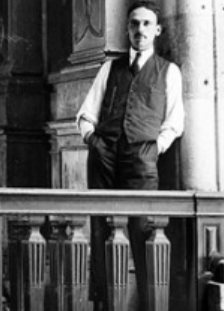
Baltazar da Silva Castro’s heritage restoration campaign in 1950s Goa marked a pivotal moment in colonial conservation, transforming the appearance of key monuments, particularly those in Old Goa, and igniting a long-standing debate over authenticity versus ideology in heritage preservation. Guided by the Portuguese regime’s ambition to highlight the antiquity and distinctiveness of its colonial legacy, Castro’s interventions led to the deplastering of several historic structures, including the Chapel of Saint Catherine, with consequences that remain evident to this day.
The initiative took shape as Goa prepared to commemorate the 400th death anniversary of Saint Francis Xavier, a significant Catholic event leveraged by the Portuguese administration as an instrument of colonial propaganda. Castro, an experienced Portuguese architect-restorer, was tasked with restoring and, in many ways, reimagining the monuments. His mission was clear: to make Old Goa’s architecture appear more ancient and “authentic,” thereby reinforcing the image of Portuguese cultural supremacy distinct from Indian influences at a time when Goa’s political future as part of India appeared imminent.

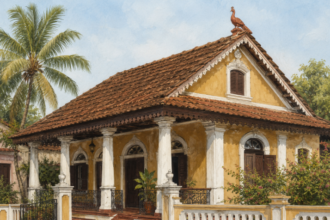
One of the most striking transformations occurred at the Basilica of Bom Jesus, where Castro ordered the removal of the white lime plaster to expose the raw laterite stone beneath. This decision, justified as a return to the building’s “original” form, proved disastrous. The plaster, which had served as a crucial protective layer against Goa’s humid climate, was essential to the structure’s longevity. Its removal not only accelerated the weathering process but also permanently altered the Basilica’s iconic appearance. Due to the porous nature of laterite rock, rain water began seeping in through its walls. Conservation experts now regard this act as a misguided intervention that placed colonial symbolism above architectural preservation.
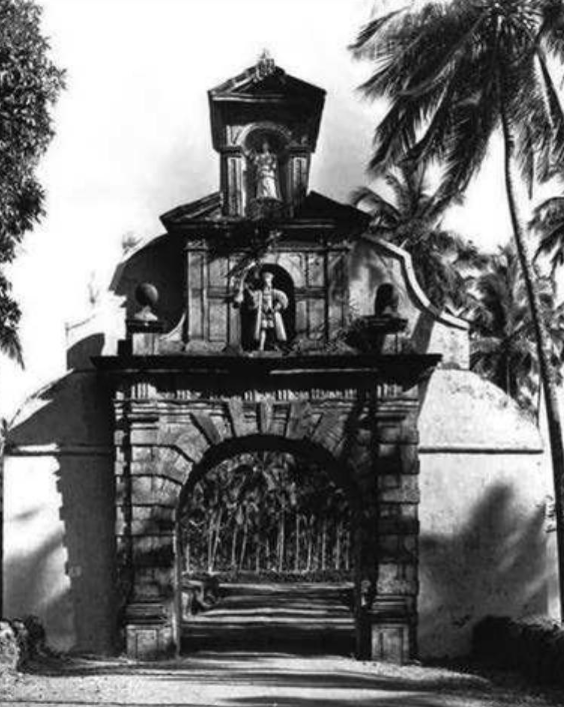
Arch of Viceroys before the intervention performed by Baltazar Castro, photographed during the study mission led by Mario Chicé in 1951.
Although Castro’s work brought international attention to Goa’s historic monuments, it also provoked lasting questions about the purpose of restoration: should conservation prioritize colonial narratives or historical authenticity? The removal of protective plaster from multiple monuments heightened their exposure to natural decay the Basilica of Bom Jesus standing as the most notable example. These issues continue to shape present-day debates on how Goa’s heritage should be conserved in a manner that respects both its layered history and the living communities that surround it.
Among the most visible casualties of this era was the Viceroy’s Arch in Old Goa. Originally built in 1599 by Viceroy Francisco da Gama as a ceremonial gateway, the structure suffered heavily during postwar restoration efforts under Castro’s supervision. In the early 1950s, the protective lime plaster that had safeguarded its laterite stone for centuries was stripped away. This act of “deplastering”, intended to reveal the raw ancient stone and emphasize the monument’s colonial age, left the arch dangerously vulnerable to Goa’s monsoon-driven humidity.
The outcome was catastrophic. The exposed laterite deteriorated rapidly, and the arch collapsed during heavy rains around 1951 or 1952, depending on varying accounts. The collapse was a direct result of removing the plaster in adherence to the colonial doctrine of “returning to original purity.” Recognizing the arch’s cultural significance, the Portuguese authorities undertook its reconstruction between 1952 and 1954, though the rebuilt version omitted certain original features, such as its third storey. The statues were repositioned, and the design simplified, turning the rebuilt arch into a stark reminder of both colonial ambition and the hazards of ideologically driven restoration.
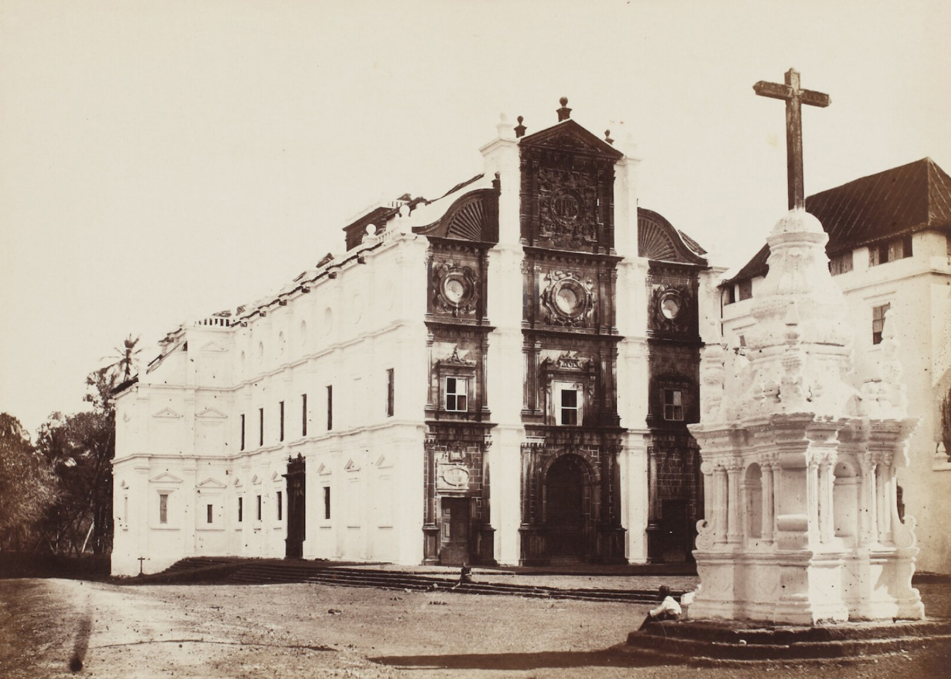
Basilica of Bom Jesus, before being de-plastered
Baltazar da Silva Castro’s restoration work in 1950s Goa defined by the widespread removal of protective plaster from historic monuments remains a complex and controversial legacy. His interventions, left behind enduring physical scars and sparked a critical conversation about the ethics of conservation, a debate that continues to influence heritage preservation practices well into the 21st century.