JENIFER FERNANDES
[email protected]
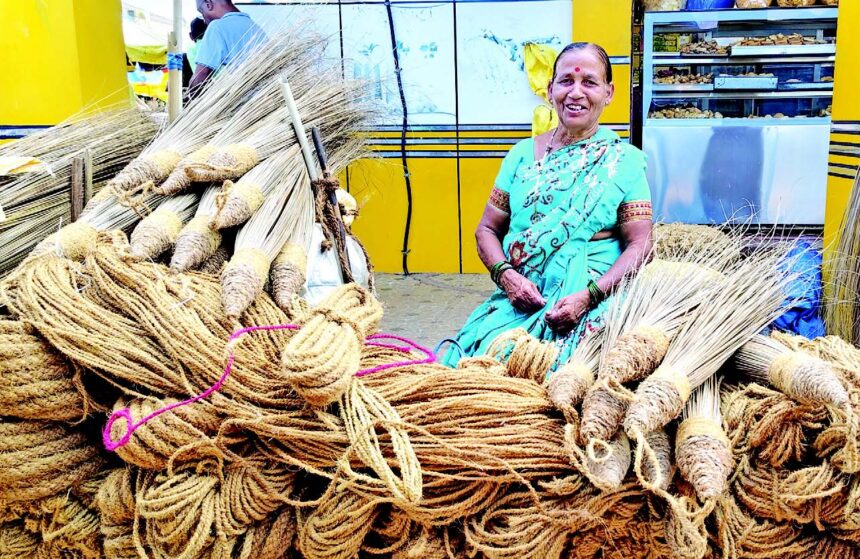
MAPUSA: In the bustling heart of Mapusa market, amid the chatter of vendors and the aroma of local produce, sits Jaimini (Mira), a 50-year-old woman from Oxel, Siolim, quietly weaving strands of Goan tradition into every broom and rope she makes by hand. Her brooms and ropes, simple yet full of history, stands as a living reminder of an art form slowly fading from our daily lives.
“I’ve been doing this work for over 30 years now,” Mira says with a soft smile, her hands deftly tying strands of coconut coir. “Before me, my mother did it for more than 70 years. I grew up watching her, learning every little step. After she passed away, I continued because this is not just work — it’s part of who we are.”
For Mira, crafting brooms and ropes is not just a means of earning a living — it’s a year-long labour of love. The process begins with collecting coconut palms and coir, which must be soaked in the river for over a year before they become soft and pliable enough to use. The dried fibres are then peeled, cleaned, and carefully tied into neat bunches to make a single broom — a task that takes more than an hour of sitting on the floor, working patiently with her hands.
“I can make one broom in few hours,” she explains, “but ropes take even longer. There are different types — long, short, and very short brooms for cleaning floors, roof tiles, or walls. The ropes too come in many kinds — some used for tying hay or other household items.”
Her brooms and ropes are made purely from natural coconut fibre — strong, durable, and eco-friendly. Yet, despite their quality and charm, the demand has dropped drastically with the rise of plastic alternatives.
“People now want easy life and automatic things,” Mira says with a sigh. “Plastic brooms have come, and everyone wants them because they look fancy. But these brooms — our Goan brooms — are made with effort and heart. They’re part of our culture, and they’re disappearing fast.”
Over the decades, Mira has become a familiar face in Mapusa market. Regular customers still seek her out, many appreciating the lasting quality of her handmade brooms. Some Goans even place special orders, wanting to preserve a touch of authenticity in their homes.
But the reality, Mira fears, is that her craft is on the brink of extinction.
“Young people don’t want to do this,” she says. “They feel shy or think there’s no profit. They prefer office jobs with monthly salaries. But remember — for us, selling these brooms and ropes was our only source of livelihood. We lived our whole lives by this work.”
Despite her worries, Mira’s spirit remains unbroken. Every morning, she travels to the market with her handmade goods, setting up her small space before sunrise. In the evening, she packs up her remaining brooms, leaves them safely in a nearby shop, and returns home to Siolim — ready to begin again the next day.
“This work doesn’t need education — it needs patience and love,” she says proudly. “I may not have gone to school, but I’ve learned the art of living through this. As long as I can, I will keep doing it.”
Her final message is one of hope and appeal:
“I want the government to support people like us — to teach students about this traditional craft before it disappears. I want children to see how our ancestors lived and worked. Let every Goan house have at least one handmade broom — a reminder of who we are.”
In a world rushing toward convenience, Mira’s quiet determination offers a powerful lesson — that true craftsmanship, born from the heart and hands, is what keeps the soul of a community alive.
Mira’s journey is a reminder that traditions survive only when hearts choose to keep them alive. Through her dedication and hard work, she proves that even the simplest craft holds the power to preserve culture and inspire generations.