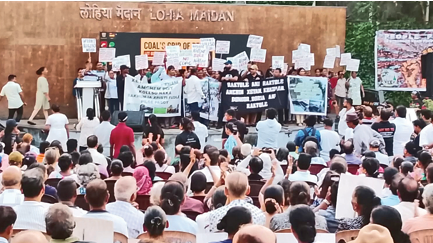
A sea of peo ple filled Margao’s Lohia Maidan on Sunday as peo ple from across the State gathered under the ban ner of the Goyant Kollso Naka (GKN) movement, reaffirming four clear demands — to stop coal handling in Goa and turn Mormugao Port Authority (MPA) into a green port; to delist all six rivers of Goa from the National Water ways Act and port limits while scrapping dredg ing and jetty proposals; to halt all coal-related infrastructure projects, including double track ing, highway expansion and port dredging; and to deny permissions for new or existing steel plants in the State. The demands, central to Goa’s five-year-long envi ronmental battle, oppose a range of projects that together risk turning the State into a coal corridor — from the double-tracking of the South Western Railway line and highway works through Mollem, to the 400 kv power line, the Borim bridge alignment favoured for coal logistics, the diver sion of the Mhadei and the nationalisation and dredg ing of Goa’s rivers. The meeting made clear that public resistance now embraces coastal, forest and riverine concerns. Speakers warned that Na tional Highway (NH) ex pansion works have been fragmented into smaller tenders to bypass scru tiny and push road wid ening through forest and agricultural areas, while rail and port expansions threaten the Bhagwan Mahaveer and Mollem sanctuaries and local live lihoods.
The Supreme Court (SC) quashed wildlife clearance for the rail double-tracking project in 2022 after the Central Empowered Committee (CEC) pointed out that more than 90 per cent of freight on the Castlerock–Kulem stretch was coal and that the expansion lacked a public-interest case. Yet, opponents said, approvals for dredging and port works continue under other development labels. GKN convener AbhijitPrabhudesai pointed to what he called a pattern of “tacit administrative permissions” — where agencies continue preparatory work even with out clearances. He said this included forest surveys, soil testing and land acquisition notices issued under coloni al-era provisions that still empower forcible acquisition. These, he argued, show how official machinery is being used to ease project execution despite legal and public opposition. He had earlier informed the media that the meet ing had been rescheduled from November 1 to No vember 9 because of rain and the planned use of LED projections. On Sunday, his presentation on the LED screen — built largely on government documents and peer-reviewed studies — used master plans, the Sagarmala programme, the State Action Plan for Cli mate Change (SAPCC), the Goa Coastal Zone Manage ment Plan (CZMP) and SC orders, among other official sources, to show how coal-linked infrastructure has been layered into policy. He also highlighted excerpts from official master plans that explicitly stated local governments must be ‘pressured’ to permit double tracking — evidence, he said, that community opposi tion had been anticipated and planned around rather than addressed. Prabhudesai cited the CEC’s finding that described Goa as becoming ‘an infrastructure corridor for coal transpor tation’, and said government projections point to annual coal volumes that could be nearly three times the peak iron-ore exports of the past. He noted that many gram sab has had passed resolutions opposing double tracking and related projects, yet those local decisions under Panchayat Raj remain unheeded. Drawing on his past reporting, he explained how the double-tracking and port networks are intended to serve industrial hubs outside Goa — notably the steel and logis tics complexes around Ballari and Hospet in Karnataka — and stressed that the SC had flagged Krishnapatnam only as a possible alternate handling route, not as justification to go ahead with double tracking through Goa. He also noted Rail Vikas Nigam Limited (RVNL) as an implement ing agency on sections of the SWR works. On the Mhadei, he said tribunal records do not support the public claim that diversion is primarily for drinking water; the documentary record, he argued, shows indus trial and irrigation intent. He warned that the Mollem and BhagwanMahaveer Forest stretches would be pierced by multiple tunnels for rail works — long construction pro jects that would destabilise slopes, damage aquifers and fragment habitat over years. Prabhudesai drew attention to public health and scien tific evidence. He recounted talking to Dr Antonio Mas carenhas of the National Institute of Oceanography (NIO), who found coal dust particles inside a house in Dona Paula, nearly eight km from MPA, then called the Mormugao Port Trust (MPT), illustrating how airborne contamina tion travels. Residents near the port or in areas where coal passes through by road or rail, he said, report rising respiratory problems, skin ailments and eye irritation. In Baina, he added, proposals to dredge the river channel to allow larger vessels would destroy fishing grounds and imperil fishermen’s livelihoods. Tracing the crisis to policy choices, he recalled how op position to dredging at Kharewado in Vasco in 2016 first exposed plans to deepen river channels under the Nation al Waterways Act to accommodate barge traffic. He said locals had even approached the National Green Tribunal (NGT) to stop capital dredging — a move he alleged had earlier been sanctioned by then-Union environment min ister Prakash Javadekar and by Union highways minister Nitin Gadkari despite environmental breaches — and which the tribunal later held up. The presentation also drew from government and sci entific studies showing how these projects have worsened coastal flooding risk, displaced farmers and fishers, and fragmented ecosystems — outcomes GKN used to under line the stakes. Prabhudesai questioned why the State and Central BJP governments have not publicly rebutted the evidence presented, despite much of it being drawn from official reports, environmental clearances and policy documents. He said the administration’s silence lends weight to public suspicion that projects are being advanced for corporate rather than public interest. He alleged the government was ‘bent on destroying Goa for coal’, and urged attendees to remain united. Op position MLAs and party presidents who attended later addressed the media, backing the movement and urging authorities to withdraw clearances that threaten ecology and livelihoods. As the meeting closed, the crowd rose to its feet, hands raised in unison, and chanted the four demands — a scene that underlined the movement’s determination that Goa will not be turned into a coal corridor