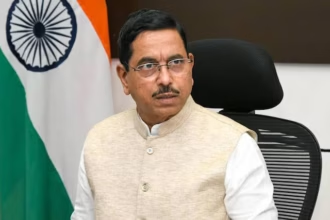
The Goa gov ernment has launched a compre hensive State-wide action plan to implement the Supreme Court’s recent directive on the manage ment of stray animals, with nodal officers appointed across all talu kas and plans to set up dedicated shelters for dogs and cattle. The Directorate of Animal Hus bandry and Veterinary Services (AH&VS) has issued orders ap pointing officers at the State and taluka levels. The appointees would need to coordinate efforts with municipal bodies, police and animal welfare organisations. These officers will oversee rescue, treatment and reha bilitation of strays, and ensure humane control measures in line with the Supreme Court’s guidelines. The initiative follows the inauguration of a new mul ti-storey Animal Husbandry Hospital at Sonsodo, Raia, where Animal Husbandry Minister Nilkanth Halarnkar an nounced that land has been identified to establish four to five dog shelters across Goa. The move is part of the State’s compliance with the apex court’s November 7 order direct ing all States and Union Territories to remove stray dogs from sensitive public areas such as schools, hospitals, bus stands and railway stations, and to ensure their sterilisa tion, vaccination and rehabilitation. “The Chief Secretary is finalising the action plan to op erationalise the shelters,” Halarnkar said, adding that the government will fully support local bodies in managing stray animals. He noted that the government bears the en tire cost of maintaining stray cattle housed at recognised gaushalas and provides a 100 per cent subsidy for hydrau lic tow vehicles used to transport animals off the streets. Panchayats and municipalities have been directed to sign Memorandums of Understanding (MoUs) with registered shelters to ensure proper housing and care of captured cat tle. “Our systems are in place; Panchayats and Municipali ties must cooperate,” the Minister said. He added that the department pays Rs 150 per animal per day to gaushalas for upkeep and maintenance. Halarnkar also urged NGOs and veterinary professionals to intensify sterilisation under the Animal Birth Control (ABC) programme, assuring them of complete government assistance. At the State level, Dr Prakash Korgaonkar, Deputy Direc tor (Planning), has been appointed as the nodal officer for Goa. Taluka-level officers have been designated across both districts to coordinate local implementation. In North Goa, the officers include Dr Natasha N Asolkar (Bardez), Dr Gayatridas Gauthankar (Bicholim and Sanque lim), Dr Vaibhav Parab (Pernem), Dr Yogesh S Naik (Sattari) and Dr Priya Dalal (Tiswadi). In South Goa, the officers are Dr Arpita T Naik (Canaco na), Dr Deepika Prabhakar (Mormugao), Dr Atanazia T Fer nandes (Salcete), Dr Manish M Bale (Sanguem), Dr Malory Maria Ferrao (Quepem and Curchorem–Cacora), Dr Nata sha Rachel Coutinho (Ponda) and Dr Ketan B Chowgule (Dharbandora). The Directorate stated that these nodal officers will en sure timely treatment of injured or sick animals, coordinate with civic and law-enforcement agencies, and monitor the humane implementation of the Supreme Court’s directions across Goa. Highlighting the scale of the issue, Halarnkar said the Sinquerim Goshala alone currently cares for between 6,000 and 7,000 cattle, underscoring the urgency of organised co ordination among local bodies and shelters. He reiterated that effective cooperation between panchayats, municipal ities, and recognised goshalas is essential to curb the stray menace and ensure both public safety and animal welfare.
Goa Government Launches State-Wide Action Plan to Implement Supreme Court’s Stray Animal Directive