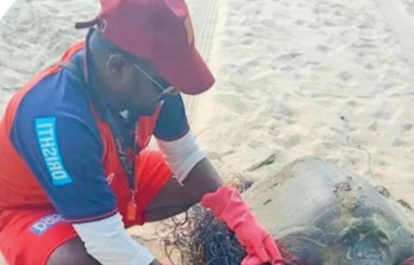
As another year draws to a close, the tide leaves behind a familiar and unsettling testimony. Along Goa’s beaches, scenes that once felt exceptional have become disturbingly routine — a dolphin lying motionless near the waterline, a turtle struggling to breathe, a seabird too weak to fly. These encounters, unfolding in full public view, have quietly marked the passage of the year, turning the shoreline itself into a record of mounting stress in the sea.
What is striking is not just that these strandings are happening, but that they keep happening — across locations, across months, and across species.

A pattern that refuses to fade
Over the past year, marine wildlife strandings have been reported along the length of Goa’s coastline, from heavily visited tourist beaches in the north to quieter stretches in the south. Dolphins and porpoises have been found dead with unsettling regularity. Sea turtles have turned up both alive and lifeless. Birds and snakes have repeatedly required rescue after becoming entangled, exhausted or injured.
These are not hidden incidents. They occur on open, public beaches, often in daylight, witnessed by beachgoers, shack staff, lifeguards and local residents. The repetition has made it increasingly difficult to dismiss strandings as rare or exceptional events. For many who live and work along the coast, they have become an uneasy part of the shoreline’s rhythm — a recurring reminder that something offshore is not right.
What the numbers suggest
Based on reported strandings that have repeatedly come to light along Goa’s coast over the years, preliminary information pending official verification indicates a scale that is difficult to ignore. Over the past year, more than 225 sea turtles, around 80 birds, 75 dolphins, 48 porpoises, 22 snakes, and over 10 turtle nests were reported along Goa’s beaches.
These figures represent a mix of live and dead strandings. While many turtles, birds and snakes were rescued alive and given treatment, most marine mammals were found dead. The numbers are not presented as a definitive tally, and some cases may not have been recorded. Even so, conservationists say they are already high enough to signal a serious and persistent problem.
Importantly, incidents have been recorded throughout the year — from the months following the monsoon through to the end of the calendar year — reinforcing the sense that this is an annual pattern rather than a brief or seasonal spike. The beaches, unintentionally, have become witnesses to a slow accumulation of stress and mortality.
Why resident species matter
Goa’s coastal waters support residential populations of dolphins and porpoises that depend on shallow nearshore habitats and estuaries. These animals are not migratory visitors; they live, feed and breed in these waters year-round.
That makes them especially vulnerable to local pressures — and means that repeated mortalities can have lasting consequences for population health. Conservationists say the appearance of calves and juveniles among stranded animals is particularly worrying, pointing to stress affecting breeding populations rather than only older or weaker individuals.
Beyond their intrinsic value, these species play a role in maintaining healthy marine food webs, and their decline can signal deeper disruptions that ultimately affect fisheries and coastal livelihoods. When resident species begin to decline, recovery is far more difficult than for migratory wildlife that can recolonise from elsewhere.
What may be driving the strandings
Marine scientists caution that strandings rarely have a single cause. Entanglement in fishing gear remains one of the most common threats to dolphins and porpoises in nearshore waters. Vessel strikes pose another risk in areas with dense boat traffic. Pollution — including untreated sewage and runoff — degrades water quality in estuaries where many species feed. Plastic debris and discarded fishing gear continue to present persistent entanglement hazards.
Noise and stress from marine activity can disorient animals, while disease and sudden changes in salinity or temperature may weaken individuals already under pressure. In many cases, internal injuries or physiological stress leave few visible signs, making definitive conclusions difficult without detailed examination.
What concerns conservationists is not any single explanation, but the cumulative effect of multiple stressors acting simultaneously. Repeated strandings across locations and months point to chronic pressure rather than random or unavoidable accidents.
Voices from the coast
Those involved in reporting and response describe a steady stream of calls from beachgoers and local residents. Turtles are the most frequently encountered species, often found alive but weak. Dolphins and porpoises account for most marine mammal deaths. Birds are commonly rescued after exhaustion or entanglement, while snakes are usually found alive, trapped in fencing or marine debris along the shore.
“At some point, this stops being about individual carcasses,” says coastal environmentalist Arjun Naik. “Year after year, dolphins and porpoises keep washing up on our beaches, but there is no sustained public accounting of what is killing them. Without investigation, transparency and a coordinated plan to address the causes, we are watching a local crisis unfold in slow motion.”
First responders on the shore
In many strandings along Goa’s beaches, the first people to reach the site are not scientists or officials, but lifeguards already stationed along the coast. Since 2017, Drishti Marine lifeguards have played a central role in this early response, acting as first points of contact when distressed or stranded marine animals are spotted on public beaches. Their constant presence along the shoreline often means they are the first to assess a situation, secure the area, and trigger the wider response.
Navin Awasthi, CEO of Drishti Marine, says this role has evolved steadily over the years, with lifeguards receiving specialised training to handle marine wildlife encounters responsibly.
“Drishti Marine lifesavers are trained in accordance with the Wildlife Protection Act of India to serve as first responders for marine life strandings, working closely with the state Forest Department and NGOs focused on marine welfare. The lifesavers have been involved in mammal rescue along the shoreline for several years. Our lifesavers are trained in handling marine strandings and provide essential support to the State Forest Department in rescuing stranded marine creatures.”
“Our lifesavers undergo extensive training in various modules. They learn to assign codes that indicate whether an animal is alive and needs treatment or if it has washed ashore dead. In the latter case, they assess the stage of decomposition. Additionally, they are trained to take photographs and measurements of the carcass, which helps identify the species, age and gender of the marine animal.”
“They also learn safe methods for lifting, transporting, and handling injured sea turtles, marine mammals and seabirds. Goa’s coast is home to various marine species, including the Indian Ocean Humpback Dolphin and the Finless Porpoise, apart from sea turtle species such as Olive Ridley, Hawksbill and Green Turtles. We also encounter snakes trapped in fencing or ghost nets along the beaches.”
For conservationists, this first-response role is crucial. Accurate early assessment and proper handling can influence everything that follows — from veterinary intervention to understanding broader patterns. But they also stress that even the most efficient response on the beach cannot compensate for what happens offshore, where the causes of most strandings originate.
The policy gap
Despite the scale and persistence of strandings, Goa still lacks a dedicated conservation action plan for marine mammals. While the state has an official plan for sea turtles, no equivalent framework exists for dolphins or porpoises, despite their protected status and ecological importance.
This absence leaves pressures from fisheries, tourism, coastal development and pollution acting on marine mammals without coordination or long-term monitoring. Responses remain largely reactive, focused on individual incidents rather than reducing the risks that lead to strandings in the first place.
The contradiction is especially visible in dolphin-watching tourism. Dolphins are promoted as a coastal attraction, yet dolphin-watching remains categorised as a watersport rather than wildlife tourism, placing it outside stricter regulatory frameworks that govern land-based wildlife activities.
Beyond rescue
Conservationists stress that rescue alone cannot solve the problem. Rescue saves individuals; prevention protects populations.
What is needed, they argue, are species-specific measures that address fishing practices in sensitive nearshore zones, set clear rules for marine wildlife tourism, improve waste and wastewater management, and ensure long-term monitoring of resident populations. In other coastal regions, simple interventions — such as time-area fishing restrictions, regulated wildlife viewing protocols, and coordinated reporting systems — have helped reduce pressure on vulnerable species. Without similar preventive measures, Goa risks continuing to respond to strandings without ever addressing why they occur.
As another year ends
As the year closes, the accumulation of strandings offers a sobering measure of what has — and has not — changed. The animals that share Goa’s coastal waters live largely unseen, their struggles hidden beneath the surface. When they wash ashore, they force those struggles into the open.
On one beach this month, a small crowd gathered silently around a stranded dolphin as the tide crept closer, waves brushing against its flank. There were no speeches or slogans — just a few minutes of uneasy stillness before the sea reclaimed the shore.
Scenes like this have repeated themselves often enough to leave an imprint. The shoreline has become a messenger, reflecting the health of the sea and the choices made on land. Whether those messages finally translate into meaningful action remains uncertain. For now, the tide continues to return what the ocean can no longer hold — reminding Goa that another year has passed, and the warnings have not gone away.