SHASHWAT GUPTA RAY
CUNCOLIM: After a brainstroke, many patients get paralysed and lose the ability to move their limbs, even though their brain continues to send movement-related signals. Now, researchers at National Institute of Technology (NIT) Goa have developed an artificial intelligence enabled technology which will help. such patients to move their limbs in the direction that they want by capturing and understanding these hidden signals from the brain and converting them into meaningful commands.

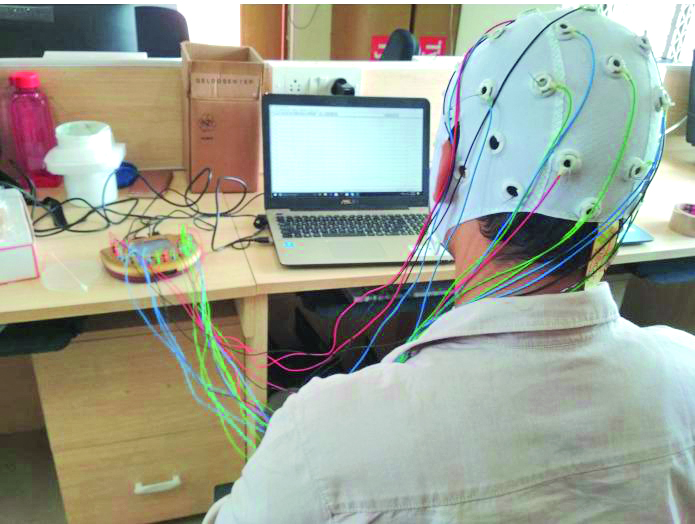
“Our technology is a smart brain-computer in-terface (BCI) system that reads brain signals and understands what a stroke patient is trying to do or imagine, such as moving a hand or leg.” Associate Professor, Department of NIT Goa, Dr Damodar Reddy Edla told O Heraldo. It uses artificial intelligence (AI) to study brain signals recorded through Electroencephalography (EEG), which is a painless method of placing sensors on the scalp, and then learns patterns related to move-ment and recovery “In simple words, it is a computer system that listens to the brain and understands it,” Dr Edla said. This technological proposal has been published in the peer-reviewed journals Computers in Biology and Medi-cine and Journal of Neuroscience Methods. It has been de-vised by PhD scholar and Assistant Professor at Goa Col-lege of Engineering, VaishaliRamakant Shirodkar (Naik), supported by AnnuKumari, Melina Maria Afonso and Ramesh Dharavath.
When asked how this technology will help brain stroke patients, Dr Reddy said, “After a stroke, many patients lose the ability to move their hands or legs, even though their brain continues to send movement-related signals. Our technology helps by capturing and understanding these hidden signals from the brain and converting them into meaningful commands.” Specifically, this technology can enable assistive systems such as brain-controlled wheelchairs and neuroprosthetic arms. For example, a patient can imagine moving their hand, and the system can interpret this intention to move a robotic arm or change the direction of a wheelchair. “This allows patients with severe paralysis to regain independence in daily activities, such as moving around, reaching for objects, or performing simple tasks. In addition, the system helps doctors and therapists monitor brain recovery by observing how brain signals change during rehabilitation,” Shirodkar said. It also supports neuro feedback-based therapies, where patients receive real-time feedback from assistive devices, encouraging the brain to relearn lost motor functions.
Overall, this technology allows stroke patients to begin rehabilitation earlier, use personalised assistive devices, and gradually transition from machine-assisted movement to natural recovery, significantly improving quality of life. According to Shirodkar, the core algorithms of this technology have already been developed and validated using real stroke-patient EEG data and publicly available bench-mark datasets. These results demonstrate the technical feasibility and strong potential of the proposed approach.
However, the transition from a research framework to a fully functional prototype requires close collaboration with industry partners and medical institutions. “With appropriate industry support and medical collaboration, the technology can be gradually translated into a prototype for assistive and rehabilitation applications,”
she said.
HOW DOES THE APPLICATION WORK?
- Brain signals are recorded using EEG sensors placed on – the head
- The system cleans and analyses these signals
- Important patterns related to movement and brain activity are extracted
- An Al model learns these patterns and optimises using nature-inspired optimisation techniques
- The system predicts brain intention
- Feedback can be used for therapy or control applications
- The computer learns directly from the patient’s brain activity