Co-curated by widely recognised artist, muralist, gallerist Yolanda de Sousa Kammermeier and independent art writer and curator Samira Sheth, ‘Artists and a World in Turmoil’ brings together 42 artists from around the world in Goa in a collective response to an era marked by rupture-political unrest, ecological fragility, displacement, and the quiet violence of inequality. Spanning painting, graphics, works in textile, photography and works on paper, the exhibition moves between abstraction and figuration, anguish and hope. Rather than offering a single narrative, the show holds multiple truths at once-inviting viewers to slow down, look longer, and encounter the world not as a headline, but as a lived emotional reality. “From Picasso’s monumental anti-war painting ‘Guernica’ to Goya’s series ‘The Disasters of War’; to more recent artists from Ai Wei Wei’s work with issues of refugees and displacement; FN Souza’s paintings reflecting post-colonial disillusionment to Nalini Malini addressing gendered violence or Arpita Singh responding to the anxieties of modern India – artists have historically served as witnesses to the anxieties that plague our world. Through their emotionally charged artworks, these 42 participating contemporary artists offer us a way to frame our own response to difficult times, making us see the world differently,” says Samira. Throughout her art journey, Yolanda has responded to what is happening in the world, to “topics close to my heart or those that disturb my heart, mind and soul. If it moves me it finds its way onto my canvas.” With her works ‘Blind Believer’ and ‘In the Thick of Things’, the leading artist works in her unmistakable visual language, bold saturated colour and jagged fractured textures that carry a sense of disruption. Painting a ceramic style effect in acrylic, the ruptured surfaces of her work combine text and image to portray her anguish and what it means to stand “in the thick of things” while still searching for clarity.

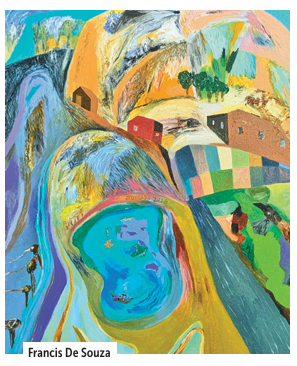
In Ukrainian abstract expressionist artist Serhiy Savchenko’s work, a military uniform lies draped over the back of a chair in a series of monoprints titled ‘Back Home’. Anchoring the show, the deceptively simple image becomes a powerful visual symbol for what war does to people’s lives; bringing the terrible tragedy of a war, happening thousands of miles away from us, closer to home. “I paint these chairs with a single wish: that all my friends return home from the war alive,” says Serhiy Savchenko In the midst of this fearful ongoing violence and conflict, the artist continues to create artworks. “Perhaps, creating, making, going on, looking for answers, for small joys, for hope, for peace, for a better future is the only way to survive and go on in a world riven by hostilities, shrinking civic freedoms, the exhaustion of constant media and other urgencies,” says Samira. “Yes our world may feel fractured, but the exhibition is not a catalogue of despair; it is a map of how artists continue to see, feel, and make meaning, reminding us we are not machines designed only to process information; we are human beings designed to feel, to imagine, to grieve, to hope, share joy,” she adds. The show presents works that speak of displacement and belonging, of environmental change, of the vulnerability of the body, and of the beauty of our natural world. By coming together from all over the world, from places as diverse as Poland, Hungary, Romania, the US, Australia and more; despite speaking different languages and living distinctly different lives, these artists show that it is possible to respond to the common humanity through the shared language of art; that it is in fact essential to respond, shaking one out of their apathy to make one feel again. Two artists from Japan, Takeshi Fuji and Tomoko Inagaki, respond to today’s difficult times in gentle tones, hoping the beauty of nature will offer some respite to a harsh world. Senior Goan artist Nirupa Naik also responds to a World in Turmoil not with anxiety, but with intention, believing the first step towards positive change begins within. Swapnesh Vaigankar’s poignant cry for Goa in ‘Anxiety’ echoes across nine frames, the grid like structure reinforcing the fragmentation of his beloved homeland, sectioned off for exploitation. Francis De Souza divides his canvas into two emotional terrains, one half carries a yearning nostalgia for a Goa that was open and abundant while a quieter despair for a Goa that is strained and overburdened permeates the second half. In her mixed media tapestry titled ‘Healers of the Eco-System’, Goan artist Sonia Sabharwal Rodrigues, dives deep into the specific wounds inflicted upon Goa’s precious water, its ancient trees, its land and forests. Liesl Cotta De Souza paints with thread on textile, perhaps a gesture of repair in a world marked by instability and ‘Displacement’? Widely collected and honoured with numerous awards, artist, curator and mentor, Theodore Mesquita’s ‘Sanctuary City’ in acrylic and graphite carries an undertone of warning; reflecting on deceptive insular migrations unsettling the fragile foundations of identity, culture, and belonging. Amongst the principal pioneers of performance, land and feminist art in Poland, Teresa Muracka’s work ‘Loneliness’ continues to centre around her nearly fifty year concern with the phenomenon of life and the process of growth.
Internationally known artist Agnes Peter creates large-scale, site-specific art installations. She participates in the exhibition with photographic prints of her huge immersive environmental artworks, each establishing a harmonious dialogue between nature, art, and human perception. Brazilian artist Tasciso Viriato uses colour and collage, combining avant garde elements with graffiti to question control and hierarchy, discrimination and erasures of cultural histories in ‘Once upon a Time in America’. Karl Abramovic responds from Arizona, inspired by social commentary and subconscious perceptions to tap into an alternate dreamscape world. From Portland, Oregon, Dan Ness’s large montage style painting echoes his interests in painting, printmaking, animation, and film. Multiple perspectives, changing realities also emerge as a thematic concern in Indonesian artist Zusfa Roihan’s ‘The Swirl of View’ in pretty colours and fluid forms. Professor Rajan Fulari, Dean of the School of Visual Arts, World University of Design, Delhi NCR, presents Focus of Kurukshetra. The work reimagines the epic battlefield of the Mahabharata as a contemporary condition. Today, the battlefield exists not only in mythology, but globally, within our societies, ecological crises, political tensions, and within ourselves. ‘Artists and a World in Turmoil’ previews on February 28 at Art Chamber, Galeria Belas Artes, Calangute. The show runs until May 31.