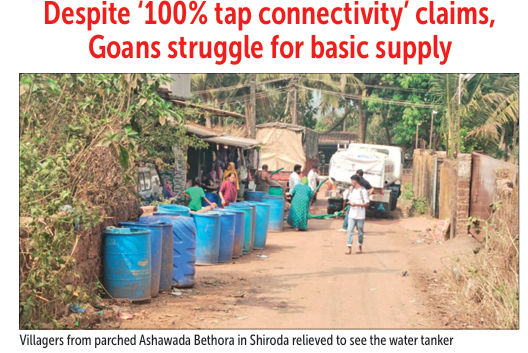
In a biting irony that cuts to the core of Goa’s water governance narrative, the constituency of Water Re sources Minister Subhash Shirodkar is itself grappling with an acute drinking wa ter crisis, with residents in Shiroda struggling for even basic supply — years after the State declared itself a model of universal tap connectivity under the Har Ghar Jal mission. What makes the situa tion explosive is not merely the scarcity, but its location. This is not a remote hin terland or an overlooked village cluster. It is the po litical backyard of the very minister tasked with ensur ing water security. Across Shiroda, taps have effectively run dry in several pockets, pushing residents into distress. The vacuum has grown so stark that relief has come not from the State machinery, but from a private citizen. Stepping in where the government has faltered, social worker Shivprasad Shirodkar has launched a free water tanker ser vice, supplying affected localities. “We can’t just sit back and watch our community suffer. Every drop counts, and we’re committed to helping our people,” he said. For residents, this pri vate intervention has be come a lifeline — and an uncomfortable symbol of government failure. “This is a huge relief for us. Without water, it is im possible to live a normal life. We were struggling to cope,” said Geeta Gaude from Savarbhat, Borim.
The crisis has hit the most vulnerable the hardest. Households with young children, the elderly and pregnant women report going days without reliable supply. Senior citizen Nalini Gaude said they have been facing prolonged disruptions, with water unavailable for several days at a stretch. The breakdown in Shiroda directly contradicts the Goa government’s repeated assertion that it achieved 100% Functional Household Tap Connections (FHTCs) as early as 2020 under the Jal Jeevan Mission — a milestone once showcased as a national benchmark. On paper, Goa is fully connected. On the ground, even the minister’s own constituency is queuing up for tanker water. The contradiction does not end in Shiroda. Data tabled in the Legislative Assembly reveals a persis tent pattern of distress across the State, with over 5,500 water-related complaints recorded since 2022. Salcete alone accounts for 2,682 complaints, followed by Bardez (996) and Mormugao (512), indicating the crisis is neither isolated nor incidental. In Salcete — the worst-affected region — residents de scribe a daily battle for survival. “Water shortage has become a daily struggle for our fam ily. We wake up early hoping the taps will run, but most days there is nothing. When water does come, it is for a very short time, and we rush to store as much as possible in buckets and containers,” said Peter Fernandes from Ma jorda. “This affects everything — cooking, cleaning and even basic hygiene. My children sometimes go to school with out a proper bath because we simply cannot afford to waste water. We have complained to the authorities many times, but nothing has changed. During summer, the prob lem worsens, and we are forced to buy water from private tankers, which is expensive. Water is a basic necessity, not a luxury, and it is painful to see how difficult it has become just to meet our daily needs,” Fernandes added. Erratic supply has compounded the crisis. “Some days we get water; other days we don’t receive a single drop. This uncertainty makes it very difficult to plan our routine. I often have to skip household chores because there isn’t enough water. Low pressure is another issue — sometimes water doesn’t even reach our overhead tank. We end up depending on neighbours or buying bottled water, which adds to our expenses. It is frustrating because we pay our bills regularly, yet the service is so unreliable,” complained Anita D’Costa from Raia. For working households, the burden is even heavier. “As a working woman, managing household responsibilities during a water shortage is extremely challenging. I have to plan everything in advance — from cooking to washing clothes — based on uncertain supply. Sometimes I return home to find there is no water stored, which creates stress. We have elderly people at home who need water regularly, and it becomes difficult to meet their needs,” Meena Desai from Navelim moaned. Drinking Water Minister Subhash Phal Dessai has main tained that complaints are being addressed on priority. But in several areas, scarcity has effectively become normal ised. Even in urban centres, reliability remains elusive. “Our area has been facing severe water shortages for several years, and the situation keeps getting worse. Supply is not only irregular but also insufficient for the growing popu lation. People often fight over water, which shows how serious the problem has become. We have tried to con serve water, but without proper supply, our efforts are not enough,” a resigned Imran Sheikh from Gogol said. “Until recently, supply was not even daily. Pressure is inconsistent. As promised by the CM, water was to be re leased for four hours every day, but it is barely supplied — often not even for two hours. There is no fixed timing. People have to stay home all day just to catch the supply, leaving aside their work. Many houses don’t have storage tanks, so they depend on daily supply,” said Jose Almeida from Dona Paula. In Panjim, dependence on alternative sources has become routine. “We rely on well water, which is a good source as it falls within the Boca de Vaca spring catchment. The PWD supply is irregular and often contaminated. The promise of 24×7 supply made by the then Manohar Parrikar govern ment remains unfulfilled,” Avertino Miranda stated. Miranda also flagged a deeper, emerging crisis. “The city’s groundwater is being rapidly depleted due to illegal extraction and sale by tanker operators. This water is sup plied commercially, including to offshore establishments. Water is a public resource, and authorities have failed to regulate its misuse,” he alleged. With an estimated daily shortfall of 65 million litres and an ageing pipeline network — nearly a third over a dec ade old — the system is visibly under strain. Transmission losses, leakages, illegal connections, and rising demand driven by urbanisation and tourism are compounding the problem. Yet, even as tanker supply becomes routine across talu kas, official claims continue to project normalcy. As summer intensifies, the crisis in the minister’s own backyard is no longer just a local failure — it is a stark in dictment of a model that appears increasingly disconnect ed from the ground it claims to serve.