ANIL KUMAR MISHRA
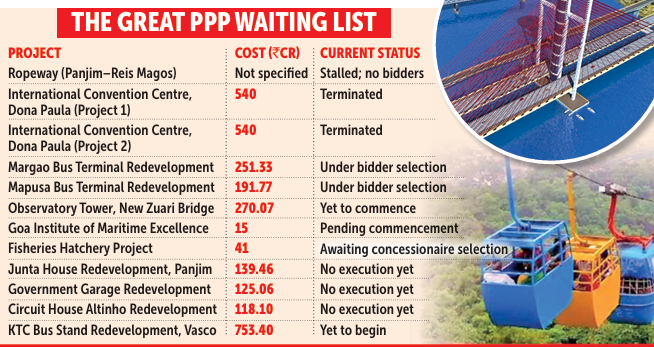
A growing list of high-value Public-Private Partnership (PPP) projects in Goa is either stalled, scrapped, or yet to begin, exposing a widening gap between the government’s ambitious announce ments and on-ground execution. Data tabled in the As sembly in response to questions by MLAs Aleixo Lourenco and Chandrakant Shetye lays bare a trou bling pattern: projects worth several thousand crores remain stuck at var ious stages, with little to show in terms of tangible progress. Among the most prom inent setbacks is the pro posed passenger ropeway between Panjim and Reis Magos — pitched as a tour ism booster — which has stalled after failing to at tract a single bidder. The lack of investor in terest raises fundamental questions about project viability and planning.

Even more striking is the fate of two marquee Inter national Convention Centre projects at Dona Paula, each pegged at around Rs 540 crore. Both have been terminat ed — one after the selected bidder failed to meet Letter of Award conditions, and the other due to failure in furnishing performance security — pointing to serious lapses in due diligence and contract structuring. Opposition leaders say these failures are symptomatic of major governance issues. Benaulim MLA Venzy Viegas said, “The government’s priorities are misplaced. The government is busy plan ning, but the plans are not executed. Has anybody thought about what will happen if there is Covid again? Do we have a sufficient number of oxygen cylinders? There is an LPG supply issue. Are we self-sufficient in gas production? Is there enough biogas production in the State? Is the State self-reliant in power generation? What happens if power is not supplied by other States? Are we waiting for a crisis to unfold? The government should focus on providing basic facilities to the people.” Beyond stalled and scrapped projects, a significant pipeline of PPP initiatives remains frozen in pre-execu tion stages. Bus terminal redevelopments in Margao and Mapusa — together worth over Rs 440 crore — are still under bidder evaluation. The Rs 270 crore observatory tower near the New Zuari Bridge has not commenced, while projects like the Goa Institute of Maritime Excel lence and a fisheries hatchery continue to await basic in itiation. In Panjim and surrounding areas, multiple redevelop ment projects — Junta House, the government garage, Cir cuit House Altinho, and the KTC bus stand in Vasco — are technically under ‘implementation’ but have yet to tran sition into visible execution, reinforcing the perception of administrative inertia. Critics argue that the problem is not just delays, but flawed conception and lack of transparency. AITC National Spokesperson Trajano D’Mello said, “Public–private part nership projects continue to face significant implemen tation challenges, often being stalled or even terminated. Data presented in the Assembly suggests that these issues are widely attributed — though only whispered in the cor ridors of power — to the failure to ‘grease the palms’ of those in authority.” Questions are also being raised about the relevance and sustainability of several proposed projects. GPCC vice president Tulio De Souza said, “Many of the projects are not desirable at all. The Reis Magos project faced a lot of opposition because it was neither desirable to the people nor environmentally sustainable. The government does not come out with feasibility reports or detailed project re ports as expected. Many projects have been red-flagged by CRZ. There are apprehensions among the people because the projects are neither financially sustainable nor envi ronmentally feasible.” At the grassroots level, activists point to a lack of public consultation and transparency as a key driver of resistance. Social activist Cecille Rodrigues said, “The fact is that the proposals are not placed before gram sabhas, so people have no idea what is coming up. The projects are, in fact, being imposed on the people against their wishes. In Talei gao, there is no biodiversity committee. People are not al lowed to give their opinion, which is why they oppose these projects. Why should villagers allow projects if they do not get water to drink? How can a government that is strug gling to maintain Kala Academy talk about big projects? Dr Shyama Prasad Mukherjee Indoor Stadium is used more for other events than sports.” The lack of investor confidence is another recurring theme. Amit Palekar, a prominent leader from St Cruz, said, “This only shows that investors do not have faith in the government. Tourism and business are already low. There are no basic facilities for the people. Panjim does not get a proper supply of drinking water. The gov ernment does not conduct feasibility studies before an nouncing any project. What is the need to have a tower on the Zuari River?” The data and reactions point to a systemic problem – weak project structuring, poor feasibility assessment, reg ulatory hurdles and a credibility deficit with both investors and citizens.