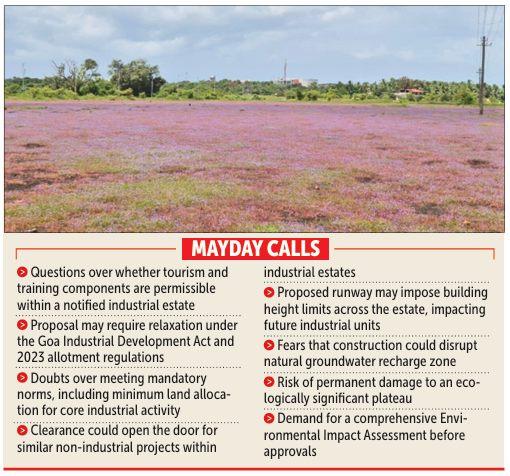
A proposed ae ro-sports and aviation hub at the Quitol Industrial Es tate has come under fresh scrutiny, with the Goa In dustrial Development Cor poration (GIDC) flagging multiple concerns and re ferring the matter to the State government, even as opposition from villagers and environmental groups continues to gather ground. The project, proposed by M/s Skydiving Adventures Pvt Ltd, had earlier received in-principle approval from the Goa Investment Promo tion and Facilitation Board (IPB) for setting up an inte grated aero-sports ecosys tem comprising adventure tourism, aviation training, drone manufacturing, and hospitality components. The proposal involves the allotment of over 2.4 lakh square metres of land at the Quitol Industrial Estate. At its recent meeting, the GIDC Board raised reser vations over the nature of the project and its compat ibility with the designated industrial use of the es tate. Concerns centred on whether components such as tourism, training, and hospitality fall within the scope of permissible indus trial activity, and whether the proposal fits within the broader policy framework governing notified industri al estates. In a comment to the me dia, GIDC chairman Aleixo Reginaldo Lourenco said the Board had decided to refer the matter to the government after detailed deliberations, with mem bers expressing differing views. He said the concerns raised during the meeting had been compiled and for warded for a decision. Sources indicated that while the Board did not re ject the proposal outright, it opted to leave the final call to the State government, particularly on whether the project could be considered a ‘special case’ requiring relaxation under provi sions of the Goa Industrial Development Act and the Goa (Allotment, Transfer and Sub-Lease) Regula tions, 2023. The question of granting such relaxations is expected to be central to the government’s deci sion-making process. The issue of compliance with industrial norms also figured prominently in the discussions. Members ques tioned whether the project would meet mandatory requirements, including maintaining the prescribed minimum land coverage for industrial activity within no tified estates, and whether non-industrial components could be accommodated within existing regulations. Concerns have also been raised in earlier discussions over whether the proposed aviation activity could im pose height restrictions on future development with in the industrial estate. With the project expected to involve a short runway, apprehensions have been expressed that regulato ry limitations on building heights could apply across the estate, potentially af fecting other units—par ticularly if the proposal is cleared as the first major project in the area. It may be recalled that the IPB, at its 40th Board meeting held on December 23, 2025, had approved the project in principle and rec ommended the allotment of land to the private firm at the Quitol Industrial Estate.
It had also suggested facilitating infrastructure support, including power supply requirements for the proposed unit, in accordance with applicable rules. The approval was subject to compliance with relevant laws and clearances at subsequent stages. Even as the proposal moved through institutional chan nels, resistance has been building on the ground. At the Betul gram sabha, residents from Quitol, Betul, Navelim, and neighbouring areas reiterated their objections, raising concerns over the ecological sensitivity of the plateau and its role in sustaining local water resources. Villagers pointed out that the laterite plateau functions as a natural recharge zone, acting like a sponge during the monsoon and aiding groundwater replenishment. They warned that large-scale construction and aviation-relat ed activity could disrupt this system and aggravate water scarcity in surrounding areas that depend on these sourc es. Concerns were also raised over potential habitat de struction, disturbance to wildlife due to increased human and vehicular activity, soil compaction, and the impact of noise and light pollution on the fragile ecosystem. The pla teau is known to support a range of biodiversity, including several bird species, some of which are listed under pro tected categories. Residents also flagged that the project could result in the irreversible loss of an ecologically significant landscape, with long-term consequences for both biodiversity and lo cal livelihoods. At the gram sabha, locals also called for the plateau to be recognised as a Biodiversity Heritage Site and demanded that a comprehensive Environmental Impact Assessment be carried out before any clearances are granted. With regulatory questions, land-use compliance issues, and sustained local opposition now converging, the future of the project hinges on the State government’s decision on whether to grant it special consideration or require strict adherence to existing industrial norms.