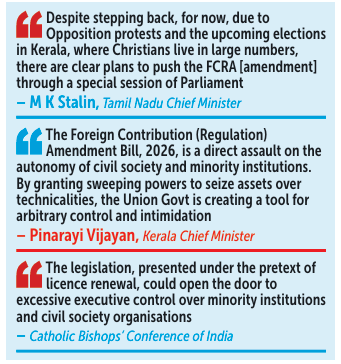
A day after the Union government indicated in the Lok Sabha that it would not move the proposed amendments to the Foreign Contribution (Regulation) Act (FCRA) in the ongoing Budget session, M K Stalin accused the Cen tre of merely pressing pause under political pressure, not abandoning the move. “Despite stepping back, for now, due to Opposition protests and the upcoming elections in Kerala, where Christians live in large num bers, there are clear plans to push the FCRA [amend ment] through a special ses sion of Parliament,” Stalin said, framing the govern ment’s decision as a cali brated retreat in the face of electoral sensitivities ahead of the April 9 Kerala polls. He strongly condemned the proposed legislation, calling it a “direct attack on Christian NGOs, churches, and other minority institu tions,” and alleging a broad er pattern of targeting mi nority-run bodies. “After attempts to take over Waqf properties, the BJP-led Un ion government was now moving to choke foreign funding for other minority institutions,” he charged, urging immediate with drawal of what he termed an ‘unjust, arbitrary Bill’. The concerns raised by Stalin find resonance in Kerala, where Chief Min ister Pinarayi Vijayan has already flagged the issue directly with Prime Minister Narendra Modi. In a strong ly worded letter, Vijayan warned that the proposed amendments have triggered “apprehensions among mi nority communities and religious institutions” and called for a rethink. “The Foreign Contribution (Regulation) Amendment Bill, 2026, is a direct assault on the autonomy of civil so ciety and minority institu tions. By granting sweeping powers to seize assets over technicalities, the Union Govt is creating a tool for arbitrary control and intim idation,” Vijayan wrote, un derscoring the risk of execu tive overreach. He cautioned that even procedural delays — such as technical lapses in licence renewals — could invite disproportionate pu nitive action, including state control over institutional assets.
At the heart of the controversy are provisions that would allow the Centre to assume control of assets created through foreign contributions if an organisation’s FCRA li cence is cancelled, lapses, or is not renewed. The proposed framework envisages a ‘designated authority’ empowered to take over, manage, and even dispose of such assets — temporarily or permanently. Critics argue that these provisions mark a significant de parture from regulatory oversight into direct State control. This apprehension has been most sharply articulated by Church bodies, which have warned of far-reaching implica tions for institutions engaged in education, healthcare, and charitable work. The Catholic Bishops’ Conference of India (CBCI) described the proposed amendments as ‘dangerous and alarming’, cautioning that they could erode constitu tional protections and institutional autonomy. Reacting to the Bill, the CBCI said the legislation, “pre sented under the pretext of license renewal, could open the door to excessive executive control over minority in stitutions and civil society organisations.” The bishops expressed concern that the government, as the licensing authority, would be vested with sweeping discretionary powers to cancel registrations and assume control over governance, funds, and assets. Of particular concern, the Conference noted, is the provision allowing the takeover of assets upon expiry or non-renewal of registration — an action it termed ‘undem ocratic’ and ‘unconstitutional’. The bishops also flagged the absence of wider consultation, stressing that legislation affecting fundamental rights requires “careful deliberation and inclusive dialogue.” In Kerala, where church-run institutions form a signifi cant part of the social infrastructure, these concerns have translated into palpable anxiety. Many such institutions rely on foreign contributions to sustain schools, hospitals and welfare programmes, particularly in underserved areas. The fear is that even partial foreign funding could expose entire asset bases to state control if regulatory hur dles arise. Political opposition in the State has seized on this un ease. Leaders across the ideological spectrum — from the CPI(M) to the Congress — have characterised the Bill as an attempt to centralise control over civil society under the guise of financial regulation. Congress leader K C Venugo pal described the legislation as a ‘Damocles sword’ over minority communities, alleging that it is aimed at bringing Christian institutions under tighter state scrutiny. The timing of the Centre’s decision to hold back the Bill has further sharpened suspicion. With Kerala heading into Assembly elections on April 9, and the Christian commu nity emerging as a vocal stakeholder on the issue, both the ruling Left Democratic Front and the opposition United Democratic Front have demanded that the amendments be withdrawn or substantially revised. Even as the Centre has maintained that the proposed changes are intended to prevent misuse of foreign funds and improve regulatory compliance, the convergence of political, institutional, and community-level resistance suggests that the FCRA amendments have evolved into a high-stakes flashpoint.