MARGAO: The Goa Forest Development Corporation (GFDC)’s renewed push to expand cashew plantations and set up a Cashew Board has reopened a wider debate over the future of Goa’s cashew economy, with growers, distillers and agricultural voices warning that the State’s orchard ecosystem is steadily shrinking, ageing and becoming increasingly dependent on fruit sourced from outside Goa.
Recently, GFDC chairperson Deviya Rane announced plans to strengthen the sector through plantation expansion, value-addition initiatives and a proposed Cashew Board aimed at boosting the industry. Rane said the initiatives were intended to strengthen Goa’s traditional cashew economy while encouraging long-term growth and value addition linked to the sector.

The announcement comes at a time when concerns over declining local production, shrinking orchard belts and erratic weather patterns have become increasingly common among those associated with the cashew and feni industries.
Over the past year, the issue has repeatedly surfaced in public discussions and Assembly debates, with legislators and growers raising concerns over sharp production declines following unseasonal rain and disruptions during flowering and fruiting cycles. Agricultural voices say the problem goes beyond one poor season and reflects a deeper structural challenge facing Goa’s traditional cashew-growing landscape.
Questions over declining productivity and ageing plantations have also figured in recent Assembly discussions on cashew cultivation, with concerns raised over falling yields, erratic weather conditions and the long-term sustainability of orchard regeneration efforts.
Large parts of North Goa once known for extensive cashew cultivation have undergone rapid land-use changes over the last decade. Areas such as Moira, Aldona, Assonora and parts of Bicholim have seen orchards fragmented, neglected or sold for real estate and other development activity, with major projects now coming up in former orchard belts.
While South Goa still retains larger orchard stretches due to lower urbanisation pressures, plantation owners and growers said parts of North Goa have reached what some described as a “crisis point” in terms of orchard decline.
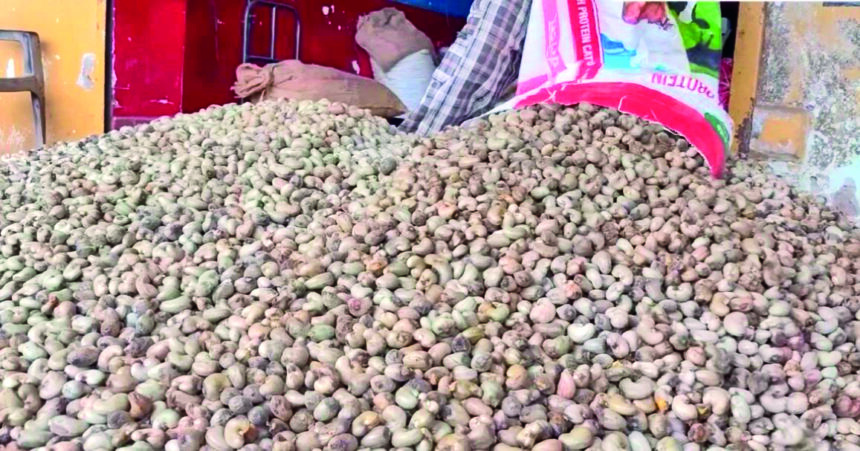
To compensate for declining local availability, truckloads of cashew apples now routinely enter Goa from neighbouring Maharashtra during the season — what once involved smaller tempo-based transport has evolved into large-scale truck movement.
Industry voices were careful to stress this is not the core concern.
“This is not about saying outside fruit should not come,” one distiller associated with the sector said. “The concern is whether Goa is slowly losing the orchard economy that sustains the industry itself.”
The inflow has also significantly altered the economics of the sector. Locally harvested cashew apples require orchard maintenance, labour-intensive collection and transportation from scattered plantations, while fruit sourced from outside often arrives in bulk and can be processed more cheaply and efficiently.
Workers associated with orchard collection activities in parts of North Goa said labour shortages have become one of the biggest difficulties faced during the season, with fewer people willing to undertake collection work in orchards.
A small-scale processor from North Goa involved in seasonal cashew collection activities said sourcing local fruit had become increasingly difficult due to falling orchard productivity and labour shortages.
Some growers also pointed to differences in fruit handling and quality. Goa-grown fruit is typically processed soon after naturally ripening and falling from trees.
Transported fruit, however, may spend days in transit before reaching processing units, increasing the risk of bruising, fungal activity or uncontrolled fermentation before processing.
Across Goa, many plantations are now decades old and increasingly vulnerable to disease and erratic weather. Cashew growers have repeatedly complained about unseasonal rain during flowering periods, fluctuating yields, pest attacks, declining fruit quality and reducing fruit sizes over successive seasons.
Official data cited in recent reports also showed that hundreds of fires have damaged large stretches of cashew plantations across Goa over the last few years, with farmers repeatedly raising concerns over orchard losses linked to fires, erratic rainfall and heat stress affecting flowering and fruiting cycles.
Similar concerns were raised earlier this year by Sattari zonal agriculture officer Vishwanath Gawas during discussions on falling cashew output, where he linked production decline in some areas to extreme heat and disruptions affecting pollination and flowering cycles.
Feni entrepreneur and plantation revival advocate Hansel Vaz said the ageing of Goa’s orchards is a long-running and largely unaddressed problem.
“Most of the orchards we depend on today were planted by our grandparents,” he said. “We have not planted enough trees for generations and many of the existing trees are becoming old and less productive.”
According to growers and others associated with orchard regeneration efforts, the issue also reflects a wider generational shift away from land-based livelihoods. While older generations planted orchards over decades, many younger Goans moved away from agriculture and did not continue plantation cycles at the same scale — creating a long-term sustainability problem because rebuilding orchards takes years before commercial returns become viable.
“A young farmer planting today may wait close to a decade before seeing stable production,” one grower said.
Several industry representatives warned that if plantation renewal is delayed further, demand for cashew products and feni could keep growing while the State’s own cultivation base keeps shrinking.
During technical sessions at this year’s Goa Cashew Fest, agricultural experts, growers and cultivation stakeholders also discussed concerns over the long-term sustainability of Goa’s cashew economy, particularly as erratic weather patterns and changing land-use trends continue affecting traditional orchard systems.
Dr Suresh Kunkalikar spoke about the need to future-proof cashew cultivation through more climate-resilient practices and stronger long-term planning as weather conditions become increasingly unpredictable.
Organic grower Angelo Barreto also stressed the importance of soil health and sustainable cultivation systems, with discussions touching on the long-term impact of excessive chemical dependence and the need to preserve climate-adapted farming practices.
Vindesh Shirodkar, meanwhile, raised concerns over weakening orchard productivity, labour pressures and the long-term viability of cultivation in areas increasingly facing fragmentation of orchard land and development pressure.
The renewed focus on cashew plantations has also brought attention to differing approaches on how new orchards should be developed.
Vaz pointed to differences between grafted varieties promoted through agricultural institutions such as the Indian Council of Agricultural Research (ICAR) — selected for higher nut yield — and seed-grown local varieties raised by the Forest Department from trees already adapted to Goa’s conditions.
He argued that local seed-grown strains collected from long-surviving trees may offer stronger adaptability, having already withstood changing weather, fire and environmental stress over decades.
Excessive dependence on cloned grafts, he added, could eventually create vulnerability if plantations become genetically uniform — a risk seen in monoculture planting systems internationally.
He cited the Vengurla variety as an example: widely adopted for nut production but found by many farmers to be less effective for fruit yield and juice quality critical to feni production.
Vaz, who has been working with farmers, schools, panchayats and landowners in parts of South Goa to distribute saplings and encourage plantation activity, said the Forest Department has been raising large numbers of saplings over the years, but actual plantation efforts need to happen at a far larger scale if Goa hopes to see meaningful production growth a decade from now.
Some drives have also focused on restoration of degraded land, erosion-prone patches and coastal areas — with environmental voices arguing that orchard restoration should be viewed not only as an agricultural exercise but as a form of landscape and ecological restoration.
The State Budget earlier this year proposed setting up a Goa State Cashew Board and development of “Cashew Mother Blocks” with improved varieties at government farms, reflecting official concern over the sector’s long-term sustainability.
Industry representatives say such initiatives may help, but only if accompanied by sustained work on orchard regeneration, farmer incentives, climate adaptation and protection of existing cultivation belts — along with stronger coordination between departments dealing with agriculture, forestry, excise and rural land use.
Others associated with the sector argued that the long-term economics of cashew cultivation would improve if higher-value products and better prices eventually reached growers rather than only processors and marketers.
For now, growers, distillers and plantation stakeholders say the renewed focus on cashew cultivation has at least reopened an important conversation about whether Goa can rebuild the plantation ecosystem needed to sustain one of its most traditional rural industries in the decades ahead.