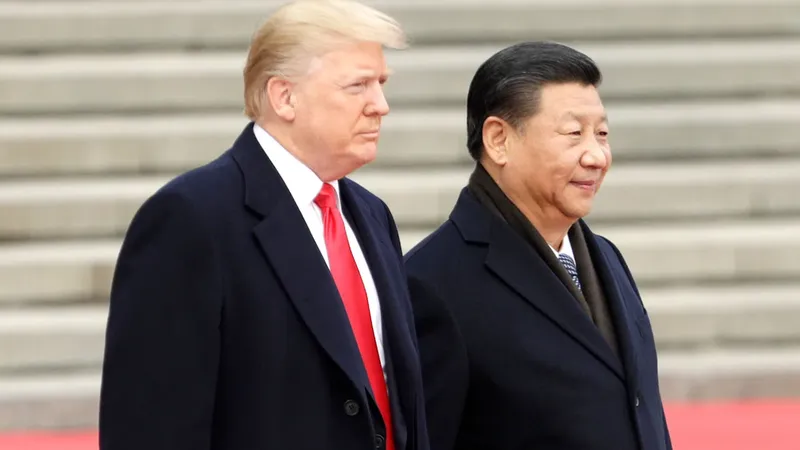
As global attention remained fixed on wars in the Middle East, rising tensions in the Taiwan Strait, and the increasingly fragile relationship between Washington and Beijing, many expected this week’s meeting between Xi Jinping and Donald Trump to revolve around trade, military competition, and regional security.
Instead, Xi Jinping reached back more than two thousand years into ancient Greek history to frame one of the most important geopolitical questions of the modern era.

During his opening remarks in Beijing, the Chinese president invoked the Peloponnesian War — the devastating conflict fought between Athens and Sparta beginning in 431 BC. In doing so, Xi referenced what has become one of the most debated theories in international relations: the “Thucydides Trap”.
Xi asked whether China and the United States could “transcend the so-called Thucydides Trap and forge a new paradigm for major-power relations”.
The statement immediately stood out because the phrase has long been associated with fears that strategic rivalry between China and the United States could eventually escalate into direct conflict.
What Is the Thucydides Trap?
The term originates from Thucydides, the historian who documented the Peloponnesian War between Athens and Sparta. In his account of the conflict, Thucydides famously wrote: “It was the rise of Athens and the fear that this instilled in Sparta that made war inevitable.”
Over time, scholars and policymakers transformed that historical observation into a modern geopolitical theory. The “Thucydides Trap” broadly refers to the danger that arises when a rapidly rising power threatens to challenge an existing dominant power. According to the theory, fear, mistrust, and competition between the two sides often increase the chances of war.
In today’s context, China is viewed as the rising power, while the United States represents the established superpower attempting to maintain its global dominance.
The phrase has become increasingly common in foreign policy circles over the last decade as China’s military expansion, technological growth, and economic influence have accelerated. Several American strategists and political figures, including former Trump adviser Steve Bannon, have previously used the term while discussing US-China competition.
Xi himself has referenced the concept before, but analysts believe its use during Trump’s latest visit to Beijing carried additional significance because of the current state of bilateral relations.
Why Xi Raised It During Talks With Trump
Xi’s decision to invoke the Thucydides Trap was not simply an academic or historical reference. It appeared to serve as both a warning and a diplomatic message.
The Chinese leader was essentially acknowledging that rivalry between China and the United States is becoming increasingly intense, but he also suggested that conflict is not inevitable if both countries manage the relationship carefully.
That message became even clearer when discussions shifted toward Taiwan.
During the meeting, Xi reportedly warned Trump that the Taiwan issue remained the single most dangerous flashpoint in China-US relations. China considers Taiwan part of its territory under the “One China” policy, while Taiwan operates as a self-governing democracy with growing political and military support from the United States.
“The Taiwan question is the most important issue in China-US relations,” Xi said during the discussions.
He further warned that if the issue was mishandled, the two countries could “collide or even come into conflict”, pushing bilateral ties into what he described as a “highly perilous situation”.
That warning reflects Beijing’s growing sensitivity over Taiwan as the island continues strengthening ties with Washington. Over recent years, China has increased military exercises near Taiwan, while the US has expanded security cooperation and political engagement with Taipei.
For Beijing, Taiwan is not just another diplomatic dispute. It is viewed as a core sovereignty issue directly connected to national unity and political legitimacy. Any perception of foreign interference on the matter is treated extremely seriously by Chinese leadership.
By invoking the Thucydides Trap before discussing Taiwan, Xi appeared to frame the issue as the modern equivalent of a great-power flashpoint capable of destabilising the global order if not handled carefully.
Trump later reacted to Xi’s comments on social media, saying the Chinese leader had “very elegantly referred to the United States as perhaps being a declining nation”.
However, Trump immediately rejected that characterisation when referring to his own administration.
“Two years ago, we were, in fact, a Nation in decline,” Trump posted online. “Now, the United States is the hottest Nation anywhere in the world.”
Even so, Xi’s use of the Thucydides Trap highlighted a broader reality shaping global politics today.
The rivalry between China and the United States is no longer viewed merely as a trade disagreement or temporary diplomatic tension. Increasingly, it is being treated as the defining geopolitical contest of the 21st century — one involving economic power, military influence, technological dominance, and competing visions for the future world order.
By invoking ancient Greece during talks with Trump, Xi was effectively delivering a message rooted in history: great-power competition can spiral into conflict if driven by fear and mistrust.
But unlike Athens and Sparta, he appeared to suggest, China and the United States still have an opportunity to avoid repeating history.