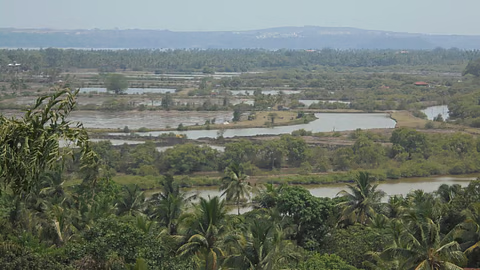
MARGAO: Farmers opposing the proposed high-level Borim bridge through khazan lands at Loutolim are preparing to write to the Town and Country Planning (TCP) Minister questioning why ecological safeguards now being extended to Mandovi and Zuari riverbank stretches have not been applied to khazan lands in their area linked to the Zuari river system.
The move comes after the Forest Department recently identified 6,729.54 hectares along the Mandovi and Zuari riverbanks as ecologically sensitive and forwarded maps and recommendations to the TCP Department for protection measures. Subsequently, the TCP Department initiated the process of identifying around 82 lakh square metres as No Development Zone under Section 39A of the TCP Act, including khazan lands, paddy fields, orchards, low-lying floodplains, sand dunes and other environmentally sensitive terrain.

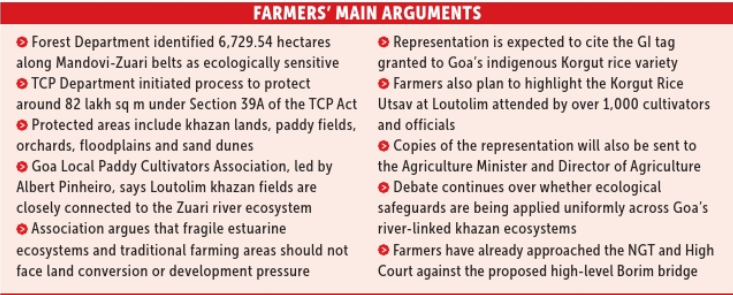
Against this backdrop, members of the Goa Local Paddy Cultivators Association, led by president Albert Pinheiro, are now seeking similar protection for khazan paddy fields at Loutolim, where farmers have already approached the National Green Tribunal (NGT) and the High Court against the proposed Borim bridge project that would cut through their age-old khazan fields.
The farmers are expected to argue that if khazan-linked ecosystems and riverbank stretches elsewhere along the Mandovi and Zuari belts are being protected from land conversion and development pressure, the same safeguards should apply to khazan lands at Loutolim that are closely connected to the Zuari river ecosystem.
In their proposed representation to the TCP Minister, the association is expected to point out that large tracts have already been brought under protection measures under Section 39A and that khazan paddy fields should also be declared protected land under similar safeguards.
The farmers are expected to state that such khazan fields should not be subjected to development activity or permitted for conversion, arguing that these protections are necessary not only to preserve Goa’s fragile estuarine ecosystem and biodiversity, but also to promote traditional agriculture in the state.
The representation is also expected to refer to the recent Geographical Indication (GI) tag granted to Goa’s indigenous Korgut rice variety and highlight that farmers across Goa are in a celebratory mood following the recognition.
Pinheiro and the association are expected to highlight the Korgut Rice Utsav organised at Loutolim on April 26, which drew more than 1,000 cultivators, enthusiastic citizens and Agriculture Department officials, as evidence that khazan farming remains active, culturally significant and agriculturally relevant.
The farmers believe the government’s ongoing move to classify ecologically sensitive riverbank and khazan-linked areas under protection strengthens their argument against infrastructure projects passing through vulnerable agricultural and tidal ecosystems.
The representation will be addressed to the TCP Minister, with copies marked to the Agriculture Minister and the Director of Agriculture.
Meanwhile, the wider move to identify ecologically sensitive stretches along the Mandovi and Zuari belts has also triggered fresh discussion over future land conversion, reclamation activity and environmentally sensitive projects along Goa’s major river systems.
Environmental concerns surrounding the Mandovi-Zuari belt have repeatedly involved mangrove destruction, saline intrusion, riverbank alteration and pressure from sand extraction and riverfront development activity.
The ongoing exercise has also drawn attention to whether ecological safeguards are being applied uniformly across Goa’s river-linked khazan ecosystems or only in selected stretches identified under the current protection process.
Forest Minister Vishwajit Rane had earlier stated that natural areas and forests along the Mandovi and Zuari rivers would remain protected and that no land conversion would be permitted in such stretches.