JOSEPH FERNANDES
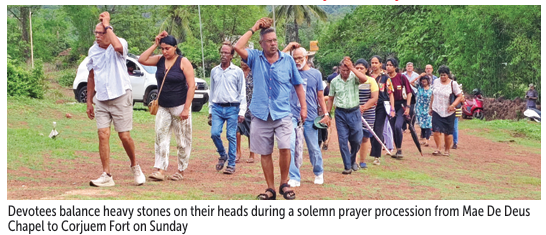
In times of de layed monsoon, the people of Corjuem have traditional ly turned to faith, following an age-old rain prayer ritual that combines devotion, sac rifice and community partic ipation. The ritual involved dev otees carrying stones on their heads while walking in procession to a cross sit uated on a hilltop. Along the route, participants recited the Rosary and sang devo tional hymns. On reaching the destination, they offered prayers, recited the Litany, and placed stones and floral offerings at the feet of the St Anthony statue. Among those who vividly remember the tradition is Tecla D’Souza, a resident of Corjuem, who participated in the ritual as a child more than four decades ago. “This tradition has been part of our lives for as long as I can remember. Whenever there was no rain, villagers would gather and undertake a prayer procession seeking the intercession of St Antho ny for good rainfall,” she said.

According to Tecla, the tra dition in Premeiro Vaddo is believed to be over 60 years old. “The elders taught us how to pray and seek St Anthony’s blessings. As chil dren, we followed them and learned the customs from them,” she recalled. The procession often drew large participation from villagers and was usu ally accompanied by a priest who blessed the faithful at the conclusion of the prayers. Tecla said the practice of carrying stones symbolised sacrifice and suffering. “The idea was that by carrying the weight of the stone, we would experience hardship and offer it as a sacrifice. We never went empty-handed and believed God would hear our prayers offered with sincerity,” she said. She also recalled that rain often followed the prayer gatherings. “We would pray earnestly for rain, and many times heavy showers came after wards. The rains allowed us to begin our farming activities,” she added. Historian Sanjeev Sardesai described the two-and-a-half-kilometre proces sion from Mae De Deus Chapel to Corjuem Fort as an important part of the is land village’s history and lifestyle. “This was possibly an act of penance undertaken by the farming community during periods of drought.
While St Medard is traditionally regarded as the saint associated with rain, the people here pray to St Anthony, who is considered the saint of lost and found, asking for the return of the missing rain clouds,” Sardesai said. He said the tradition survives in only a few places in Goa and represents an important intangible cultural heritage that brings together people of different communities with a common prayer for rain.
Fr Jeronimo Afonso, chaplain of Mae De Deus Chapel, said the age-old tradi tion begins with a procession from the chapel to Corjuem Fort. “Five years ago, when there was no rain, similar prayers were held and we were blessed with good rainfall. With the same faith, we have undertaken the procession again this year, and through the intercession of St Anthony, we be lieve God will bless us with good rains,” he said. He expressed hope that adequate rainfall would enable farmers to begin cul tivation and help address the water needs of the region. Though the practice may no longer be observed on the same scale as in earlier times, it continues to serve as a reminder of the faith, resilience, and community spirit that sustained generations of villagers in Corjuem.