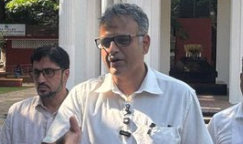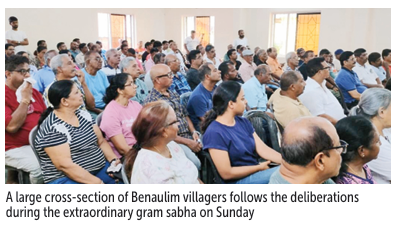
Defending its green cover, Benaulim’s extraordinary gram sabha on Sunday unani mously adopted two major reso lutions opposing agricultural land conversion under Section 39A of the Goa Town and Country Plan ning (TCP) Act and the govern ment notifications targeting the village’s traditional paddy fields. Explaining the provisions of Section 39A from a technical perspective, resource person Avinash Tavares elaborated on the provision’s implications, the procedures involved and the con cerns that have emerged across Goa over its implementation. Tavares answered queries raised by gram sabha members, who expressed satisfaction with the clarifications provided.
Gram sabha member Rudolph Barretto stressed the need for objections to be legally sound and supported by facts and evidence capable of withstanding scrutiny in court. Referring to previous le gal battles fought by villagers, in cluding matters that reached the High Court and Supreme Court, Barretto pointed out that genu ine concerns were not enough to secure favourable outcomes. He said objections must be backed by strong legal grounds and fac tual material to withstand judicial examination, a point that found support among members pres ent. One of the resolutions adopted by the gram sabha called for re jecting all proposals seeking con version of agricultural land into settlement zones under Section 39A and retaining existing zoning classifications.

Members argued that agricultural land remains a vital and diminishing re source that must be protected in the larger public interest. The resolution stated that such conversions were contrary to planned devel opment, environmental sustainability, food security and public interest. It fur ther argued that the Regional Plan was the product of scientific studies, expert evaluation and public consultation and that Section 39A should not be used to undermine the planning framework through isolated plot-specific alterations. It was also decided to hold a protest at Dando Ground on July 4. Members maintained that applicants seeking conversion had failed to demon strate any genuine public purpose, planning necessity, community benefit or ex ceptional circumstances that would justify such changes. Environmental concerns featured prominently in the discussion and resolu tion. Members cited the potential loss of agricultural and green cover, reduction in groundwater recharge, increased flooding risks, damage to biodiversity and additional pressure on water, sewage and road infrastructure. Concerns were raised over the cumulative impact of repeated conversions across Goa and the gradual erosion of agricultural and environmentally sensitive areas.
The resolution referred to the pending challenge to Section 39A before the High Court and urged authorities to adopt a cautious approach before permit ting irreversible changes to agricultural lands. The discussion turned to an application filed under Section 39A by local fish erman Pele. Several members felt that Pele should appear before the gram sab ha and apologise for filing the application. Concerns were raised that if Goans themselves sought such conversions, it would weaken the larger campaign against Section 39A and raise questions about the future protection of Goa’s ag ricultural land. Referring to the fishermen’s festival organised by Pele, Activist Santan Pereira recalled that to facilitate the event, a road had been laid, which could also pro vide access to private properties. He noted that following objections raised by villagers, the road was subsequently removed. The gram sabha also adopted a second resolution opposing TCP notifications concerning paddy fields in the village, a proposal brought before the meeting by Benaulim MLA Capt Venzy Viegas. There was some debate regarding Viegas’s participation in the gram sabha. Members, however, agreed that he had every right to attend the meeting. Viegas briefly touched upon the issue of Section 39A before turning his atten tion to the second resolution.
Describing the move as a “sinister” one, he ques tioned why lands that already enjoyed statutory protection were being subject ed to such changes. He argued that the move could ultimately benefit real estate interests and weaken existing safeguards protecting agricultural lands. Viegas remarked that he was perhaps the first MLA to bring such a proposal before a gram sabha and proceeded to read out the proposed resolution. Explaining the rationale behind the proposal, Viegas argued that the TCP no tifications sought to alter the status of paddy fields that were already protected as NDZ lands under the Regional Plan and enjoyed additional safeguards under the Goa (Restriction of Transfer of Agricultural Land) Act, 2023. Expressing concern over introducing the term ‘NDA’ (Non-Developable Area), he described it as ambiguous and warned that it could weaken existing protec tions and create a pathway for future development of agricultural lands.
Viegas maintained that any such change could adversely affect agriculture, biodiversity, groundwater recharge and the traditional livelihoods of farmers. The resolution demanded that the paddy fields continue to enjoy the protec tions available to them prior to the notifications and remain fully protected un der the Goa (Restriction of Transfer of Agricultural Land) Act, 2023. Members maintained that existing safeguards should not be diluted through newly intro duced classifications or categories.
The proposal called for formal objections to be filed with the Chief Town Planner and other authorities, urged the Panchayat to pursue legal remedies if necessary, and appealed to neighbouring villages and gram sabhas to unite in protecting Goa’s paddy fields and agricultural lands from any dilution of existing safeguards. As MLA Viegas is not a gram sabha member, it was subsequently recorded that Santan Pereira formally proposed the resolution before the gram sabha adopted it. The twin resolutions were eventually passed after extensive deliberations, with villagers reiterating the need to protect Benaulim’s agricultural lands and paddy fields from what they viewed as growing development pressures and threats to existing legal safeguards.